


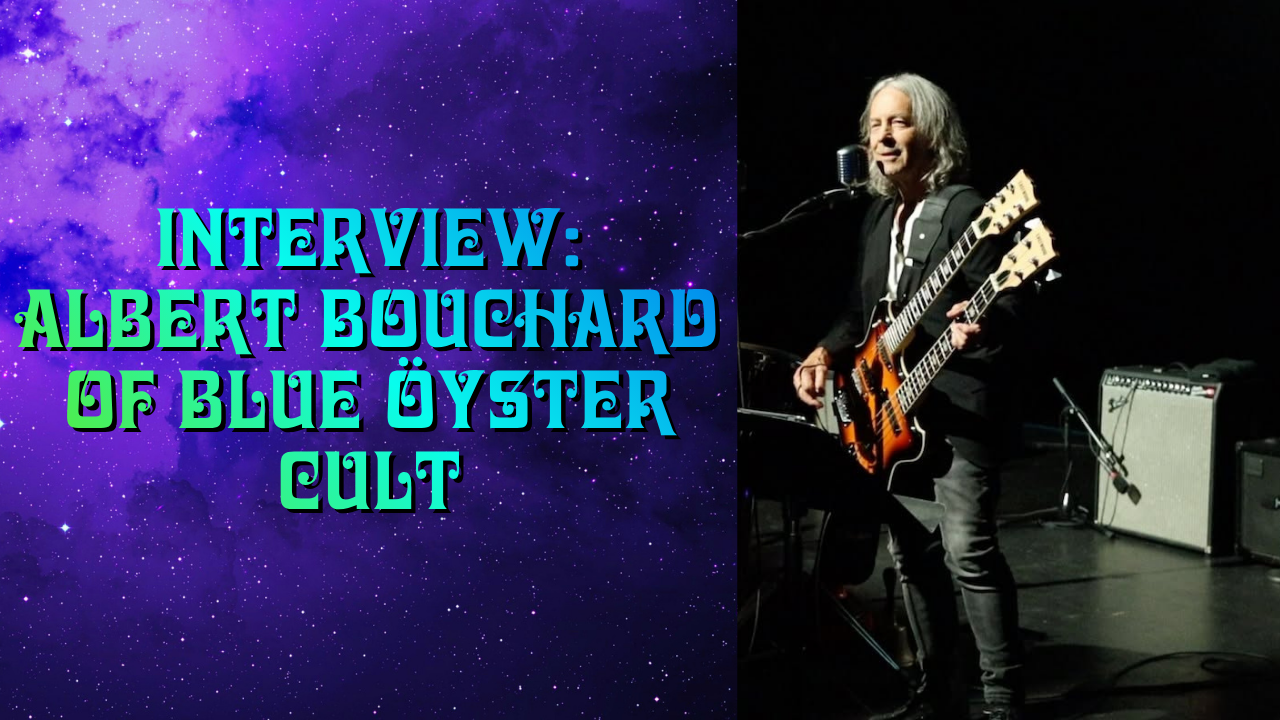
As classic rock fans we all know at least one Blue Öyster Cult song, probably “Don’t Fear The Reaper”, “Godzilla”, or “Burnin’ For You”. If you’re a casual listener, you may not know the band’s backstory and it goes back further than you think.
The Story of Blue Öyster Cult:
Blue Öyster Cult were formed in 1967 in New York City as Soft White Underbelly. They came together when writer and music journalist Sandy Pearlman found some musicians at Stony Brook University: Donald Roeser (better known as Buck Dharma), Allen Lanier, Andrew Winters, and Albert Bouchard. Buck Dharma, Allen Lanier, and Albert Bouchard were part of the classic BÖC lineup you know and love. Sandy Pearlman became their manager and played an important role in the group. He wasn’t just an ordinary rock band manager, he was a poet and his poems became song lyrics. He also gave everyone stage names, but only Buck Dharma used his.
Like any rock band, there were lineup changes. The band cycled through different lead vocalists before Eric Bloom joined the band in 1969. Albert Bouchard’s brother Joe joined the band in 1970 after Andrew Winters left. Not only did the band’s lineup change, so did their name. There was a series of name changes from Soft White Underbelly to Oaxaca to Stalk-Forrest Group to Santos Sisters. Finally the band settled on Blue Öyster Cult, which Sandy Pearlman came up with as part of his Imaginos cycle. They’re a group of aliens who had assembled to guide Earth’s history.
In their early years, BÖC had a signature album cover style with black and white covers and this era is known as their black and white era. Their sound was a mix of space rock, hard rock, prog rock, and a little bit of 60s psychedelia. Pearlman’s goal was for the band to be America’s answer to Black Sabbath. In the early years they collaborated with Patti Smith, who would go on to have big success in the mid-late 70s with albums like Horses and Easter.
The band’s breakthtough album was the platinum-selling Agents of Fortune, which came out in 1976 and had the big hit “Don’t Fear the Reaper”, which has become a meme thanks to SNL and “more cowbell”. Even if you don’t watch SNL, you know the reference. On the cover you can see an illustration of magician Servais Le Roy holding four tarot cards: The Empress, The Emperor, The Sun, and Death from the Thoth Tarot deck. This was their second album without a black and white cover. Their first one was a live album, On Your Feet or on Your Knees.
Blue Öyster Cult are one of those bands where you go beyond the hits and you will be rewarded with great music. We’re incredibly lucky to have founding member (and yes, he played the cowbell on “Don’t Fear The Reaper”) Albert Bouchard on the blog with us to talk about his musical background and writing. His story is a story of dedication to your craft and perseverance because success in the arts is often a slow burn. It’s also about how empowering it is to challenge yourself and get out of your comfort zone.
He has a new album out called Imaginos IV – Rhyme of the Star Clock. As I said earlier in the post, it’s connected to Sandy Pearlman’s Imaginos concept and it’s a continuation of that story.
Without further ado, Albert Bouchard of Blue Öyster Cult!
Interview: Albert Bouchard of Blue Öyster Cult
Angie Moon: You moved between the US and Greece growing up, what was that like?
Albert Bouchard: Well, It was great and it was also kind of traumatic. You know, when I first got there, when we first went to Greece we were living with my grandmother. And that was stressful because she didn’t really get along with my mother that well and she didn’t approve of how they were raising me so I got a lot of spankings and stuff like that.
So we moved to Greece and all of a sudden we were the rich people. And it was like, Oh, this is cool. You know, we got a maid and we got people that do this for us and that for us and my dad had a brand new car. And so, it was cool, but it was also shocking. I didn’t think I was rich or poor when I was in the United States, when I got to Greece, I thought, Oh, I guess we’re rich, because all the kids had nothing. They had no toys or anything. So I started giving away my toys, and I got in my trouble for that, beause my parents were mad, you know? They worked so hard and (laughs) I’m just giving things away.
We moved there in the summer and then I had to go to first grade and they sent me to the Catholic school, which was a French school, and they only spoke French, and I didn’t speak French, so I struggled there. The kids were making fun of me, I didn’t understand anything, so I went for a few days. I made my parents send my brother with me just for one day and my mother went, and then when we came back that night they took me out of that school and sent me to the American school. And that was great and I love Greece. It was a wonderful experience.
And then when we came back, We lived in Rochester, New York, and that was very traumatic, because I was getting beat up after school by our next door neighbour kids, they were like three brothers, and they would hold me and the littlest one would, you know, punch me and stuff. So that was dramatic. And I don’t think I did very well in school, because in third grade, I still couldn’t read. We went back to Clayton, where we were from. Clayton is a little town in upstate New York, it’s very close to the Canadian border, by the St Laurence River.
Angie: What music did you listen to growing up?
Albert: Well, at that point, up until we went back to Clayton, I heard the music that my mother had. She had an extensive record collection. I think she had about one hundred 78s and so she was playing them all the time, and it was basically a lot of Bing Crosby, but it was also Benny Goodman, you know, the swing band stuff. So I liked that a lot.
And then, I guess, well, all her records got ruined coming back. You know, she was heartbroken, actually, when we got back from Greece. Well, we put the cartons in storage. That creates some storage for all our stuff, and then we didn’t see what happened until we got back to Clayton and we took the records out, and they were all cracked and unplayable.
So then I just listened to the radio, basically, and they had classical music most of the time. I didn’t really listen to that music that much. But then as a teenager, I got into Les Paul and that kind of pop jazz music, and then I heard The Ventures’ “Walk, Don’t Run”, that’s a famous thing. You know, Thom Yorke from Radiohead said, Oh, yeah, that’s what I heard and I had to play guitar. And I heard that, and I had to be in a band. A lot of people have that as a common reference for rock and roll.
Angie: So you could say The Ventures were your gateway to rock and roll.
Albert: Yes. Before that, I really not that much into pop music, you know?
Angie: What other rock bands would you listen to?
Albert: Well, I like novelty songs, like “The Purple People Eater”, or “The Witch Doctor”, “The Flying Saucer”, “Flying Saucers Rock ‘n’ Roll”
I liked all the space stuff, because what got me to read was when I had discovered this writer named Andre Norton and she wrote all these great sci-fi books, and I just ate them up, you know, and that’s how I learned to read was reading Andre Norton, so I liked that kind of music.
And then later on, I had a little rock band with my cousin. Of course, we played The Ventures first. His dad had a band that played on weekends, and so we learned the songs that his dad played, like “Misty” or “Autumn Leaves”, all these jazz tunes.
Then we learned Joey Dee and the Starlighters’ “Hey Let’s Twist” and then we did Chubby Checker, and then we were learning every single song on the pop radio for our band. And then by the time I was a sophomore in high school we discovered the Beach Boys, and we became a Beach Boys tribute band. We dressed like the Beach Boys. We had the striped shirts and all of that, and we played every Beach Boy, song that we could play.
So we did that for a while, and then the next year, the Beatles came out and so we became a Beatles tribute band, and we played every Beatles song that we could fit into learning. That was basically it, but, you know, then I guess for my senior year, I started writing songs. We were like the only band up there that did any original tunes. It was kind of funny, because we were younger than most of the other bands, but I guess they didn’t feel the need to do anything other than copy other people.
Angie: And then professionally you moved [to Long Island], what brought you there and what was that music scene like?
Albert: Oh yeah, well it was great. Actually, I mean, from the very beginning of me being in a band it was I think better than it is now. Because there was so many places to play, you know? You didn’t have to play in a club. You know, you could play at a party, you know, nobody had a DJ, that didn’t happen. People just didn’t have sound systems that could compete with a band. A band was like this big, big thing, so there was plenty of places to play and New York, it was, although when I first got there, you know, not being anybody, we didn’t really make a lot of money. You know, they would pay us very little, but we could play, you know, so we just worked really hard, played as much as we could, you know, we had a residency at a club on Hempstead Turnpike in Amityville and we played there every Monday and Wednesday night, you know? All the off nights (laughs). We’d play a week there and then we’d go somewhere else, then we’d come back to the club. It was called Conry’s West [side note: it was a biker bar and it was mentioned in the song “Before The Kiss, A Redcap” from their debut album].
And once in a while, there were two brothers, and once in a while, we play with the other brother, Conry’s East, you know, which is further out [in Babylon] on Long Island.
Angie: Would you say that the science fiction that you read inspired a lot of your songwriting with Blue Öyster Cult?
Albert: Yeah. I mean, it was something that we all had in common too. Especially Eric Bloom. When Eric joined, you know, he really loved science fiction as much as I did. And Sandy Pearlman did too. So Sandy would write these sci-fi songs and pretty much, you know…
Yeah, I would say, it was Sandy’s influence, because we didn’t really know how to write a sci-fi song, but, you know, I mean, you know, because, you know, even though I loved “The Purple People Eater”, that was before I ever was in a band.
Angie: Yeah, there’s not a lot of sci-fi [rock and roll] songs I can think of before, like, Blue Oyster Cult. I mean, there’s kind of like space related astronomy related stuff. But not a whole lot.
Albert: And then of course, By the time we did a tour with Hawkwind and they were also doing space rock. But we had started right at the very beginning in ’67.
Angie: So that’s when the band started.
Albert: Yeah, the basic, Donald and I and Alan, we started in 67, the three of us and we had other, uh, people in the band, a different bass player, a different singer, and people would come and go. There were other guitar players. We had a cello player for a while.
Angie: Patti Smith was involved, right?
Albert: Patti Smith actually did not sing with us until she was she was already a star and we were on our way too. She sang on the Agents of Fortune record. I had been writing with her from the very, from when we got the Columbia contract, essentially and she gave me, um, a song called “The Revenge of Vera Gemini” and I wrote music to it, and the other guys in Blue Öyster Cult said, “Nah that’s not good enough, Al.” So I ended up writing another song with it “Baby Ice Dog” was the first one and that was just a poem that was in Creem magazine and I took it and set it to music. And then I did the same thing with “Career of Evil”. That was in a poetry book, I think it was Seventh Heaven that she had.
And then finally (laughs) I wrote the song that she gave me when we did Agents of Fortune, and I wrote another song that she gave me, too, which was “Debbie Denise”.
So, yeah, but she was Alan Lanier’s girlfriend for, for many, many years. You know, not in the very beginning, but, um, by the ’70s, they were an item.
Angie: “Don’t Fear The Reaper” was released 50 years ago, and it’s still a classic rock radio staple and an iconic piece of pop culture. How do you feel about the legacy of the song?
Albert: Oh, it’s wonderful. It’s great, you know, and I think it’s deserved. It’s really unique, you know? A piece of music and kind of a refreshing idea, a fresh take on mortal life, you know? I mean, you could take it as a religious thing too, or metaphysical.
I mean it’s really weird how at some point, people got it in their minds that it was about suicide, because we never, didn’t even consider it really, in the beginning, and neither did the guy that wrote it [Buck Dharma]. I mean, it was like, no, this is way more powerful than that.
Angie: You have an MA in English, what inspired you to study English?
Albert: It was my worst subject in school, even though I didn’t hate it or anything. I just struggled with it because I think probably because I was just slow, you know, because it took me so long to learn to read, that, uh, you know, it wasn’t on the same level as the other kids.
So, but I took it in college, because the other thing is that I was teaching in a school and I felt like it didn’t make any sense to get a master’s in music, because that would be a waste. I would never use it. I would never use it in my professional life, and I wouldn’t use it in my teaching life, so I thought, you know, what these kids need is they need to know how to, how to present themselves, how to read and write and speak. So I got, I took the English, because I thought it would be better for me, number one, and better for them, too.
Angie: How do you think we can get more people into reading in everyday life?
Albert: Well, I mean, people do read, you know, but they don’t read a lot. They read their computer screens. They read the captions on TikTok (laughs). So they do read, but they don’t read like, I think that it’s more like attention span. I don’t know. I don’t think that reading is dead.
There was a feeling when people came out with the Kindle and the iPad, people are gonna be looking at screens rather than buying books. But I find myself, and I have nothing against it, I had a Kindle. I don’t know what happened to it. It’s gone now. But you know, I still read on my iPad, but I find it difficult when you’re looking at a screen, things are moving all the time, you know, even if it’s just a Word document, it’s still moving, the light is doing its thing, and it’s tiring, so I find a book is relaxing.
So I still buy books and Amazon, you know, you see people still buying the bestsellers. I think books are still used, but I don’t know if younger people are into that idea of relaxing with a book, you know? But that’s something that you would, you will learn.
Angie: What was it like writing the concept album, Rhyme of the Star Clock?
Albert: Oh, okay, so I had this insight into it, today, actually. So of course, all the lyrics are written by my friend Sandy Pearlman [he passed away in 2016], who was also my manager and my collaborator on a lot of my songs. So, when I discovered these things, these lyrics, because they were in his house, and when they sold the house, they found all these papers and in the papers were songs that I’d never seen before. And so when I started to work on it, I felt a great joy being able to collaborate with my friend again. You know, it made me feel closer to him, and not miss him so much. [phone rings, ringtone is The Ventures’ “Walk Don’t Run]
Angie: Oh that’s The Ventures! What are your favourite concept albums?
Albert: Oh, well, I love Tommy [The Who]. I loved Ummagumma and any of the the later Pink Floyd records, fantastic. Tales From Topographic Oceans [Yes], great. Lamb Lies Down on Broadway [Genesis], you know, yeah, I like most of them, most of the big ones that you’ve heard of, that’s what got me into it, you know?
I like classical music. I like symphonies that last for 20 minutes or, you know, 25 minutes, so I do like that. I’m not that, you know, I mean, it’s kind of nice to have a Grateful Dead kind of jam where the song just goes on and on and on, but I kind of like having some drama in there, you know, just makes it more interesting.
Angie: “Godzilla” is a fan favourite from back in the day, what was it like writing and recording it?
Albert: It was a lot of fun. Buck Dharma, he’s quite a zany guy. You know, he always had a great sense of humour and we shared a love for Godzilla and any of those monster movies, you know?
So, in college, we had a song called “Go-Go Gorilla” [by The Ideals, a doo-wop group from Chicago]. It was a goofy college song, and it went, go, go, go, go, gorilla, go, now. So he incorporated “go-gorilla” into Godzilla, which was pretty brilliant.
I remember when I started playing it like, a real heavy thing, and he’s like you know, play a jazzy, play, like, a lot of syncopation, and he kind of showed me what to do.
Okay, you know, so that’s what I did, you know, so, the drum part is as goofy as the lyrics.
Angie: What is your proudest accomplishment in your career?
Albert: I don’t know. I can’t really tell you. I’m still working on that. I have a autobiography that I’m finishing up and I have a movie that’s coming out at Christmas, a little movie that I made, which I think is pretty cool. I mean, a highlight of my life was meeting President Obama, that was pretty cool.
Angie: What advice do you have for aspiring musicians?
Albert: Oh, stick with it. You know, keep on keeping on, as my friend, Melvin Van Peebles would say. Yes, just stick with it, you know? And, you know, you’re gonna get setbacks, you’re gonna feel disappointed, you’re gonna feel disgusted. And just keep your eye on the prize.
If you want to be a musician you have to roll with it and keep it up and the other thing is to keep improving, keep perfecting your craft as much as you can learn and learn new things. Don’t do the same thing twice, except for when you’re practising.
Yeah, you’re really not doing it the same. You know, you’re trying to get better and better. Each time, so that’s it.
You can follow Albert Bouchard on his website, Facebook, and Instagram.
Liked this blog post and want to support independent classic rock journalism? Donate to The Diversity of Classic Rock on Patreon or Paypal or follow me on Facebook, Bluesky, or Instagram, buy my book Crime of the Century, click the follow button on my website, leave a nice comment, send your music or classic rock related books for review, or donate your art and writing talents to the blog.
If you donate any amount to my Patreon or PayPal, you’ll get a Crime of the Century ebook, so it’s pay what you can! The best deal you’ll get on the book and you won’t find this deal anywhere else! I just want to give back to my readers and say thank you for your support.


Leave a Reply