


Disclosure: I was given a screener in exchange for my honest review.
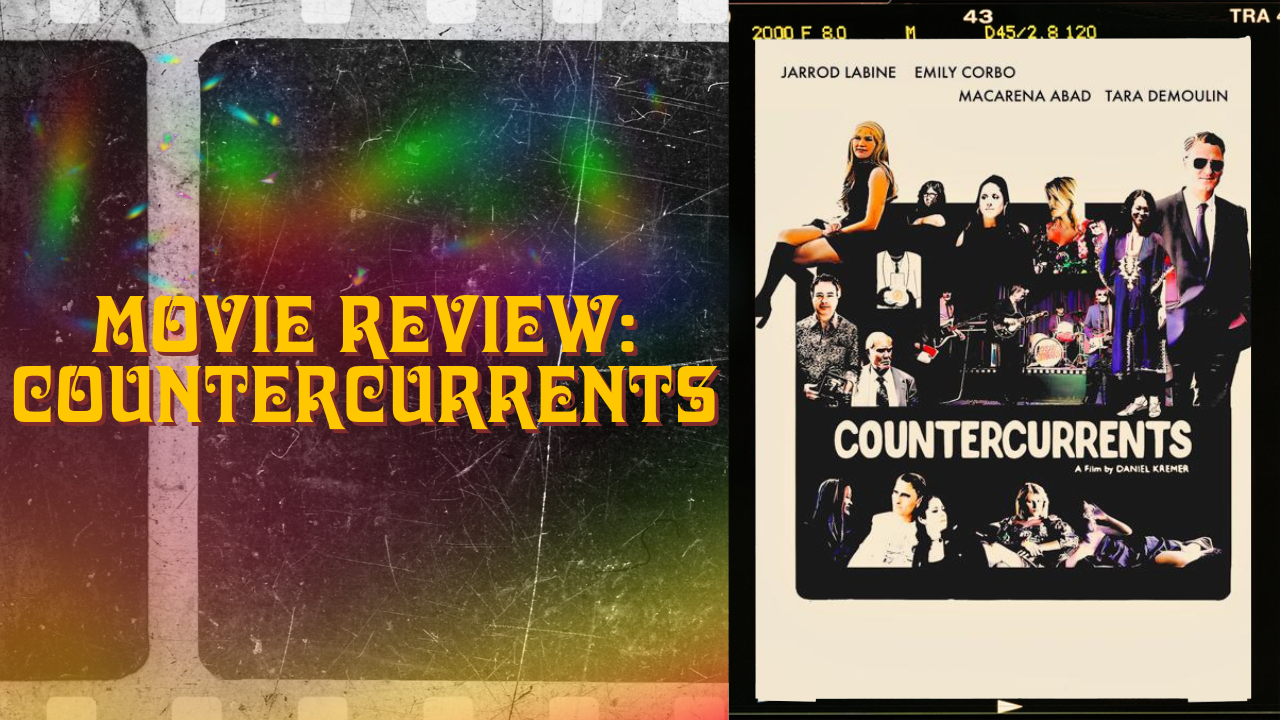
My friend Mick Cantone of Children of Minerva has been talking about a film score has been working on for a while now. And he makes a cameo in the film as Jess the Mr Cheapo manager. Finally, the film is here and it’s called Countercurrents and it’s a tribute to counterculture films of the 1960s, one of them being the 1970 film The Magic Garden of Stanley Sweetheart. I watched that film first to get some background information and context so I can better appreciate Countercurrents. It’s not a period film that takes place in the 60s, but it is inspired by that time with record stores, small businesses full of character, and film cameras appearing prominently in the film and it taking place in important cities in the counterculture: New York City and San Francisco. If you’re really observant you’ll see album covers and hear mentions of classic albums from the 60s and 70s. Actor/screenwriter Jarrod LaBine and actress Alexandra Santini were both in the Leonard Bernstein biopic Maestro (side note: my grandfather’s cousin Michael “Mendy” Wager was portrayed in the film by Zachary Booth).
If you haven’t seen Stanley Sweetheart, here’s a little background information. Andy Warhol once said that The Magic Garden of Stanley Sweetheart is the most accurate film about 1960s New York City, so that’s quite an endorsement. You can watch the film on YouTube. The film is about the romantic and sexual adventures of an early 20s university dropout/aspiring filmmaker Stanley Sweetheart, free love (or really just being a total sleazebag)! He’s a trust fund kid who lives in his own flat and makes experimental films starring the women he comes across. In Latin class he looks over his shoulder and sees a pretty blonde girl named Cathy who captures his attention. He musters up the courage to talk to her and they start a relationship. While in that relationship, he sleeps with Cathy’s roommate Fran and lures him into his flat by saying he wants to make an experimental film with her. He gives her a drink and they end up having sex. He’s two-timing and eventually Cathy leaves Stanley for Danny, a cool musician. Not because of the cheating, but because she’s fallen out of love. Pretty hypocritical of Stanley to be upset with her when he’s been cheating. He befriends Danny and they party and smoke pot, sex, drugs, and rock and roll. He then has a threesome with Andrea and Barbara. Danny shoots and kills himself for I’m not sure what reason. There’s a cliffhanger ending. Will Stanley go live a straight, square life or will he continue being a free love hippie? In a way the film makes me think a bit of Fritz the Cat, although race relations aren’t discussed in Stanley Sweetheart.
Similarly in Countercurrents the main character is an aspiring experimental filmmaker named Stanley who has a part time job at an independent cinema called Film Noir Cinema. He really knows his stuff when it comes to movies and he has a big record collection and he wants to follow his passion instead of working a dull, boring job, much to his ex-wife Fiona’s dismay. Eventually Fiona’s had enough and she files divorce papers. She wants to be with a man who has different ambitions from Stanley: a good career, owning a house, and starting a family.
Stanley is devastated and he leaves New York for San Francisco, where his sister Nancy lives. He hasn’t seen her in a decade. He drives all the way there and picks up a hitchhiker named Monica along the way. Meanwhile back in New York, Fiona sells off Stanley’s prized record collection to get some money. Nancy works at a record store called Rooky Ricardo’s Records (the real life owner Dick Vivian appears in the film, RIP Dick Vivian) and makes t-shirts of counterculture cinema. She lives a bohemian lifestyle living with other creatives in Camille’s Castle, owned by a woman named Camille whose family are Old San Francisco money so she inherited the house from her grandma and she makes money by renting rooms out to creatives.
As San Francisco has been gentrified like crazy, they’re looking for the remnants of the 1967 Summer of Love. Stanley gets a camera and does some filmmaking, goes on dates and hooks up with various women, and goes to gigs. Nancy isn’t a fan of his lifestyle and feels neglected. How will it turn out in the end?
The cinematography is beautiful and the story is interesting, but I think the best part was the music. The film score by Children of Minerva is great. Through this movie I’ve heard a lot of retro sounding music from modern bands and I love hearing bands that I’ve never heard before. Musically, this film is a mix of psychedelic, garage rock, baroque pop, and surf rock, all genres that I adore. My favourite songs from the film are “Your Sorrow” by Bart & The Bedazzled, “Burning Bridges” by The Phenomenal Handclap Band, “The Missing Link” by Ancient Sons, “(This Man Will Self Destruct In) T-Minus” by Th’ Losin’ Streaks, and “The After After After Party” by The Seismics.
In short, if you love counterculture movies of the 60s, you’ll like this film.
You can buy the Children of Minerva album Music From Countercurrents on Bandcamp. Countercurrents premieres at the Film Noir Cinema on 13 December 2026. You can find more information and buy tickets on Film Noir Cinema’s website.
Liked this blog post and want to support independent classic rock journalism? Donate to The Diversity of Classic Rock on Patreon or Paypal or follow me on Facebook, Bluesky, or Instagram, buy my book Crime of the Century, click the follow button on my website, leave a nice comment, send your music or classic rock related books for review, or donate your art and writing talents to the blog.
If you donate any amount to my Patreon or PayPal, you’ll get a Crime of the Century ebook, so it’s pay what you can! The best deal you’ll get on the book and you won’t find this deal anywhere else! I just want to give back to my readers and say thank you for your support.
Leave a Reply