


Disclosure: I received a review copy of this book in exchange for my honest opinion.
2027 is right around the corner and you know what that means, a lot of albums are going to be turning 50 next year. If you were to ask a sample size of 100 people: “Name an album from 1977”, one of the top answers would no doubt be Fleetwood Mac’s Rumours. If this were a game of Family Feud and you gave that answer, your team would be like “good answer!” Rumours is the best known Fleetwood Mac album and it’s still being talked about to this day. It’s the 8th best selling album of all time, with over 40 million sales internationally. Who knew that you could turn personal life drama into art? Who doesn’t love this album? Everyone loves Fleetwood Mac. I don’t care what your background is or what generation you are, there’s something you love about that band. Everyone can unite over Fleetwood Mac.
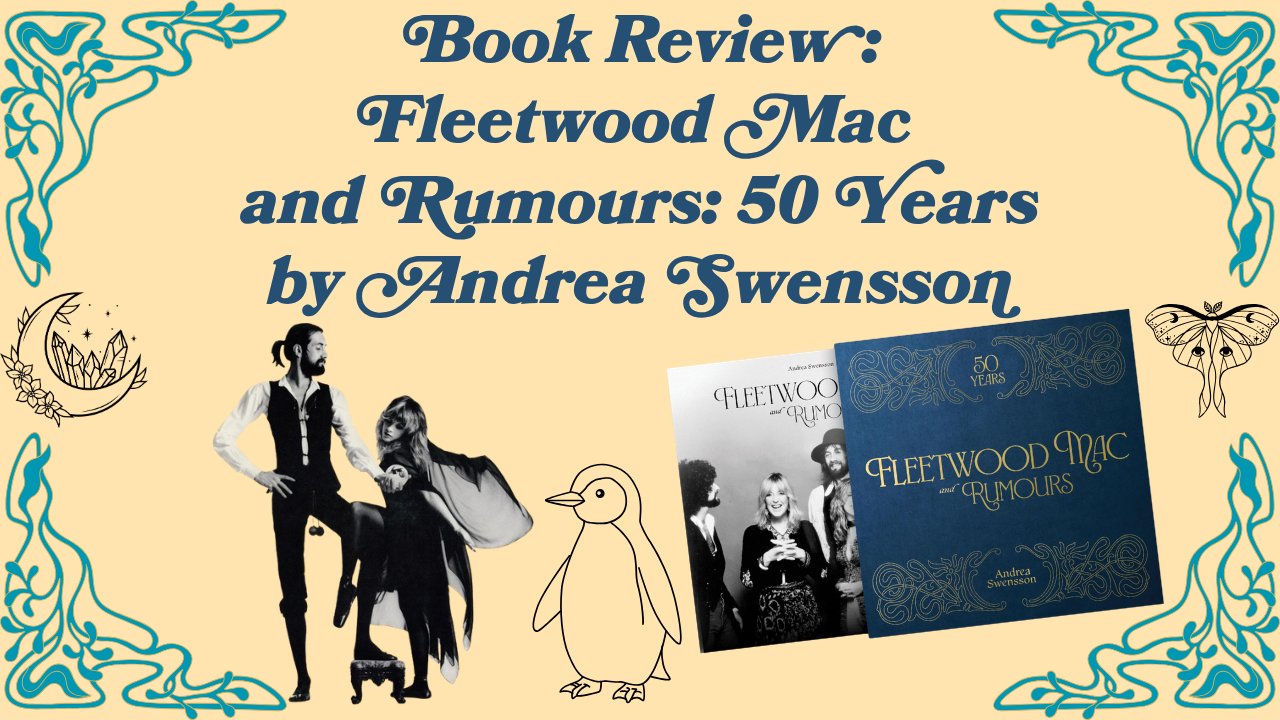
This new coffee table book by Minnesota based music journalist Andrea Swenson tells the story of Fleetwood Mac and Rumours from before the Rumours five to its legacy 50 years later. If you want an idea of how iconic of an album it is, there’s a Wikipedia article for each of the songs on the album.
As you probably already know, Fleetwood Mac are a band that have changed a lot in lineup. You thought the love triangles were the only mess? Try the family tree that makes up the band! Fleetwood Mac got their start in London in the 60s as a blues rock band. The Fleetwood Mac you know and love from this time isn’t even the first lineup, it’s their third lineup: Peter Green, Mick Fleetwood, Jeremy Spencer, Danny Kirwan, and John McVie. Mick Fleetwood said in his autobiography that he’s “always felt a sense of depth and destiny” about the band and everything’s been done on instinct, it’s like there was a little magic star looking out for them.
British boomer rock musicians had a lot of appreciation for the blues and there was a big British blues boom in the 60s with musicians like Alexis Korner, Cyril Davies, The Rolling Stones, The Animals, Manfred Mann, Georgie Fame, The Yardbirds, John Mayall, Cream, Free, Savoy Brown, and Led Zeppelin. These artists got popular in America and introduced a new generation to the blues, and no doubt piqued people’s curiosity and interest in the Black American musicians who invented this sound: Robert Johnson, Big Bill Broonzy, Elmore James, Ma Rainey, Bessie Smith, Fats Waller, Muddy Waters, Howlin’ Wolf, and Bo Diddley.
If you’ve been reading about classic rock, you’ll know that classic rockers are always within a couple of degrees of separation, it’s really tight-knit! John McVie used to be in John Mayall’s Bluesbreakers with Eric Clapton and John Mayall. When Eric Clapton left John Mayall’s Bluesbreakers (another band with an ever-changing lineup), Peter Green replaced him briefly. Mick Fleetwood was also briefly in the Bluesbreakers and when he left, Peter Green followed and they formed Fleetwood Mac with John McVie when McVie left the Bluesbreakers. Peter Green became known as a well-respected guitarist, inspiring Gary Moore, Joe Perry, Andy Powell, Mark Knopfler, and Noel Gallagher. Eric Clapton and B.B. King praised his playing too, with B.B. King saying “He’s the only one that ever gave me cold sweats. He had the sweetest tone I ever heard.” That’s a senpai noticed me moment right there! Peter Green recruited guitarists Danny Kirwan and Jeremy Spencer and bob’s your uncle. Christine Perfect from Chicken Shack started working with them as a session piano player before officially joining the band in 1970. The two bands would cross paths a lot. After Peter Green left the band, they continued as a foursome and recorded Kiln House. After Jeremy Spencer left, Bob Welch replaced him. He was the first American to join Fleetwood Mac. After Danny Kirwan’s turbulent departure, Bob Weston joined. Then there was the whole legal battle with the “Fake Mac” and after that was sorted out, the remaining Fleetwood Mac band members: John McVie, Christine McVie, and Mick Fleetwood joined forces with Lindsey Buckingham and Stevie Nicks. This unique combination of band members got them dubbed: “The great British-American-male-female-old-new-blues-rock-ballad band”. Lindsey Buckingham said in a 2021 interview “Early on, soon after joining Fleetwood Mac, I realised that we were the kind of group who didn’t, on paper, belong in the same group together. But yet that was the very thing that made us so effective. There was a synergy there, where the whole became more than the sum of its parts. What happens is that you begin to understand that and accept it as a gift.”
Fleetwood Mac were a band made for the famous VH1 series Behind The Music and it’s easy to hear on Rumours because it’s a bunch of diss tracks about each other and the two couples in the band were falling apart and there were lots of drugs involved in the creation of the album. John and Christine got divorced in 1976 and then after the breakup, Stevie was sleeping with Mick Fleetwood. She ended that affair pretty quickly because had that developed further, it would have meant the end of Fleetwood Mac.
The book is organised into seven chapters, each focusing on an important part of the story. The first chapter is dedicated to early Fleetwood Mac, so the Peter Green and Bob eras. The second chapter is dedicated to profiles of each of the Rumours Five with a spread dedicated to each band member, talking about their upbringing, how they got into music, and how they joined Fleetwood Mac. The two camps (McVies + Fleetwood and Buckingham/Nicks) came together when Fleetwood Mac were in Los Angeles checking out Sound City Studios and in house engineer Keith Olsen played “Frozen Love” from Buckingham Nicks for them. Mick Fleetwood was so impressed with what he had heard and Olsen introduced him to Lindsey Buckingham and he invited him to join the band. Lindsey Buckingham agreed on the condition that they let his girlfriend and music partner Stevie Nicks join the band. Christine McVie had final say in letting Stevie join the band and she accepted her and the two became lifetime friends. The two officially joined on New Year’s Eve 1974, what a way to ring in the new year! The third chapter is about the recording of Rumours at Record Plant in Sausalito. There are profiles of co-producers Ken Caillat and Richard Dashut. Ken Caillat was working as a studio engineer at Wally Heider Studios in Hollywood. Caillat had never heard of Fleetwood Mac when he received a request to create a radio mix of their performance for the King Biscuit Flour Hour. Two days after meeting the band, they asked him to come to their rescue to help salvage the radio mix of “Rhiannon”. Mick Fleetwood was so impressed with his work that he hired him on as producer and engineer for Rumours. They would continue to work together on Tusk and Mirage. Richard Dashut was at the right place at the right time working as an assistant maintenance man at Sound City and through that he got to know Lindsey and Stevie and they became friends and he climbed up the ladder at Sound City to be the second engineer to Keith Olsen. Later, he became Fleetwood Mac’s live engineer. Drugs and interpersonal issues weren’t the only barriers, there as also a tape machine called “Jaws” that was notorious for destroying takes. Caillat and Dashut had to work hard to sync the tape machines to save the recordings from the deteriorated master tape with no click tracks or guides. The hard work paid off in the end!
Fleetwood Mac were already experiencing commercial success whilst recording Rumours. “Overflow my Head”, “Rhiannon”, and “Say You Love Me” were all top 20 hits. Their 1975 self-titled album had just become Warner Brothers Records’ best-selling album ever by the time Rumours came out on 4 February 1977. Rumours was even bigger, with 800,000 presale orders (which was a record for Warner Bros.) and “Go Your Own Way” was released as a single in time for Christmas and it made its way up the charts, peaking at #10, their first top 10 hit in the US. This book does a track by track overview with descriptions of each track, the sound, what it’s about, and what makes it special. Radio airplay plus a 1.5 year long tour to promote Rumours helped to move more copies of the album.
“Second Hand News” was a Lindsey Buckingham breakup song that had the working title of “Strummer” in reference to how rapidly he strummed it on his Martin acoustic guitar. To avoid arguments with Stevie Nicks, he had hidden the lyrics for a long time. The Bee Gees’ “Jive Talking” was an influence on that song as well as some Scottish and Irish folk music.
Stevie Nicks’ composition “Dreams” was the big hit from the album, topping the charts in the US. Decades later it became a meme thanks to a viral TikTok by a man named Nathan Apodaca who was skateboarding while drinking cranberry juice and playing the song in the background. Stevie Nicks wrote the song in less than an hour on a Fender Rhodes organ. When she shared her song with Fleetwood Mac, they were so impressed that they recorded it straight away. For her, it was an expression of hope, that things were going to be alright even though there’s a lot of drama and chaos.
“Never Going Back Again” is another Lindsey Buckingham composition and it’s the shortest on the album at 2:02. It’s a quiet, contemplative track and it only features him. The working title for it was “Brushes”. There’s a duet version with Stevie Nicks released on the Super Deluxe Edition.
“Don’t Stop” is a Christine McVie composition. Almost as big as ‘Dreams’, it reached #3 on the Billboard Charts and in 1992 Bill Clinton adopted it as the theme for his presidential campaign. For years John McVie didn’t know that the song was written about him and that’s thanks to its upbeat, optimistic sound.
“Go Your Own Way” is equally iconic and shows how much of a creative force Lindsey Buckingham is. He had written the song while on a break in Florida after the Fleetwood Mac tour. It’s pop rock, but it’s full of anger and Stevie Nicks really didn’t like the lyrics saying that “packing up, shacking up” with different men was all she wanted to do. Christine McVie wasn’t wrong when she said that “trauma” was the one word that best described the recording of Rumours. Lindsey Buckingham told Mick Fleetwood to “just be an animal” when Fleetwood asked what he wanted from his drumming.
On “Songbird” Christine McVie pours her heart out and it’s a minimalist song like “Never Going Back Again”. It was recorded at the Zellerbach Auditorium at University of California, Berkeley because Ken Caillat felt like Record Plant was a little too cramped for the song so they sent a remote truck from Record Plant to Berkeley. Christine McVie was up on stage alone with her piano and some roses and champagne.
Opening up side two is “The Chain”, the most collaborative song on the album and everyone is credited as a songwriter on it. The song’s roots were an instrumental composition by Christine McVie called “Keep Me There” and from there it blossomed thanks to everyone’s contributions. John McVie contributed that iconic 10 note bass solo, one of the most memorable parts of the song. Stevie Nicks wrote the line “If you don’t love me now, you will never love me again” and she called her song “The Chain” and that got incorporated in the mix. Lindsey Buckingham drew from the song “Lola (My Love)” from Buckingham Nicks and Mick Fleetwood’s drumming had a marching military sound. The song was called “The Chain” because it strung together a bunch of pieces. It’s a masterpiece!
Christine McVie’s “You Make Loving Fun” was blatantly about her live-in boyfriend, Curry Grant, Fleetwood Mac’s lighting director. When you’re working so closely with people and you click, sometimes you catch feelings and affairs happen. I have to imagine this was painful for John McVie to play on and to have to listen to lyrics like “And I don’t have to tell you, but you’re the only one”.
“I Don’t Want To Know” is another song with a lot of bitterness and frustration. It was a replacement song for Stevie Nicks’ “Silver Springs”, which had been deemed too long for the album and Mick Fleetwood had to break the news to her, that they wanted her to re-record her vocal part over Buckingham’s vocals for the song. Only two songwriting credits on the album wasn’t enough for her so she gave in. The vocal harmonies between Buckingham and Nicks have been compared to the Everly Brothers, who also had their share of drama.
Christine McVie wrote “Oh Daddy” about Mick Fleetwood and Jenny Boyd. Mick Fleetwood was the only father in the band at that point and he was so dedicated to the band that his marriage to Jenny Boyd was falling apart. Stevie Nicks called this song “her favourite Christine song of all time”.
The meaning of Stevie Nicks’ “Gold Dust Woman” is fluid. She once said it was about male-centred groupie-type ladies who would give her and Christine dirty looks, but when they see men, they smile. Cocaine was around for the recording of this song and from that point onwards, it was everywhere and it followed them on tour. Stevie Nicks struggled with a cocaine addiction for a decade, finally getting clean in 1986. The rock and roll lifestyle is heavy and fast-paced and keeping up while sober is difficult.
In the next chapter, California Gold, the artwork, additional recordings, and tour are discussed. John McVie came up with the title Rumours, a reference to the tabloid gossip about the band. Notably, it was spelled the British way and the Americans, Lindsey and Stevie agreed. Herbert W. Worthington photographed the tallest and shortest members of the band, Mick Fleetwood and Stevie Nicks, giving it a Renaissance Faire feel. In the 70s Gunne Sax dresses were popular and other bands like Heart on their album Little Queen went for that look. Designer Margi Kent made Stevie’s chiffon Rhiannon dress. The photographs of the band on the back show each of the Rumours Five’s unique personalities.
One of the rejected songs, “Silver Springs” ended up released on the B-side of “Go Your Own Way” and was edited from eight minutes to 4:33. She got the name of the song while on the road driving past Silver Spring, Maryland during the Buckingham Nicks days. A lot of effort was put into recording the song, so it’s a surprise it was left off of the original release of Rumours, but vinyl has time constraints. She saw it as a centrepiece of the Rumours sessions. The song would later go on to be a TikTok viral sound when it was mashed up with Billy Joel’s piano man.
“Butter Cookie/Keep Me There” has a rollicking blues piano progression and hints at what “The Chain” would become, that bass! “Planets of the Universe” is a ballad written by Stevie Nicks about her fractured relationship with Lindsey Buckingham. It was only recorded as a demo. “Doesn’t Anything Last” is a demo written by Lindsey Buckingham and it’s a very short song at just over a minute long. Stevie Nicks wrote “Think About It” for Christine McVie as a therapy session of a song to remind each other that they’re giving up a lot if they leave the band. The song would later be released on Bella Donna.
The Rumours tour took Fleetwood Mac, they sold over 580,000 tickets and grossed nearly $4.9 million. The tour took them all over North America, Europe, and Australia and to Japan and New Zealand.
What makes Rumours stand the test of time is the great music and how timeless it is. Stevie Nicks said, “It’s kind of creepy how it doesn’t get old. Rumours still sounds like it could have been done in your living room three days ago.” Decades after the album’s release, Fleetwood Mac went on reunion tours playing songs from Rumours. They released live album The Dance 20 years after Rumours and it topped the Billboard albums charts. Lindsey and Stevie’s relationship is still volatile even to this day. Perhaps you can relate the themes of Rumours to what’s going on in today’s world, which keeps getting more and more polarising and divided with each day.
Overall, this is a well written and well put together book with great organisation and quotes and lots of beautiful pictures in between. As always, the design and layout is top notch! I especially love the Art Nouveau inspired gold lines on the slipcover of the book. This will make a great gift for Fleetwood Mac fans.
Fleetwood Mac and Rumours: 50 Years comes out later in October. You can follow Andrea Swensson on her website, Instagram, and Facebook.
Liked this blog post and want to support independent classic rock journalism? Donate to The Diversity of Classic Rock on Patreon or Paypal or follow me on Facebook, Bluesky, or Instagram, buy my book Crime of the Century, click the follow button on my website, leave a nice comment, send your music or classic rock related books for review, or donate your art and writing talents to the blog.
If you donate any amount to my Patreon or PayPal, you’ll get a Crime of the Century ebook, so it’s pay what you can! The best deal you’ll get on the book and you won’t find this deal anywhere else! I just want to give back to my readers and say thank you for your support.
Leave a Reply