


My last blog post was about the things that make the 1950s special and it’s part of this series about what makes each classic rock era decade special.
I wanted to celebrate the beautiful things of the past: pop culture, style, aesthetics, and vibes. This series is apolitical and a safe haven for positivity, celebration, and appreciation of the past. Each of these blog posts is my love letter to the decade.
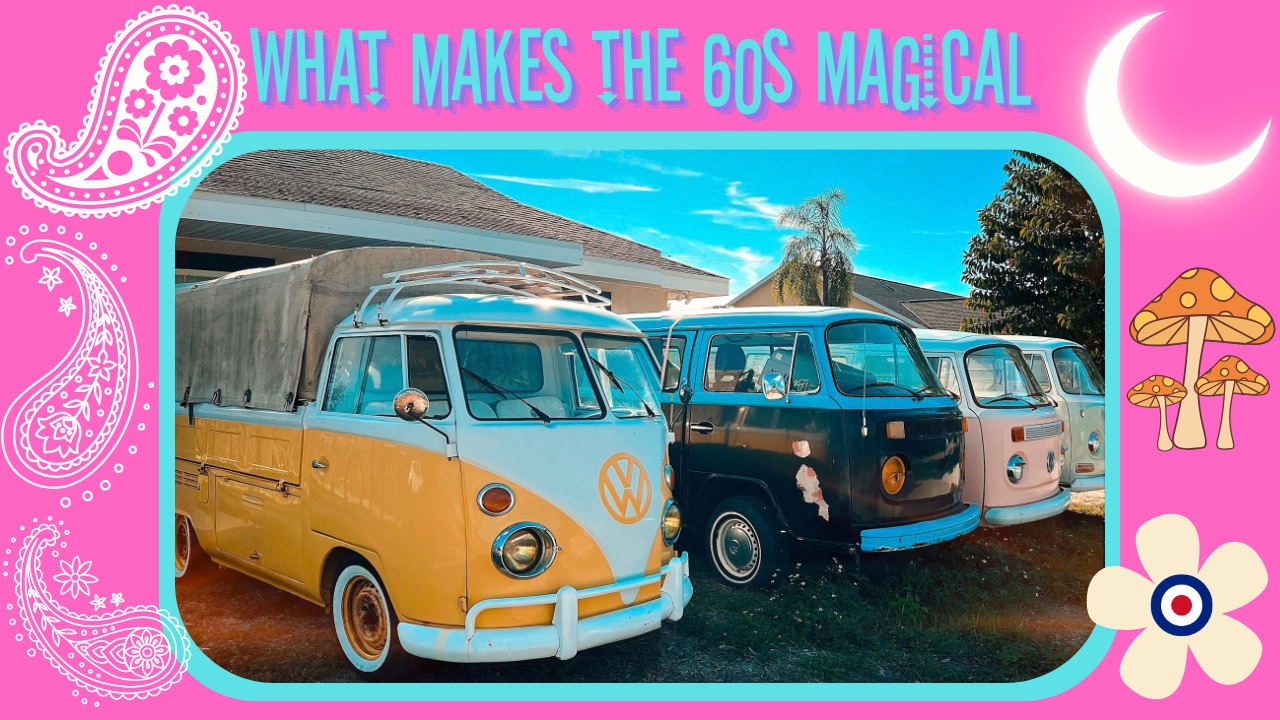
I’ve often asked musicians what makes the decades they’ve grown up in, played in, or were inspired by special. This time it’s my turn to share. This blog post in the series is extra special for me because this was the classic rock decade I fell in love with first. And I know I’m far from the only classic rock fan who feels this way. How many people have said their gateway band were The Beatles? There’s a lot to love about the 60s and I think it’s a decade that has always gone appreciated pop culture wise and there’s good reason for it.
The 1960s most importantly was a decade of changes. Yes, changes in plural. I’ve touched upon this before in a blog post about songs that marked the beginning of the 1960s culturally. I want to talk about it again and talk about why I love this dynamic decade full of variety. There really is something for everyone in the 60s. I have yet to meet someone who hates the 1960s wholesale. There’s a lot to love about this vibrant, dynamic decade so let’s get started.
The British Invasion
This is a no-brainer for me and many other people. The 60s was a decade of change in so many ways: style, technology, and music. Music is something very important to every decade and I think it’s one of the most important things about the 60s. You can’t have a discussion about the 60s without talking about music in depth. The music is the context. The music is part of the revolution. Life reflected the music. The 60s had the best soundtrack of any decade.
In my opinion the things that marked the end of the 50s culturally and the beginning of the 60s culturally are the JFK assassination and the British Invasion, late 1963/early 1964. The JFK assassination was the boomers’ 9/11. Every boomer remembers where they were when they heard the news. Historians will frame it as America being in mourning after the JFK assassination and here comes The Beatles to lift everyone’s spirits.
Not only did The Beatles lift everyone’s spirits, they changed the entire music scene and paved the way for other British groups. What was popular from 1960-1963 and what was popular from 1964-1969 was very different. The Kingsmen’s “Louie Louie” and The Rivieras’ “California Sun” marked the end of an era of American domination in rock and roll. The US needed that shakeup in the charts and because America was the biggest music market at the time it had ripple effects all over the world. After The Beatles, rock music became more youthful. Finally it wasn’t music made by the greatest and silent generations for boomers, it was music by boomers for boomers. Finally something they could call their own. For those late 40s and early 50s babies, The Beatles were young enough to be their older siblings or cousins. Yeah, I know The Beatles weren’t technically boomers, but I don’t see a much of a difference between early 40s and late 40s babies culturally. They all grew up on the same music and pop culture.
Now don’t get it twisted, The Beatles weren’t the first British rock band nor were they the first British act to make it onto the Billboard charts (Vera Lynn, Acker Bilk, and The Tornados had them beat there), but The Beatles did it best. If you want to see me yap about how great The Beatles are and how they’re not overrated and here’s the evidence why, I’ve got a blog post here all about that so I don’t have to repeat myself.
The Range of Popular Music: Unbeaten
Piggybacking off the last point, the 60s was a decade of change musically and there was an incredible breadth of popular music. The 60s wins the Diversity of Classic Rock Award for most diverse music decade: look at the increasing diversity of sound and the people who make music. The music of the 60s was not just straight white men. You’ll know that’s certainly not the case if you’re a longtime reader of this blog.
There was all kinds of rock and pop music R&B, soul, blues, folk, country, bossa nova, jazz, and ska. You started to see more international influences like surf rock borrowing from Middle Eastern music, psychedelic rock borrowing from Indian classical music, and ska influencing rock music.
Rock and roll alone was so diverse: surf rock, instrumental rock, beat music, folk rock, blues rock, psychedelic rock, the beginnings of prog rock and heavy metal
There was something for everyone and it was all great. Take a song from 1960 and compare it to something from 1969 and it feels like two totally different eras and it’s hard to believe these songs were made in the same decade. Name another decade you could do that for and have your mind blown!
Here’s a little list of rock and pop songs from the early 60s, pre-British Invasion, a lot of this sounds like the kind of music you’d hear in Fallout:
- “Apache” – The Shadows (1960)
- “Cathy’s Clown” – The Everly Brothers (1960)
- “Shakin’ All Over” – Johnny Kidd & The Pirates (1960)
- “The Wanderer” – Dion DiMucci (1961)
- “Pretty Little Angel Eyes” – Curtis Lee (1961)
- “Sherry” – Frankie Valli & The Four Seasons (1962)
- “Misirlou” – Dick Dale (1962)
- “The Loco-Motion” – Little Eva (1962)
- “Wipe Out” – The Surfaris (1963)
- “The End of the World” – Skeeter Davis (1963)
Here’s a little list of rock and pop songs from the late 60s, see the difference in names and sound. Can you believe these songs came out in the same decade as the ones above? The tough competition accelerated the progress and evolution of rock and roll! It pushed everyone to be the best they can be.
- “I Can See For Miles” – The Who (1967)
- “Itchycoo Park” – The Small Faces (1967)
- “A Whiter Shade of Pale” – Procol Harum (1967)
- “Purple Haze” – Jimi Hendrix (1967)
- “You Keep Me Hangin’ On” – Vanilla Fudge (1967)
- “In-A-Gadda-Da-Vida” – Iron Butterfly (1968)
- “Hush” – Deep Purple (1968)
- “The Court of the Crimson King” – King Crimson (1969)
- “Whole Lotta Love” – Led Zeppelin (1969)
- “Space Oddity” – David Bowie (1969)
Now let’s look at the early 60s for R&B, that scene had changed a lot over the decade:
- “Chain Gang” – Sam Cooke (1960)
- “Road Runner” – Bo Diddley (1960)
- “Hit The Road Jack” – Ray Charles (1961)
- “Quarter To Three” – Gary US Bonds (1961)
- “Watch Your Step” – Bobby Parker (1961)
- “Duke of Earl” – Gene Chandler (1962)
- “Twist and Shout” – Isley Brothers (1962)
- “Green Onions” – Booker T & The MG’s (1962)
- “Da Doo Ron Ron” – The Crystals (1963)
- “Fingertips” – Stevie Wonder (1963)
Let’s look at R&B and soul later in the decade. Also very different!
- “You Keep Me Hangin’ On” – The Supremes (1966)
- “River Deep – Mountain High” – Tina Turner (1966)
- “Soul Man” – Sam and Dave (1967)
- “Bernadette” – The Four Tops (1967)
- “Respect” – Aretha Franklin (1967)
- “Cold Sweat” – James Brown (1967)
- “Sittin’ On The Dock of the Bay” – Otis Redding (1968)
- “Tighten Up” – Archie Bell & The Drells (1968)
- “I Want You Back” – The Jackson 5 (1969)
- “Cissy Strut” – The Meters (1969)
You start at the beginning of the decade and doo-wop was still very much alive. In the mid 60s, you started to get soul music and that absorbed some psychedelic influences over time. In rock and roll there were a lot of instrumentals and it was mellower, but thanks to technology and the influence of R&B, soul, jazz, and other genres it evolved and changed. Sure, rock music became heavier as time went on, but that’s not the be-all, end-all. Heck, you could look at one band’s discography and see the change and evolution reflected in it. Look at The Beach Boys, Beatles, or Rolling Stones.
It’s really not rock and roll versus R&B as in rivals and enemies, the relationship was symbiotic and the genres influenced each other. A lot of rock musicians are very outspoken about their love for R&B music and black music as a whole.
The optimistic mood in spite of it all
People will say there’s just as many problems now as in the 60s, but I think what makes the 60s better is that there was always this mood of optimism be it in the music, art, film, or decor. The 60s had the California Myth thanks to The Beach Boys and that provided escapism. Sunshine pop and bubblegum pop were huge in this decade. Escapism also came in the form of throwbacks like baroque pop, psychedelic art borrowing from Art Nouveau, 60s dandyism borrowing from Victoriana, and the medieval revival of the 60s. We have a bit of that today with cottagecore, dark academia, and historybounding in general, but we don’t have a monoculture anymore like in the past for better or worse so you have to go out and seek it.
Visually the 2020s is so boring and neutral, from the bland boxy architecture to neutral, conservative colours in clothing to AI slop masquerading as art. The 60s had character and colour! Everything was so colourful and colour wise, anything goes and that made things fun and vibrant! I make it a point in my house to make things as colourful as possible. I don’t want to feel like I’m in a jail cell! These days I don’t see a lot of optimism, but then again I don’t listen to much pop music from today. I can definitely tell people are feeling jaded and cynical.
I made a whole playlist of happy sounding 60s songs called Angie’s 60s Happy Place. I may not be the most cheerful person, but even these songs turn my RBF into an expression that’s more pleasant. There’s really something cheerful, optimistic, and hopeful about 60s music. Sure, not all music from the 60s is happy, but a lot of it was and it needed to be because it was a turbulent decade!
The 60s was the Golden Age of Protest Music
To piggyback off the last point, the 60s was known for great protest music. Unfortunately a war was going on and ever since WWII every war’s got a theme song. For WWII it was Vera Lynn’s “We’ll Meet Again”, which was covered by The Byrds and The Turtles in the 60s and for the Vietnam War it was CCR’s “Fortunate Son”.
Once again the 60s was a decade of change and one of those big changes was social change: women’s lib, gay liberation, anti-war activism, free speech activism, and working class activism. Politics was a huge part of the counterculture and I’m not going to get too into it here, but it’s an important thing to know. Rock and roll symbolised freedom.
I’ve written blog posts about protest, political (part 1, part 2, part 3), and anti-war music, and the 60s was for sure the golden age! Sure, there’s plenty of art for art’s sake, but a lot of the music had a message. It really grinds my gears when people act like classic rock is super conservative, when the reality is there’s a lot of pro-working class messaging.
It’s hard to pick favourites, so here’s a playlist, not strictly the 60s, but the songs that came afterwards were inspired by the golden age of protest music:
There’s a great blog called The Ongoing History of Protest Music and if you want some 60s protest songs, they’ve written a blog post about that.
The Effortlessly Cool Fashions of the 60s
The fashion of the 50s and the fashion of the 60s is completely different. It was like a redo of the 1910s vs the 1920s. Similarly, the changes didn’t come overnight like pop history will like you to think, but they were huge changes. Both men’s fashion and women’s fashion changed a lot, but I think the women’s changes were even more revolutionary as you’ll see in the video linked above. A woman was asked about the most radical change of the 60s and instead of music or politics, she said clothing!
Clothing really does say a lot about a decade and it’s silly to dismiss the study of fashion as trivial. You heard freedom in the music. You experienced progress with techological advancements. You saw more political action thanks to protest songs and activists mobilising people. Not only that, you also were wearing progress. Not only was the rock and roll music something that was truly yours, so was the fashion! These changes were the world saying to the young generation it’s your turn!
The 60s in my opinion is the earliest decade where you can wear the clothing today and it doesn’t look like a costume. You can style clothing actually from the 60s in a way that it looks contemporary and not like you raided grandma’s wardrobe. And I think that’s all thanks to the radical change in silhouette for women! If you hate tight clothing, the 60s is your decade, it’s heaven for you. I find that the mind likes simplicity and the 60s silhouette is simple and still classy.
As sophisticated and elegant the silhouettes of the 1950s are, it can be cumbersome and unwieldy and that’s why women were clamouring for change! Imagine running for a bus in a full circle skirt with a petticoat or a past the knee pencil skirt and you have a girdle underneath. It’s so much easier in a mini skirt or dress. The dance moves were getting wilder in the 60s and you can’t dance like that in restrictive 50s clothes. Something’s gotta give, no?
The youth wanted to differentiate themselves from the older generations and they did so with music and fashion. Clothes for women especially became more streamlined and unfussy, and later flowy and more flamboyant. No more fiddly garter belts and stockings. If you hate pantyhose, you can skip it if you’re feeling daring like Jean Shrimpton! Girdles became redundant thanks to the more relaxed fit of clothing. Young people ditched hats and gloves. Things didn’t have to be so matchy-matchy anymore.
If you want to get into historical costuming and you need an affordable decade to get into, look no further than the 60s. It’s 60 years ago, so it’s definitely historical. There’s no expensive niche underpinnings you need to buy. Not everything has to match, a little edginess is hip! Just grab a dress and wear it and you’re good. You can easily get sewing patterns to make your own stuff if you can’t find anything in the shop. Because the clothes aren’t super curvy, it’s a lot easier to make. There have been a few revivals in 60s fashion that look pretty close to the OG 60s fashion.
Best yet, if it’s summertime, you don’t want to be faffing about with all these layers, you wanna keep cool. The 60s is the best for effortlessly cool, unfussy fashion. Lots of colour and character, whilst staying cool and comfortable. I personally love tightlacing and that extreme hourglass shape is definitely the most flattering look on me, but when it’s hot I don’t want to sweat like crazy and overheat, so you’ll often see me in 60s outfits in summertime since they’re more comfortable and breathable. Dressing in both styles oddly gives me more of an appreciation of the freedom of 60s fashion. In cold weather though? Gimme more layers! I’ll gladly be anachronistic for warmth!
Women had face card
While the 50s was all about body tea, the 60s was all about face card. Anyone can get a decent looking body. Eat right, exercise, dress well, you’ll look fine. But face card? Now that’s something you’re born with. The supermodels, actresses, and singers of the 60s served face. Brigitte Bardot, Ann-Margret, Anita Ekberg, Jean Shrimpton, Jane Birkin, Pattie Boyd, Cathy McGowan, Françoise Hardy, Julie Newmar, Sharon Tate, Catherine Deneuve, Jane Fonda, Raquel Welch, the list goes on! My first celebrity crush was Jane Birkin. When I saw a picture of her from the 60s, 14 year old me was like I wanna be like her.
The makeup really enhanced the face and was artistic at the same time. I love the bold graphic eyeliner and the pale pink lipsticks. I’m not a fan of red lipstick since it looks severe on me since I have pale skin and black hair and that’s enough contrast for me. The 60s eye makeup look is still my go-to no matter what era I dress up as, I just like how it makes you look like a doll.
Peacock Revolution: Men got in touch with their feminine side
Not only was the fashion a revolution for women, it was also a revolution for men. The fashions of the 60s were androgynous. I love how as the hemlines got shorter for women, the hair grew longer for men, starting with the moptop and then by the end of the 60s, men started giving up their fringe and going for that centre parted long hair. My favourite hairstyle on a man has to be the straight or wavy shoulder length centre parted hair, the hairstyle of the dandy. I have this look myself, but with waist length hair (I have shrinkage because of my hair texture so it looks shorter than it is). I’m a bisexual woman, what can I say?
In the 60s you went from mod to hippie, but there’s an under appreciated style between these two subcultures and that is the dandy. Everyone talks about the mods, rockers, and hippies, but no one talks about the dandy. It’s the perfect combination of the classy, timeless, impeccable tailoring of the mod and the flamboyance and bold, rainbow colour palette of the hippie. It was in style from about 1966-1968, and gone in the blink of an eye!
If you wanna know what I mean by dandy, read the Granny Takes a Trip book. Or you can look at these rock stars for dandy inspiration:
- Brian Jones
- Dave Davies
- Jimi Hendrix
- Keith Moon
- George Harrison
- Steve Marriott
- Syd Barrett
- Twink (The Pretty Things, Tomorrow)
Luxurious fabrics like brocades, satins, and velvets, paisleys, florals, psychedelic prints on the shirts, frilly shirts, ties with colourful prints, dagger collars, beagle collars, bell bottoms, Chelsea boots, thigh high boots. Top tier fashion!
The Space Race and Technology
Ever since I was a little kid I had a fascination with outer space. If you’re obsessed with outer space, then what better decade to love than the 60s? That was the decade of the space race. Soviets vs Americans, who’s making it to the moon first? Of course, classic rockers made space themed music. The space race also inspired fashion trends so that’s why some mod fashion looked space age, most famously the designs of André Courrèges.
The 60s was also a decade that started off with black and white TV and ended with colour TV. It was like seeing a decade come to life.
Well that concludes my list of what makes the 60s so special to me. What are your favourite things about the 60s? Feel free to share your thoughts in the comments section below.
Liked this blog post and want to support independent classic rock journalism? Donate to The Diversity of Classic Rock on Patreon or Paypal or follow me on Facebook, Bluesky, or Instagram, buy my book Crime of the Century, click the follow button on my website, leave a nice comment, send your music or classic rock related books for review, or donate your art and writing talents to the blog.
If you donate any amount to my Patreon or PayPal, you’ll get a Crime of the Century ebook, so it’s pay what you can! The best deal you’ll get on the book and you won’t find this deal anywhere else! I just want to give back to my readers and say thank you for your support.


Leave a Reply