


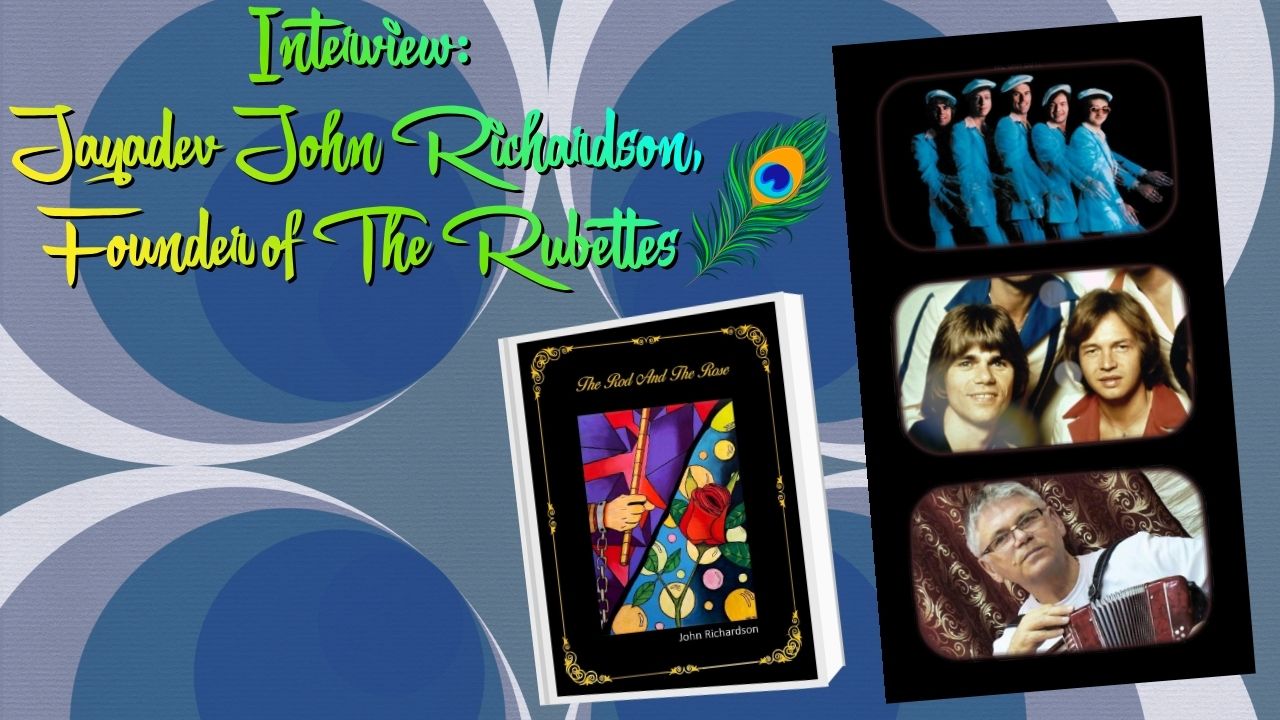
Recently I reviewed John Richardson’s autobiography The Rod and The Rose (you can buy a copy on Amazon). A great read for Rubettes fans and especially a great read for those who are into spirituality and want to learn more about the Hare Krishnas and their beliefs: reincarnation, past lives, and compassion for animals. In this interview we talk about rock and roll history, a bit about The Rubettes, spirituality, vegetarianism, and past life regression. This was an incredibly interesting discussion and you’re in for a real treat. This is definitely a story of hard work, luck, fate, the butterfly effect, whatever you call it.
We’re very lucky to have Jayadev John Richardson on the blog to talk about all these things. So without further ado, here’s the interview!
Angie Moon: What makes the music of the 1950s special to you?
John Richardson: Well, I think it’s because I was around [at] that time when the first rise of real contemporary music. It started to appear occasionally on the radio, and occasionally on some friends’ hi-fi players, or they were in the Merchant Navy, and they would [sometimes] bring across songs and music from the black community in America. You know, they travel all around the world, and when they went to America, they’re always loaded up with this amazing music. So I got to know about American music in the 50s.
Angie: What was it like working as a musician in 1960s London? You worked at the Cromwellian and played gigs around there.
John: That was a crazy time. It was, you know, you could easily get lost in it or should I get involved in this or I should I do that? I think the main thing that helped me back [then] was that I couldn’t really associate with what was going on at that time was I didn’t have the money for the clothes and I didn’t have the money for the drinks or the drugs. So I was just a pure musician who was just hoping to, you know, get enough money to pay for his rent and stuff like that. I was living in the West End above the 2i’s Coffee Bar. I think you remember that.
Angie: Yup.
John: That was where in the 50s where the music started, a contemporary music started in England.
Angie: Yeah, like Cliff Richard and those guys played there.
John: Yeah, Cliff Richard, Tommy Steele, Marty Wilde, probably some of those names you don’t know. You’re too young.
Angie: What are your thoughts on Beatlemania as it was going on?
John: It was a definite thumbs up to its your world. It’s not their world anymore, you know every generation that comes up, they want to sort of like turn their back on their parents’ ideas and ideals, and establish themselves, and all of a sudden we had a real form of music that could give the thumbs up to our generation, say, yeah, told you so, this is what real music’s all about.
It was a very exciting time. But everything was really in in a sense, by the early 60s, everything was was dominated by The Beatles.
Because, and even, which was something that, I’m told, never really ever happened before, was that all generations of the people of the world, so to speak, love The Beatles, the kids did, the older children, the teenagers, they made them, obviously, their hearts, desire. But the parents did and the grandparents.
It was very weird. Because my dad didn’t like sort of some of the stuff that I was into. But he really, really loved The Beatles. Never really embraced The Stones, but the Beatles dominated everything, completely honestly, and they opened up the States, which was very hard to do for a British act. Not only opened up the States, but dominated it.
And opened the door for all the other groups who were good, but nowhere near as good as The Beatles, like The Kinks, of course, The Stones were, were the dark form of the Beatles. The Kinks, The Hollies, all those guys, they all got the door open, but before them by the Beatles.
But it was a great time. Clothes. I mean, it would have been a great time for you. I’m sure in your previous life, you were there because you have such a feeling for that period, don’t you? When were you born when were you born, Angie?
Angie: 1994.
John: Oh, definitely you could have been there. And is there any particular music at that time? Was it the glam rock that you like?
Angie: So I got into classic rock through the Beatles, and then from there, just all their contemporaries, and then I just moved through classic rock history. So 70s and 80s and kind of like the natural progression as the boomers were living it, I kind of lived it like that.
John: Yeah, I can, it really feels like it when I see you talking about your clothes, your music, it feels like you, it’s yours, you know, it’s not someone else’s, it’s yours. It’s not just something that you’re doing for a living. So yeah it’s great. Well your parents, now you should be in, you’re supposed to be interviewing me, but I’m fascinated by you. Were your parents fans of that scene?
Angie: To some extent, yeah, definitely. My dad liked Motown and soul music. He was born in 1955 and my mom was born in 1959. She liked a lot of the classic rock stuff too.
John: So you grew up in a house with that kind of music?
Angie: More like disco and soul and R&B and Latin American stuff because my mom’s from Latin America.
John: So your mom’s Latin American, your dad’s American, yeah.
Angie: Yeah.
John: Wonderful. A nice mixture.
Angie: So, like, the Beatles were really into Indian, like, culture and kind of, like, helped to introduce it, like, in the 60s. What were your thoughts on the Indian kind of thing, because you converted to Hare Krishna like George.
John: We were fascinated by them as well. Of course, in the Bhagavad Gita, it says Krishna says, whatever a great man does, the common men will follow. The standards that he sets by exemplary acts, the whole world pursues, and it was absolutely true.
I mean, we were all, we didn’t understand why George would be interested, particularly. But we all thought, well, if George likes it, and the Beatles are going down there for that month and they stayed there. Then it’s alright by us.
But by that time, I was just getting established myself, desperately trying to work my way up through the challenges of becoming a professional musician, you know, swapping it out from an amateur into a semi-pro, that means obviously having a job and having the gigs at nighttime, and then to become fully professional.
So, I almost missed some of it all because I was desperate to try to become a success myself. So, while I was in the middle of it all, they were in a sense, not the enemy, but they were people we had to get become as good as, or better than, you know.
So it was a great time and we loved everyone and loved everything. But I missed it. I missed some of it, at least through, trying to become um, a success myself.
Angie: What was it like recording “Sugar Baby Love”?
John: It was just another session for me. We were called to come to Lansdowne Studios, which is in Holland Park, in the west side of London. And they said we’ve got this album we’re trying to put together, you know, a rock and roll album, which is a throwback to the 50s, for Showaddywaddy, what, you probably heard of. They just won New Faces, which was a big, it was like the 70s version of America’s Got Talent.
Polydor wanted to sign them and the head of Polydor was into 50s music. He and Tony Waddington had written all these bop-sha-waddy type songs. They wanted to try to sign them. So rather than just approach them and say, will you listen to our music and they created an album which I was a part of?
And they were trying for the Phil Spector sound. And there were, I think there were 2, there were definitely 2 drummers. I wasn’t the only drummer there, a guy called Henry Spinetti was on drums. There were 2 pianos and you know, the usual bass, guitar, and keyboard stuff. But then they brought in an orchestra as well. And it was just like a whole thing and the session singers were supposed to come in at the end of what we’d done. But they, I don’t know, session people drink a lot and I think they got drunk, and they didn’t turn up or did, I can’t remember if they turned up or didn’t.
But I said to being an opportunist. I said to Wayne Bickerton, ‘I can sing a bit’. And one of the other guys in the band that was there could sing as well, could we have a go at doing the bop-sha-waddies and stuff? So he said why not? So we tried. We did all the backing vocals. But Paul da Vinci, who was a friend of ours at that time, he put the lead vocal on at later time. So as far as we were concerned, it was just another day, and you know, another session, I was just dead pleased that I’ve got, um, I think it was £26 for the, for the session. I was just thrilled that I’d got a double session.
A couple of months later, we started to hear it on the radio. And I was thinking, because I’d been on a lot of quite a lot of hit records for other people. And I was thinking waiting to see who they had got to front it or, you know. And no one said anything about who’s going to be the group that would front it all.
And then it came to, I think, May, and Andy Stevens called and said, What are you doing tomorrow? So I said, well, I don’t think I’m doing anything. So he said, can you get down to Top of the Pops, which was the television show of that time.
And if you’ve got on there, it’s pretty much, you’re guaranteed to have a hit.
So I said, oh, who am I backing? Because I’d been on there with, um, Lynsey De Paul and Barry Blue. He said, well, it’s you, The Rubettes. So I said, well, who’s in it? So he said, it’s you, can you get the band together? They couldn’t sign Showaddywaddy.
They just decided to put the record out anyway without a band, and then when it got into the top 50, so to speak, we were chosen to do it just as a default.
And the reason why, it was at 51 at that time. There was a rule that if you weren’t inside the top 50, you could never be considered for Top of the Pops. So it was at #51 for a couple of weeks, I think. And then Sparks had “This Town Ain’t Big Enough For Both of Us” and they were booked for it, they’d just gone inside the top 50.
They turned up and they found, and Top of the Pops at that time were a bit heavy duty with the way things were run, and the Musicians Union were clamping down on non-members and people like that. And so they turned up when Sparks was there and they said, where is your visa? So they said we didn’t know we had to have a visa. So they said, yeah, get off. So they unceremoniously kicked the poor guys out.
So then they had a spot which they couldn’t fill. So because they’re in the panic, they said, well, get The Rubettes here at 51. We’ll pretend they’re at 50 and they can come in. That’s how it happened.
Angie: What was it like writing and recording “Under One Roof”? What inspired it?
John: I think at that time the gay thing was not like it is now, but it’s much more accepted now. But at that time people were getting, I don’t know what it’s like in America, but here people were getting beaten. People were afraid to come out because it would ruin their career and stuff like that.
And while I’m not and I wasn’t a homosexual, I was very much against the [hatred] that was going on and the violence and so I just made up this fictitious story of someone dying for, just for the fact that he was going with a person of the same sex.
And I also pointed out, you may not have noticed or you may have noticed, the reason why he actually became homosexual was due to the fact that there was absolutely no love in his house, and for the 1st time in his life, someone had taken notice of him and cared for him.
Okay, maybe there was, you know, a reason for that, you know, for them wanting to do that. He was out on the street there. But still, whatever reason a person becomes or gets involved in a homosexual relationship, there are many reasons for it, and one of the reasons was no one else loved him. Come on, you know, someone cared for him. Why not accept this person? Why kill him? And that’s my thing, so it’s an anti-hate song.
Angie: What was your favourite memory from your time in the Rubettes in the 70s?
John: I think that the greatest, and the 2nd greatest thing was I think just hearing our record company call us up 2 weeks after we’ve been on, and I’d been doing a session or playing in a pub the night before for like £10 a night.
Uh, and waking, the phone was by the bed and I woke up and who is it calling? 7 o’clock in the morning and it was Andy Stevens, who was at that time, he was the tea boy at Polydor. And of course, later on, he became a manager himself after I encouraged him to do so. And he became George Michael’s manager and Susan Boyle’s, and he was head of [international at] CBS at one time as well.
Anyway Andy called up and said, John, you awake? So, I said, yeah, he said, you sitting down? I said, no, I’m laying down, I’m in bed. And he said, you’re number one. That for me was just like a such a, Amazing experience, Angie. Well, it’s something never happened before, and it never happened, since, [but] we got close. But in England, that was the only number one we had. And it was an amazing experience.
I was always thinking it must be great to be recognised, but after one year of hits, you know, we had 3 hits in that first year. And I was getting sick of getting recognised and not being able to go somewhere.
So, you know, everything, you know, as the song goes by, is it? That’s what it is, what goes up must come down, dude. That saying, is it from Zen or something? So, yeah, there were many wonderful experiences.
And I think I, that was one and the second one was we were starting to go down in the charts. You know, after about three or four years. We started getting lower chart ratings. And then our record contract ran out, and I think to re-sign us there was very little money, maybe £20,000 or £30,000 would be offered to us, something like that. I said, look, I’m sorry, Wayne and Tony, I was very forthright in those days, I think the songs you’re writing are not as strong as they used to be and you’ve had a good innings.
I want to write a song. So I wrote “Baby, I Know” and it got in the top 10. Which we were only getting in the late 20s and early 30s, you know, up to that. And I think the feeling of being able to write a hit song is also a marvellous experience, and I’m sure that you’ll experience it with your books.
Angie: Thanks.
John: I’m sure it’ll come.
Angie: You used to collect Art Nouveau and Art Deco paintings and art. How did you get into that?
John: I don’t know, I’m thinking now that I was probably around in that period and I probably had some money and I probably liked the fine arts. Because when I saw Art Nouveau, oh my god, it just really just, it was like when I read the Ramayana, I heard the Ramayana, the Bhagavad Gita, it had a incredible experience on me spiritually.
And this had a, you couldn’t say a spiritual, a pseudo-spiritual sort of experience for me. It took me back there. I was there. And I had such a nice collection of Art Deco stuff. I gave it all the way in the end. But I remember loving it so much and everywhere I went I was always looking for Art Deco.
And when we went to France and to Belgium especially. There’s fantastic houses that were built around the Art Nouveau and Art Deco period. More so than in England. So yeah, I loved it. Do you like it?
Angie: Yeah, Art Nouveau is my favourite.
John: Oh, how wonderful. I used to go when we were The Rubettes, to the flea markets in Paris and look for, I used to buy some René Lalique glass, and some different types of pottery, some famous names and stuff like that. And I remember I bought a radio that was in the shape of a globe on a stand, and it was Bakelite and I just loved it so much.
But after I developed an interest in spiritual life,I lost my taste for it all and I gave it away most of it or sold it. But I still love it. I just don’t collect it or want it anymore.
Angie: When did you go vegetarian and why did you go vegetarian? Was it for animals, health, the environment, or ethics?
John: My first, if you like, dabbling of my toes in the water of spiritual life was as a spiritualist, because I’ve always been a little bit psychic. So I’ve had things happen to me as you read in the book throughout my life. I’m not massively psychic, looking at stuff and seeing weird things all the time, but I get these things happen to me.
So, I was very interested in, and the only thing that was, the church wasn’t into that. And there was nothing into it, but there was a spiritualist movement, which you probably have in America, do you?
Angie: I think to some extent, yeah.
John: Yeah, well there was quite a big spiritualist movement in the Victorian Era. It was massive. So, a bit of a leftover from those days, lots of spiritualist churches and I was invited to go and sit in a circle where the medium goes into trance and someone takes over his body and speaks to you and gives you a message. So I was in a circle for about a year. A member of that circle was Terry Edwards and he was a scientist, very intelligent, and he was a vegetarian. And I had become best friends with him. So he used to come round our house and I think his association made me think twice about eating animals. And I think when did I become maybe, the late 70s, early 80s?Something like that.
I was still in our big house then. I remember it was Christmas. It was winter time. There was this terrible blizzard and we had this big, beautiful house on this main road. I went outside, I don’t know, to go somewhere and this truck had stopped. It had broken down. It was a big truck, and it was cages and cages of turkeys. And I went ‘what’s that!’ And they were covered in snow, and some of their wings were outside of the cage, and they’d broken with the wind. And I just saw, God, this is for Christmas. I can’t be part of this anymore.
I went and got the driver a drink, because I felt sorry for him, but at the same time, I felt more sorry for the turkeys. I just walked in and I said to my wife, I’m, I’m becoming a vegetarian. She said, ‘No, you can’t! It’ll break our family up!’ I said, ‘Look, I’m gonna have everything you have, but just move the meat off.’ And so that’s how we went on and I became a vegetarian. My daughter followed me. She was supporting me. My son and my wife couldn’t make the break. So I think about 6 years later they, they decided that it was the right thing to do, and they became [vegetarian].
But yeah, I did it out of compassion and I’m so glad I did. Because now when I take people back to their past lives, very often, I may take them to an animal birth, and show them that animals have feelings, and they love their offspring and that they feel and then, uh, then later on when I read in the Bhagavad Gita, I thought, I know all this stuff. I’ve seen it in my work with with clients, because I started, jumping ahead a bit there, I started this health shop and I became a healer. I’ve always wanted to help people, but I wasn’t brainy enough to become a doctor, but later on, Krishna or God or Upstairs Management, allowed me to become a healer and helper of people in a different way. So, I’ve had all my dreams fulfilled in this life. And now I’m speaking to Angie Moon.
Angie: How did you manage on the road as a musician, early on as a vegetarian it must have been a challenge?
John: It was difficult with the band. What was I doing then? I had to go because the money that we were earning before, I turned my back on the past completely. I went back into [playing in] pubs and people will look and say, oh, that bloke looks like the bloke in The Rubettes. But I had to earn some money, so I just went, ‘Yeah, I was, but so what?’ and got on with it.
Of course I didn’t drink either, I packed in drinking, so, I was a fish out of water somewhat. But people would say, you know, you’re coming for an Indian curry afterwards or you’re gonna do this, and I said, no, I’m a vegetarian, at that time, it was kind of a rare thing.
Then later on after 20 years, being a devotee, The Rubettes called me back and said, please, we’re in trouble, and I’m sorry, it might sound a little bit pompous, but they knew that I could settle their problems. So they said, would you come back and drum for us? So I came back and drummed and I created harmony amongst the band again.
When we went on tour,, if it was in England, Sachi [his wife] would make me nice sandwiches or rolls and stuff like that, vegetarian. But I’d go on the bus with the, with the others and they go, what are you doing? They say, what are you eating there? I said, oh, uh, [that’s] mine. Can we have one? So I ended up, my vegetarian stuff was all going out.
So I got a bit. I didn’t have anything to eat. So what I used to do, I get on the bus with my stuff and they go, what have you got there? And I go, it’s vegetarian stuff. And they go, ewww! So they wouldn’t eat, they wouldn’t ask for it so then I was okay.
And then the pianist, I made him a vegetarian. And then another time, another guitarist. We had a day off in Germany, and I took him back to a past life, and he went back to when he was a fish and how fish feel and what they live like and it was absolutely terrified after that of eating fish and meat and he became a vegetarian.
So the promoters, they knew. We have a thing called a [hospitality] rider, when you say what drinks you want and what facilities you need for getting changed and all that stuff. You probably know all about that. And they used to put on the rider and no meat, fish, or eggs, you know. Anything you like for the others, but no meat or fish or eggs for, John and Mark and uh, the other guy.
France is difficult because they’re such big meat eaters and vegetarian? What is it? That’s about that, you know. But yeah, we get by and I managed to keep my principles and I didn’t drink and I didn’t eat meat. I was tempted with the uh, The beautiful girls that are on offer, but I also managed to behave myself there as well.
Angie: What is a past life regression therapy session like?
John: Well, when a person comes, first of all, I want to know everything about this life because generally they’ll come with, and they’ve got some issue. It might be a phobia. It might have been a trauma.
I’m careful not to just chuck a person back into a previous life, I do it through hypnosis. I’m careful not to just rush into that. So the first half of the session is finding out all about this life and what are the traumas, what are the upsets, what are the limitations, what are the obstructions to their perfection, because each one of us is perfect, but is covered with this imperfection.
The air, fire, earth, water, ether in mind, intelligence, and ego is the subtle body, which makes us what we are. But what we really are is beyond that, and that’s perfect. So what’s made us imperfect, what’s made us frightened, what’s made us angry, what’s made us, you know, envious. When we’re already perfect, is these coverings.
So our conditioning needs to be looked at first. So what I do, I ask them all about this life and don’t even speak about the past life. And if there’s issues with birth, or with their childhood, with the teenage years, who goes through these things and I help them to remove those traumas through hypnosis or it could be through um, a matter of different techniques that I use. And first of all, clean them up so that they’re feeling good. Now that might take a whole 2 hours and then I’d ask them to come back. Generally, I would ask them to come if they’ve had a big life with lots of stuff going on, and I had to do a lot of cleaning.
I want them to go home and assimilate the new version of themselves before we start doing the past life. But say, for instance, we were doing it all in one go. So we 1st of all do this life, clear out the tensions, the worries, the cares, the fears, et cetera. And then, uh, we take them back to a past life. There are different techniques for doing that.
But mainly it’s quite simple. Almost a school kid could do it to a kid in the playground. There’s nothing in a sense, but dealing with what you feel, what you see, what you hear. That is no joke. So it’s not something I’d recommend people do just for a bit of fun because, you know, we’ve been through a lot of stuff and we’re carrying those traumas. Quite fresh within the subtle body within the mind and the emotions. Anything can set it off and make it manifest in this life. But in a lot of people it does manifest in this life, but they don’t know why because the subconscious is not releasing or not able to release because of the conscious mind’s control, the full story. We have this conscious mind and the subconscious mind. The subconscious mind, Angie, contains everything that has ever happened to us. I’m not just talking about this life. I’m talking about all the lives we’ve had and all the different forms of that, over millennia.
So we set the person up with the idea that if we can get the conscious mind still, and not in that critical mode of what’s this all about, this is my imagination, to get just get it sort of neutral. Then the subconscious mind you’ve got, like the hard drive, is contactable and then we give instructions to the person to go to that time that is connected if in one way or another with some of the issues that you’re having in this life, and they go back to that life and then as they enter into that state, if in a very deep somnambulistic state, they’re there as that person. Say if I did it with you, Angie would be gone and the sub-self will be there. If you’re in somnambulistic trance that reality is all that exists at that time. If you’re a light trance, You can connect with a past life reality, but you’re still very much Angie Moon.
I call that light trance and in that case, you can still get good information, but it’s not perhaps as dramatic and as felt as the somnambulistic trance, but somnambulistic trance is so powerful and they can give such incredible detail and like we could ourselves. You could tell me exactly what you were wearing, where you are, who said this and stuff like that.
So, like in the case of Mozart, That was like, just astonishing and when the girl got to write Mozart’s signature no problem. And, you know, just bang, bang, bang, bang, bang with all the mistakes and everything else, that was that Mozart used to make purposely with his signature. The details are incredible. I’m not the only person in the world who does this sort of thing.
But at that time, Angie, I’m not, I’m not blowing my own trumpet here. My first client did it with, and she had that multiple sclerosis. I think you read that, didn’t you? Unbelievable, and I was so shocked that it could be so, she was in somnambulistic trance so she could tell everything and I didn’t know what to do. I thought, my God, she’s been murdered, I’m supposed to be helping her and so I removed the trauma of being raped and murdered, and it removed the impetus toward her. The nervous system being in the shock in the state of disrepair and some or other, it mended itself. So I was the first person I ever heard of, who’d used past life, as a tool for healing and I went everywhere all around the country, later on when I was a devotee and of course, as you know, the person who was Mozart came to, uh, to Cambridge. So that person came there and the students who are gathered around to have a regression. So let’s do it. Isn’t that the girl, the one that’s Mozart? So can we regress her instead of regressing us? So you saw the rest of the story. But that was incredible and I thought, I didn’t show it, but I was angry because I thought, you know, how can you put someone under that much pressure to show me your Mozart, you know, come on then, jump, you know, do it. But the person was so brave, she said, I don’t mind at all. And then he went to his room and got out before we started, got out this massive book of Mozart’s letters and then opened it to a particular letter and said, take her to that. Let’s see if she’s really Mozart and he was so cocky and I was so angry. I was like, yeah, smiling through gritted teeth. I said, okay. I said, are you ready? So I said, she didn’t know what we were doing. She was sitting 20 feet away. So I said, okay Mozart, I took it to me when she was Mozart. You’re going to August the 3rd, 1753. I can’t remember the date now. 2:30 in the afternoon because it was all written on the letter, you know. What you’re doing, she said, writing a letter to my cousin, Marianne Thekla. And the guy that was holding the book, he jumped. He was so shocked. And I thought, ‘Gotcha, you bastard!’ That’s my ambition.
So, he went, what’s in the letter? So Mozart, can you tell us what’s in the letter? So then Mozart started laughing, laughing and laughing, as was his mood. And I don’t know if you know this, but he had his lavatorial sense of humour and he said, after I calmed him down and made him speak, he said, I’m telling my cousin Marianne Thekla, how many different times, different ways you can go to the toilet and he was laughing. That what he’s like and that’s exactly what was in the letter and at the end of it, after a few more questions I brought her out and he said to her, You’ve either got a PhD with honours in his life where you are, Mozart. And she is Mozart.
Angie: How did you get into the psychic and spiritual stuff?
John: Well, some rather, I used when I used to get drunk or have a few drinks, let’s say, I used to say things to people at parties. I didn’t even say read their palm, and I’d never read a poem before in this life, or even learned about it. I used to get it right with people, you know, so I think it started a bit like that and I think my dad, I think he had a few connections with, even though he was a very difficult person and not open about himself at all. I think he, because he used to say, in the days when we were kids, we didn’t have a phone. And he’d say to my mum, Your sister has had a baby girl this morning, 9 pounds, 2 ounces. She knew that her sister was pregnant, but they lived quite a long away, you know and then a couple of weeks later, a letter would come with the, with from her sister saying, I’ve had a baby and it was 9 pounds 2 ounces. So I think maybe it might have come from my dad. I’ve always been interested in the esoteric side of things.
Angie: Tell me about the Mantra Choir and its mission.
John: Well, 500 years ago, approximately about 530, there was an avatar of Krishna, called Chaitanya Mahaprabhu and the way that you know that he’s an avatar, an avatar is one who descends from the spiritual world down into the material world to help the living entities here, who’s stuck with the idea that they had brought this body and they’re stuck in the cycle of birth and rebirth.
And the age that we’re in is called Kali Yuga, which is the worst time. As you see yourself, it’s really coming on these last few years. So frightening. And it’s the age of quarrel and hypocrisy. That just sums the whole thing up. He comes, God, Krishna himself, who was here 5000 years ago, he comes but not just as Krishna, he comes in the form with the mood of Radha, Krishna’s beloved. Now, we all know that girls have got softer hearts than men and so, Krishna comes, but in the mood of Radha. So they’re in one physical form and they’re called Gouranga or Chaitanya Mahaprabhu, he has lots of different names and he wants to set free all the people who are stuck in the cycle of birth and rebirth and looking like they have very little chance to escape it because they’re so attached to sex, drugs, rock and roll, et cetera. So he plunders the storehouse of Vedic wisdom, which he created anyway and he takes from that one process of yoga called bhakti yoga and he goes into the world, all over India showing people the strength of chanting mantras. Specifically the Maha-mantra Hare Krishna, Hare Krishna, Krishna Krishna, Hare Hare, Hare Rama, Hare Rama, Hare Hare.
And God’s name, he shows that God’s name and himself, are not different They contain all the glory, all the preciousness of God, all the mystery of God, all the wonder of God, in those names and by people chanting them.
Now at that time, they can get those things. Now, at that time, uh, The Brahmins were pretty much in charge of everything in India, and they didn’t allow so much these mantras, any mantras to be chanted outside of the birth, deaths, and marriages that they presided over.
So, Mahaprabhu Sri Chaitanya or Gouranga, he’s got so many names, he plundered that treasure house of mantras and took out the most important mantra and said this should be chanted publicly, and the Brahmins are all *gasps*, you know, he was such an upstart that he showed them that by chanting his god’s names, people would receive love of God and be ecstatic and and receive a great wealth of Bhakti yoga.
So, I’m not so attracted to Indian music, but I’m attracted to the mantras and to the process. So I thought I’d like to spread these holy names around the world, but with Western tunes. So that’s what I did and I went to America to attend my daughter’s wedding there. She got married in North Carolina and I was there for a month or so and I wrote all these mantras with counterpoints and harmonies and I went to the local Whole Foods and put an advert. Anyone in the state who is interested to come to be part of my Mantra Choir, I’ll give $50 to plus I’ll provide food and drink for the day. And we got about 40 people from all over the state turned up as singers.
And I created my first Mantra Choir. I got them to sing all the different parts to about 10 songs. And then when I got back home, I put all the parts together in the studio and made my first Mantra Choir recording.
After that, I vowed that I would do 108 of these, I’d facilitate 108 of these choirs with holy names around the world. And in the next few years, I’ve done 250 of them in 25 different countries, all over Russia, all over Ukraine, South Africa, Australia, New Zealand, America – only the east coast, all over the UK of course, and so on and so forth.
Any names of God. It’s not just in Krishna Consciousness, it’s Lord Jesus and Allah, Buddha, Jehovah. They all have a potency. It’s not we’re the only ones and you know, it’s not we’re the king of the castle, get down your dirty rascal. I’m just attracted to Krishna Consciousness because it ticks all my boxes. Other people will find something else for them.
I was doing pretty well, got quite well known with it around the world, but then I was on tour with the band and we were working too hard and I got a heart attack. So I decided to stop touring for that period of time and recover. I’m okay now. But in that period, I was proud to say that I did 2 instead of 108, I did 250 choirs and yeah, it was great fun teaching people. And the great thing about it is you can teach people how to do harmony and counterpoint, which is so difficult in 10 minutes.
Just break the audience up in 3 or 4, whatever the thing is. You’re singing that? Got it Okay guys, you sing this one. You sing that one. Right now we do it all together. And then they’d be doing it all and I’d rush to each and just make sure I was supporting them good. And then in the end, I just stand back and you let them just hear themselves do it. So that’s why I started Mantra choir to spread, you could say Krishna Consciousness far and wide.
Angie: What advice do you have for aspiring musicians?
John: First of all, I know that we have to be practical and you know, we’re looking forward to perhaps one day earning a living at it. Some of you will be able to. Some of you due to whatever reasons will not be able to. But the most important thing is that it’s a gift that you’ve got, the more you work at it, the greater and the more profound that gift will become. Don’t take it for granted.
Don’t take your body or your voice for granted either. You don’t need drugs to get high [or] to get great music. You just need commitment to what you’re doing. This craft is coming from heaven. This craft is coming from the spiritual world. I’d say to them, your training yourself up to be a musician, but the ultimate music is in the spheres above us. And there, every movement is a dance. Every word, Angie and I are speaking right now, is a song. So they don’t just speak like blah blah blah, they sing to one another.
So music, and you’re doing the right thing. Don’t worry about whether the money’s going to come or it’s not going to come, just become as good as you can at it, and enjoy as much as you can and if success comes, don’t become, don’t think that it’s your skill, it’s just a gift, and I shouldn’t say just. It’s a gift that’s given and it can be taken away. And if we misuse it, in our next life, it won’t, it’ll be there, you still want to be a musician. But the magic won’t come, because you’ve abused it. I’m talking like the musicians that are criminals (laughs).
I’d like to say just don’t take it for granted and just work and work and work at it. Share and listen. The whole universe was made from sound. The sound ‘om’. From that, comes the whole creation. So, small wonder, that music (taps), and singing, and the voice has such an impact on everyone, everywhere.
Murderers can become pacifists, can become saints through it. So you’re carrying a big responsibility and you may not want to take that responsibility, just have a bit of fun. That’s fine. Good luck with you.
But for me, I think it’s, well, you know, uh, if you’ve seen these kids on Facebook, Angie, with their skills that they’ve got at 4 years of age. Honestly, the kids out there now, they’re drummers. I’ve been drumming for 60 years. There are drummers are 12 years of age who are 10 times better than me.
But where does it come from? It comes from their previous life. They’re bringing those abilities. It’s astonishing! I saw a kid the other day, he was five. He was playing piano like Mozart.
Where does Mozart get his blessing from? From the life before when he was on the sun plane. And he could hear we don’t write anything. They’re all up there, and they’re all coming down from either the astral world or from the spiritual world, or the different tunes and different dance movements and the different melodies and the different ragas. They’re all coming from, from above. None of those guys, Mozart, Beethoven, wrote that stuff. They just hear him. What’s there? And because Mozart was there, so he remembers what he heard, and that’s where all the brilliance comes from.
Misuse it and in your next life, you’ll have a great love, a great yearning to be great or to be wonderful, but it just won’t happen for you and you won’t be able to have the skills that you had.
But if you look after it, even if you don’t have fame in this life, in your next life, but you still don’t let that stop you from being a beautiful musician and grateful for everything you have and have got. In your next life, that will be put aside again for you and you’ll start.
If you like, self-realisation is a 10 rung ladder and your die at 8, You’ll be born in your next life at 8 and so you’ll have all those skills that just come, and all that, all the help, all the good you do, all the friends will come and help you. All the bad you do, all the end was to give you a tough time. That’s what’s happening with karma.
You can buy The Rod and the Rose on Amazon.
Liked this blog post and want to support independent classic rock journalism? Donate to The Diversity of Classic Rock on Patreon or Paypal or follow me on Facebook, Bluesky, or Instagram, buy my book Crime of the Century, click the follow button on my website, leave a nice comment, send your music or classic rock related books for review, or donate your art and writing talents to the blog.
If you donate any amount to my Patreon or PayPal, you’ll get a Crime of the Century ebook, so it’s pay what you can! The best deal you’ll get on the book and you won’t find this deal anywhere else! I just want to give back to my readers and say thank you for your support.
Leave a Reply