


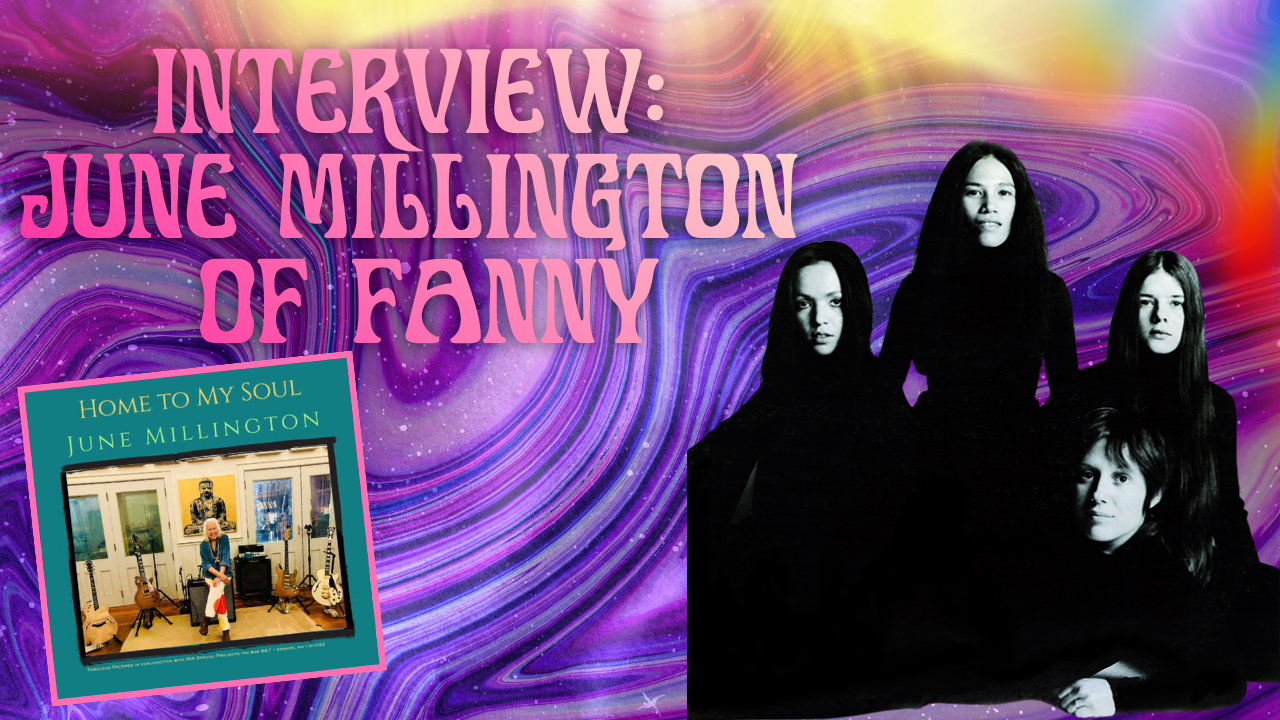
A fellow classic rock content creator, Ash secured an interview with June Millington of the legendary all-woman rock band Fanny. What an incredible opportunity and what a treat for you! She’s an incredible story teller and so authentic and to me that’s a big part of what makes rock music of the 60s and 70s so special, it’s the authenticity and storytelling making a connection with the audience.
Ash, Grant, and I interviewed June Millington and you watch the video below. June’s an incredible storyteller and she’s has a new album out called Home to My Soul. It’s not available on streaming services, so if you want a copy on CD, vinyl, or digital USB you can make a donation on the IMA website. Proceeds go towards supporting music programmes at the Institute for the Musical Arts, every summer they have summer camps for girls and young women who want to play rock and pop music and even produce and do sound engineering too. They have the opportunity to record in a state of the art studio and learn from industry experts. IMA also have workshops on voice and instrumental development, songwriting, composing and arranging, studio recording, engineering and producing, marketing, management, and publishing and licensing.
Since the interview is a little over an hour long and I want to encourage you to watch it, I’ll be posting some quotes from June that were really impactful.
June Millington on her musical influences:
“We were playing ukuleles, Jean and I, when we were younger, let’s say from 9-13 for me, and then we switched to acoustic guitars right before getting on the ship because I heard a girl playing acoustic guitar at our school and I completely flipped out. I just knew that was for me. The thing is when you say that Fanny started in 1969, you’re actually skipping over The Svelts, which was our high school band. If you want to understand Fanny, you have to understand The Svelts because we were basically a dance band like Motown and R&B mostly. And the first songs that I heard here in the US that completely freaked me out, it really did freak me out, was “Will You Still Love Me Tomorrow” by The Shirelles. I was completely blown away by the way those girls sang the song because they don’t just kinda sing it, they throw it out of their entire face. It’s coming out of their nose, out of the top of their mouth, it’s like gypsy singing. Plus with all the strings and everything, Phil Spector production. That completely blew me away and after that of course there was no end to the hits that were blowing us all away. I mean as kids our age, so we’re like 15-16-17 starting bands in Sacramento, plus at the same time psychedelia was already moving in San Francisco, which was just an hour and a half away. So we were at the right place at the right time I feel because we were exposed to all of that. In fact, in 1968, we opened for Sly Stone in Lake Tahoe and there was hardly anyone there. That was before they were a hit, but we already knew their songs because somehow we’d heard them and then he was hanging out in the studio with us in LA when we did our first album because they were recording in the same studio. So I feel like there were a lot of things that happened in kind of a magical way to bring us, to bring me in particular together with a whole bunch of people and now I’m gonna move into 1975 when I met Cris Williamson and I got involved in the women’s music thing, which was a whole other huge phenomena. I really got exposed to a lot and of course we were recorded at Apple Studios in London in 1970. That was the last album we did with Richard Perry, we did record with their engineer Geoff Emerick and he was totally fantastic, I learned so much from him. And every night after we were done, the rest of the whole gang would get in limousines and I just kinda sit there and go play the piano and after about 15 minutes he would come to me and say okay, which meant I could ask him any question I wanted and mostly it was about The Beatles, but he was also telling us Beatles stories while we were recording and then of course we met them.”
June Millington on her most impactful Beatle memory:
“The last time I saw John was when he was recording his final album because my brother in law Earl Slick was playing with them. So I went to the studio. He wanted to meet me actually, he told Slick to call and tell me to come over. That was really enjoyable because I realised that they had the same patterns of working for example, he and I were talking and then without even missing a beat, he just reached over and pushed the button and said to the band, top players, ‘I know you can play, now play the song.’ I knew exactly what he was saying because they had started to jam a little bit, it was ‘Watching the Wheels’ go round and round, which I didn’t even know the name of the song, but he wanted them to play John Lennon. He didn’t want them to play their version of John Lennon, if you know what I mean. It may seam like a slight difference, but it’s all the difference in the world. What separates John Lennon from everyone else? It’s je ne sais quoi.”
June Millington on Early Beatle memories:
“The first song of theirs that we covered as The Svelts was ‘No Reply’. We just loved everything that they wrote and they did and we tried to cover their songs along with our [other influences]. You know, we did ‘Do You Believe in Magic?’, for example. We did ‘The Letter’. We tried to do ‘Alfie’, that was hard. I don’t know if you were listening to the radio back then, but every week there was a new hit and it was fantastic! You know, ‘My Girl’, ‘Rescue Me’, we played all those songs…”
“We loved ‘Hey Bulldog’. We made it our song. Everybody says we did it better than The Beatles and I have to agree because for them that’s just a throwaway song. But you know, he wrote that because he liked the 007 theme *mimics the theme*, so just wanted something that was reminiscent of 007 *laughs*.”
June Millington on the Institution of Musical Arts:
“This is the only one in the world that’s a non-profit institute for women and girls in music that we started in California in 1986 and it wasn’t until we moved here to Goshen in 2001 that we were able to start our rock and roll girls camps, which we do every summer. We have three this summer, plus we have a recording programme because we built a recording studios here so it’s a place where women can come and get information. If you come to rock camp you can borrow equipment, you are actually supported in quite a number of ways. You can ask how do I survive on the road questions, which is a very serious question. And there have been quite a number of groups that have started out of here and solo artists who are in the pantheon of what you can see out there and hear out there. One of them is Kristen Ford and she’s with Ani DiFranco’s label now [Righteous Babe Records]. The songs that have been written here at camp and by the bands that have started at our camps are really top notch. They’re incredible. So I’m really proud of the job we’ve done and this is for all of time. IMA exists for seven generations ahead and so on and the girls who are here now, we just did a gig this weekend at a festival close to here, and the girls who sang with me, they all know they’re taking ownership of IMA and that makes them feel really good. They’re here a lot. They’re learning from us and they know they’re going to inherit this space, which is just 30 acres and a barn that was converted to a workshop/performance centre/recording studio. It’s a pretty big outfit…”
June Millington on teaching about rock and roll’s foremothers and knowing your history:
“I teach them foremothers. So I introduce them to the women who came before who contributed to [rock and popular music]. We’re standing on their shoulders and that’s so important to know. It’s important to know for instance Ella Fitzgerald couldn’t walk in the front door of the clubs she was playing in Las Vegas because she’s black. She had to go in the back. Or they couldn’t just stop and eat any place or stay at a hotel carte blanche, you know they had to just stay in certain places or they would very well get killed.”
June Millington on the diversity of music now vs today:
“I don’t really think there’s more diversity. When you think of what was coming out since 1966 for example, you have The Youngbloods with ‘come on people now smile on your brother’ [‘Get Together’], you have *does the riff from ‘Day Tripper’*, you have ‘The Letter’, you have ‘Alfie’, you have ‘Do You Believe in Magic?’, I mean there was so much stuff coming out, I can’t imagine a more diverse time. I think maybe jazz is coming more into the forefront of what’s popular because it’s being inserted which is great. But in terms of the amount of groups and the variety of the music, ‘In-A-Gadda-Da-Vida” *laughs*… Well you know when we started, The Svelts did a backyard gig with The Surfaris, you remember his drum part… ‘Wipe Out’, and he was playing with no shoes and I remember it like it was yesterday… There were so many bands coming out in the late 60s/early 70s, it’s just really daunting to list them all and we played with a lot of them. We played with Steppenwolf, the Staple Singers, but you know, one of the reasons why The Beatles, I feel like had such a great sound was they listened to those all girl groups and they did those songs and they learned those backup parts. That is all part of pop music and I think that’s partly what set them apart as an all-boy band. They did those background harmonies and they did them so well. You listen to other groups and they just don’t have that complexity. They don’t have the completion of the sound without those harmonies. I mean they were really incredible on that level and they weren’t afraid of it. But it’s not that easy to play. Motown may sound easy, but it’s not easy to really pull it off. So I feel like we were experts in that field and then when we got to LA and there was a switch up and Addie [Lee] left and Nickey [Barclay] joined the band, then we got more into rock and roll and I think that’s what the industry wanted from girls. They wanted to see girls play rock because we were held up as like the standard of girls playing, so they wanted us to compete on the boys’ level. The boys weren’t playing Motown. We had to go to them and play rock.”
June Millington on if her Filipina heritage had any influence on her music:
“I wouldn’t say it influenced us at all because in the Philippines we were listening to top 40. You know, the music in the Philippines is more Spanish-Malayan. It’s not at all like what pop and rock is at all. So I don’t think it influences, although I must say I started playing with Ruby Ibarra starting last year. She has a song ‘Bakunawa’ and she won the Tiny Desk Award for 2025 and I went on the road with them and it was so easy to play with them in part because of the commonality of all being Filipino. There’s just something about it. There’s a certain understanding. The way you laugh at things and what you laugh at and stuff, what you eat, you know. But I don’t think it influenced the music at all.”
June Millington on the band’s biggest challenge, misogyny:
“…That’s what kept us from going over the wall. That misogyny thing was impervious to anything that we did and we were really good. I thought that Fanny Hill, that album should have had at least one single that worked, but it didn’t. It had ‘Ain’t That Peculiar’, which now has over a million views on Beat-Club. It had ‘Hey Bulldog’. It had ‘Knock On My Door’. I mean it had so many great songs. And still people now say ‘How was it that I missed you?’ I don’t know how you missed us because we played all the time. We played colleges, we played clubs, we did every single rock show, and like I mentioned we even did The Tonight Show. How did you miss us? Where were you? I have no idea because we did The Sonny and Cher Show for god’s sake!”
June Millington on her favourite song on Fanny Hill:
“…It’s hard for me to pick out my favourite, but there’s so much great stuff on there. It has ‘Think About The Children’, which is my song and I adore that song still and it really shows me how I was thinking about the future, about the children of the future. And here we are at IMA because we are taking care of the children. There is no other place where the girls can come year after year and it’s the same people, there’s a continuity. The food is cooked here. The barn smells the same. And that’s one of the things the girls would say to me when they return. They visit us a lot. They don’t just come to the camps and there’s two things that they’ll say. The first thing they say is I’m home, and they mean that sincerely, I’m home. And the second thing they say is it smells the same. I protect that smell. I’m deaf in one ear. I’ve always been deaf in one ear. So my sense of smell is very much heightened. So the smell of the barn, we put in bamboo floors in the studios and I can smell that bamboo, it’s fantastic!”
June Millington on homophobia in the music industry:
“I don’t know. I didn’t pay attention to that to tell you the truth. Homophobia just paled in comparison to misogyny. You know the first thing that would happen usually, and this is starting in 1964 when we started The Svelts, the first thing automatically was the sneers. That wasn’t homophobia. That was pure misogyny. And so they would sneer at us, the boys. The girls would kind of hang back, they wouldn’t sneer at us. Then we would start to play and after the first song they were all in love with us because they realised they were wrong *laughs* and they were enjoying themselves. They jumped out on the dance floor and they were dancing. That’s what they wanted. We provided that. We gave them joy.”
June Millington on why she left Fanny:
“I think it was mostly because I knew I didn’t have a real life and I knew that I couldn’t find the, you know, there’s a way to learn about being an authentic human being and you’re not gonna learn that in LA. You’re just not. And what scared me was it wasn’t like I thought to myself, I gotta learn to be an authentic human being. I knew I had to learn how to grow up and that was not going to happen in LA. And not only that, we’ve done four albums and they were great and the public was not responding to it in a way, I didn’t even get paid for gigs, you know. Our creditors were following us in London trying to collect their money from our managers. You know also it wasn’t working on that level, plus they were making us wear clothes that were made by designers and I didn’t like that because I knew that we were great shoppers and the clothes that we wore up until 1973, everything you see were clothes that we picked. And it was just an affront to me. I just kind of felt like oh, our record company doesn’t see us. You know, they don’t really see us. They don’t get the essential thing and if we don’t have that backup, plus I wasn’t growing up. Essentially what I had to do was I had to get into Buddhist teachings. I was reading about Buddhism, but Buddhism is a very serious endeavour. So when I left Fanny in ’73, I ended up in Woodstock in ’74 and I was in a summer house in the winter in Long Island and I listened to Stevie Wonder and I listened to and watched the waves. But I did end up in Woodstock and that’s when I really started to grow…”
June Millington on the recognition of Fanny and revival of interest in the band:
“It feels really comfortable because I don’t have to lie about a thing. The actual story is more fantastic than anyone could imagine. You couldn’t put together a more amazing story. So I feel really comfortable with it all and I really appreciate all the people who write to me, like every day people are writing to me going, ‘How did I not know of you before?’ or ‘I love you!’ You know, that kind of stuff. I really like that. I never expected it to happen while I was still alive, you know. And I expect a lot more will happen after I die. I mean, I am 78 but I just did a gig. I love music so much. It’s everything. Aside from a couple of things like my partner and IMA, but it’s everything in a tangible sense. Like I can touch music all the time. I think about it all the time. Every time I walk down the stairs in the morning I’m singing a different song in my head. There’s no end to it, you know…”
June Millington on her latest album Home to My Soul:
“There’s one thing that happened that I found really fascinating. You know, when we recorded Fanny Walked The Earth, there’s a song of mine called “One” and every time Jean and Brie and I got to the tag, it’s hard to explain but we became The Svelts. Every single time, the second half of the song when we all knew it was supposed to be fading, but we just revved up and became The Svelts. And I worked a lot with my nephew Lee who is Jean, my sister, and Earl Slick’s son, he’s really fantastic and I flew him out here from LA… He was a second engineer on that project. I said, let’s listen to one and see what’s there and I know there’s something there. Wow! We put it up and it really is The Svelts. We don’t play like that anymore but there it was on tape, two or three takes, we just put it together real quick and what was the first thing that came up? My slide parts on the outro. So that’s how the whole album opens up, with those slide parts that I didn’t even know were there. It was just kind of an accident. There were a series of accidents that made this whole thing happen. I have one song called ‘Gods and Foreign Strangers’. Now you have to remember I grew up in the Philippines, I was born in ’48, that’s just three years after the war had ended and everyone was PTSD. Well nobody even knew what PTSD was back then, but they had to tell me their stories. I was the first child, grandchild born after the war and I was a girl and everybody told me their wartime stories. And my dad told me a story about his getting sunk on the ship The Hornet and that was the Battle of Midway and I wrote a song called ‘Man from Vermont’ that’s got slide guitar and every word in it is true… There’s a song on it called ‘Home To My Soul’ that I wrote I think in ’75 and I wrote it in Cris Williamson’s apartment in LA. I think I was housesitting for her…”
June Millington on women’s music:
“Women’s music was already happening when I met Cris so I just kind of got swept into it. It was just this huge river that was raging, you know, and I literally got swept up in the current. In fact, the second book that I’m writing now it spends like the first five chapters trying to explain how important it was and how it felt to me. I mean people didn’t really know it was happening. You know, this was way before the internet. Nobody was passing out flyers saying, hey listen to women’s music it’s the next great thing. People were flocking to it because they needed it. I finally figured out, this is my theory, just the June Millington Theory of Women’s Music, I feel like so many souls, we made a pact with each other that we would meet in 1975 and it was pretty hot and heavy for five years. And then 10, 15, it’s kind of there’s still a few festivals but I feel like we made a pact to come in through a vortex and we did and we all met basically through women’s music and we got turned on to what’s happening to us as women. That’s the main thing and I didn’t realise it, but that’s what I was heading towards when I left Fanny. I was heading towards women’s music and Buddhism…”
Some women’s music recommendations from June: The Changer and the Changed by Cris Williamson, the best selling women’s music album; Something Moving by Mary Watkins, and Fire in the Rain by Holly Near.
June Millington on David Bowie:
“I’ll never forget in 1999, David Bowie did that interview that was in the millennium issue that he talked about Fanny and said ‘Resurrect Fanny and my work will be done.’ Well you’re not gonna get a bigger nod from a star than that and I love David. He was a genius. He was a real genius.”
You can follow June Millington on Facebook, Instagram, YouTube, and her website. You can follow IMA on Instagram, Facebook, YouTube, and their website.
Liked this blog post and want to support independent classic rock journalism? Donate to The Diversity of Classic Rock on Patreon or Paypal or follow me on Facebook, Bluesky, or Instagram, buy my book Crime of the Century, click the follow button on my website, leave a nice comment, send your music or classic rock related books for review, or donate your art and writing talents to the blog.
If you donate any amount to my Patreon or PayPal, you’ll get a Crime of the Century ebook, so it’s pay what you can! The best deal you’ll get on the book and you won’t find this deal anywhere else! I just want to give back to my readers and say thank you for your support.
Leave a Reply