


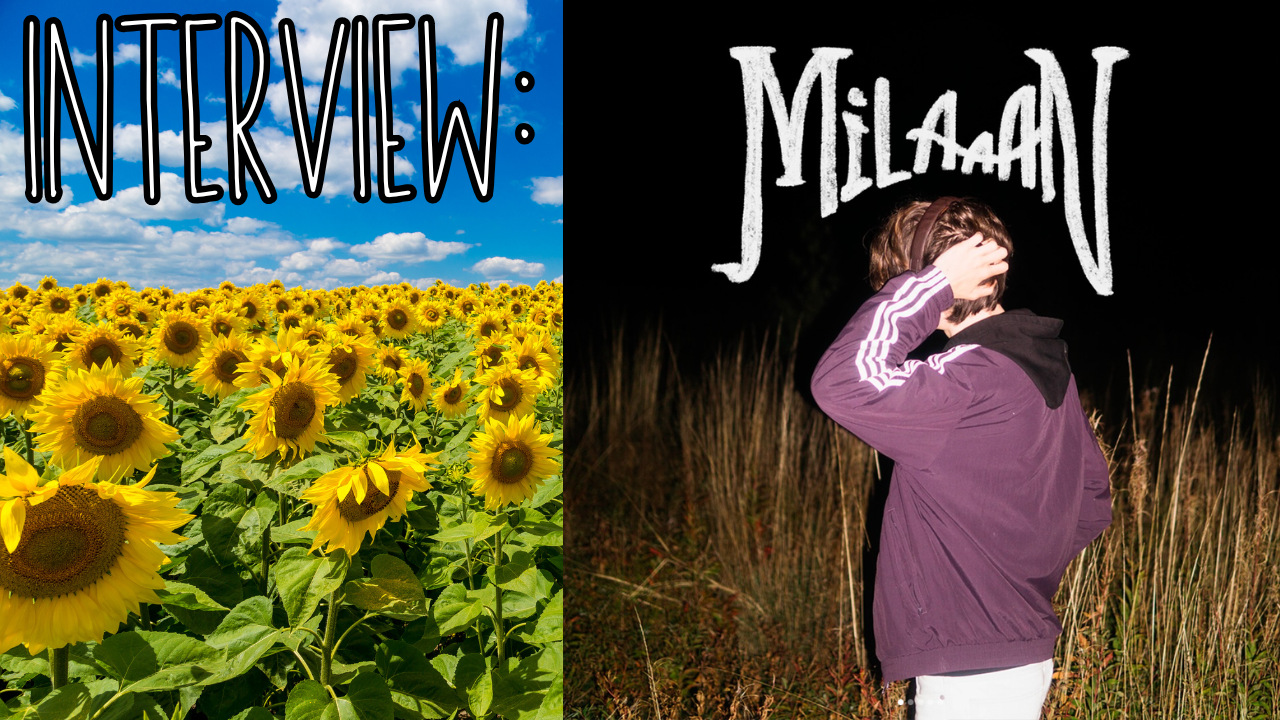
For about five years, I’ve been listening to Kino’s music and I love the sound and the authenticity of the music. I’ve talked about them a good bit on the blog, most recently in a blog post about world music for those afraid of getting into world music. I made a Kino poster and have it hanging up in my room, and if you follow me on Instagram, you’ll definitely have seen it.
I found out about Milaaan through scrolling on Instagram and seeing someone in the same city as me playing Kino covers. Now, Milaaan is evolving as a musician and writing original songs. His first album Kyiv Waits came out on 15 April 2026. My favourite tracks on the album are “Once You Were A Man”, “Breeze”, “Вспомнить Больно“, “Всё Будет“, “Веди”, and “Dust”. The album to me has that Life is Strange, but make it Eastern European vibe. If you’re a fan of groups like Kino, Bi-2, Molchat Doma, ssshhhiiittt!, Durnoy Vkus, Ploho, Nürnberg, Chernikovskaya Hata, and Valentin Strykalo, you might like Milaaan’s music.
We’re lucky to have Milan Matskevych here on the blog to talk about his music, influences, and journey as a musician.
Angie Moon: How did you get into playing music?
Milan Matskevych: I was 16. My father played guitar a bit, and there was always this guitar standing by the wall in the living room. Once I had a girl over, and she asked if the guitar was mine and whether I could play her something. Well, I couldn’t. 🙂
For some reason, that moment stuck with me, and soon after I picked up the guitar. I’ve been playing non-stop since then.
Before that, my father had tried to get me into guitar a couple of times. Once
when I was around 7, and again when I was 11 or 12, but it felt too difficult back then
and I had no real motivation. Sometimes I wonder how much more experience I’d
have if I had started earlier, but maybe being forced into it would have made me hate
music. So, we’ll never know.
Angie: How would you describe your music to a new listener?
Milan: I’d describe it as a blend of 2000s post-Soviet rock and modern
indie/alternative sound. A lot of my influences come from Ukrainian and Russian
music, but I write mostly in English because I want to bring that emotional world to
listeners who might not normally get into those artists because of the language
barrier.
It may not even be about sound, but rather about translating the feelings like
melancholy, hope, nostalgia, and this raw DIY energy.
I feel like a lot of post-Soviet music has this very specific emotional honesty. It
can be dramatic, sometimes even naive, but that is exactly what makes it powerful to
me. I’m drawn to songs that feel like they were written because the person genuinely
had no other way to process what they were feeling. That’s something I try to keep in
my own music too. Even when the production is more modern, but I still want the
songs to feel human, slightly imperfect, and emotionally direct.
Angie: How did you get into Kino?
Milan: Kino was always somewhere in the background for me. My father wasn’t the
biggest Kino fan, but he respected their music a lot and would hum some melodies
from time to time.
I think my active phase of listening to Kino started when I heard a street
performance of “Закрой за мной дверь” in the metro (subway) when I was around 14. Tsoi sang about struggle in a way that felt weirdly familiar to me. It was a bit
heroic, maybe even dramatic, but I really connected with that loneliness and the urge
to just keep going.
What I like about Kino is that the songs are simple, but they don’t feel shallow.
There’s a lot of space in them. You can project your own life onto them, which is
probably why so many people from different generations still connect with them. For
me, Kino was not just “old music”, it felt like something that could still speak to what I was going through.
Angie: What brought you from Ukraine to England?
Milan: Education. I got into the International Foundation Programme at the University of Warwick, which is basically A-levels in one year, and that’s what first brought me to England.
At the time, it felt like a big step into something completely unknown. Now I’m
finishing my Bachelor’s degree in Economics here, so England became a much
bigger part of my life than I expected.
Angie: What you like most about living in England?
Milan: I think it’s the people for me, especially the community I’ve found at university. I’ve met people from so many different places, and that made England feel less lonely.
I also like that there’s a lot of space here to become whoever you want to be.
Maybe that sounds a bit cheesy, but I feel like living here gave me room to grow,
both as a person and as a musician.
Also, because I came here quite young, England became the place where I
had to figure out many things by myself. That was difficult, but it also shaped me a
lot. I think being away from home made me more independent and also made me
understand my own identity better.
Angie: What was it like writing and recording Kyiv Waits?
Milan: It was tough, but also very important for me. Writing these songs was my way of living through separation from home. I didn’t want the whole album to feel
completely mournful, so I tried to put as much hope into it as I could.
Recording-wise, it was as DIY as it gets. Most of it was recorded in my dorm
room. The process was usually: I wrote the lyrics and chords, recorded vocals,
acoustic guitar and some electric guitar parts, and then brought some sketch (demo)
to Eumin, our guitarist. He recorded lead guitar, programmed drums, mixed and
mastered everything.
Bass was partly recorded by Evelyn, our bassist, but Eumin also recorded
some parts to speed things up. There are some rough edges in the recording quality,
but I think they actually fit the vibe of the album. In a way, it was made in a student
room, with limited equipment, by people who just really wanted to make these songs
exist. And I think that matches the emotional core of the album quite well.
Angie: What are your favourite songs on the album?
Milan: Probably “Breeze” and “Веди”.
“Breeze” because it feels magical to me. Every time I listen to it, I imagine flying on a carpet over mountain cliffs by the sea. I think it’s partly the ride cymbal that gives me that feeling.
“Веди” because I’m really proud of the songwriting on that one, both the lyricsand the acoustic guitar part. I always feel like if a song works with just vocals and
acoustic guitar, then it’s a strong song. It may be simple, but it’s very personal to me.
Also, these two songs show two different sides of the album for me. “Breeze”
is more dreamy and cinematic, while “Веди” is more direct and vulnerable. So
together they represent quite well what I was trying to do with the record. There’s
also some rock songs with distorted electric guitars, but you can discover those
yourself 🙂
Angie: How has the album been received so far?
Milan: More modestly than I expected, to be honest. I think I created this illusion that people were interested in my music because they were interested in me, but in reality a lot of people originally found me because I was talking about Kino.
So when you have 5k followers on Instagram and around 300 monthly listeners on Spotify, the math isn’t mathing 🙂
But overall, some people really connected with it, and that means a lot. I also
got feedback that some lyrics may be a bit too heavy, and I kind of agree with that
now. So at the moment I’m trying to understand how to present my music better and
how to reach the right audience.
I don’t see it as a failure though, it’s more of a reality check. Making the album
taught me a lot about songwriting, recording, collaboration, and now about
expectations. I still genuinely believe Kyiv Waits is a good album, but now I
understand that releasing music is not enough by itself. You also need to build a
world around it, explain why it matters, and help people find their way into it.
Angie: Besides Kino, who are your favourite Soviet musicians?
Milan: That question is actually harder than I expected, because I realised that most
of the music I listen to is technically post-Soviet rather than Soviet.
From the Soviet or late-Soviet scene, I’d say Алексей Вишня (Alexey Vishnya), Наутилус Помпилиус (Nautilus Pompilius), Гражданская Оборона (Grazhdanskaya Oborona), and adjacent artists like Инструкция по выживанию (Instruktsiya po vyzhivaniyu) and Янка Дягилева (Yanka Dyagileva). I listened to a lot of that when I was 16 or 17. Also Алла Пугачёва (Alla Pugacheva), very different world, but still iconic.
From the 90s and 2000s, definitely Би-2 (Bi-2), Сплин (Splean), Земфира (Zemfira) and Noize MC.
My relationship with some music from that region has changed because of
politics, especially when artists openly support Russia’s actions or avoid the topic
completely. Some of it naturally dropped out of my life. So now I listen to a lot of this music with a more complicated feeling. Some songs are still important to me personally, but I can’t completely separate the art from what is happening now.
Angie: What makes Soviet New Wave and Post-Punk special to you?
Milan: I think it’s the fact that it was as underground as it could be. People recorded
music in home studios, rehearsed in kitchens, played квартирники (small home
concerts) for their friends. That rawness adds another layer to it, and I really connect
with that DIY approach.
It feels special because it gives me hope. If they could write, record, and share music despite all those circumstances, then there’s no excuse not to create now.
There is just something very powerful about music that exists outside of the official system. You can hear that people were not making it because they wanted to
fit into an industry. They were making it because they had something to say, even if
only a few people would hear it at first.
Angie: Who are your favourite musicians from Ukraine?
Milan: Валентин Стрыкало (Valentin Strykalo), by far. He has stuck with me for a very long time. At first it was because of the meme songs, but later I got into his more serious material. I can’t overstate how much influence he had on me.
Океан Ельзи (Okean Elzy) as well, once you hear Vakarchuk’s voice, you recognise it instantly. The songs are very melodic and have this great mix of acoustic warmth
and heavier electric guitar.
Бумбокс (BoomBox) have a really nice vibe too. Their music makes me feel like I’m inside an early 2000s film.
And Иван Дорн (Ivan Dorn), he made breakthrough pop music at the time. I just love how groovy his songs are.
I think Ukrainian music is very diverse, and I myself have a lot more to discover.
Angie: What do you miss most about Ukraine?
Milan: The feeling of home. I think there’s still a long way to go before I properly
settle somewhere again.
At the same time, I don’t really want to go back in the nostalgic sense,
because I know it won’t be like it used to be. That version of home doesn’t fully exist
anymore. The album explores that feeling a lot, missing a place, but also understanding that you can’t simply return to the past.
I think what I miss is not only the physical place, but also the version of myself
that existed there. The streets, the language, the small everyday things, the feeling
that you understand how everything works without having to explain yourself. When you move away, especially under difficult circumstances, home becomes a bit
abstract. It is still real, but it also becomes a memory, and memories are never
completely accurate.
So, I guess I miss the feeling of belonging without thinking about it. That’s
probably the hardest thing to recreate somewhere else.
Angie: What are your goals for the year as a musician?
Milan: Realistically, I want to focus on social media and building an actual audience
around the music.
I’m writing new songs, and I feel like they’re good, but I don’t want to just
release them into silence. Kyiv Waits taught me that making the music is only half of
the process, and the other half is figuring out how to present it, promote it and help
people actually find it.
I still love the album format as an artistic statement, but practically, I think
singles and EPs make more sense right now. I’ll probably release an EP by the end
of the summer/autumn, but I want to be more intentional with it this time. I genuinely think Kyiv Waits is a good album, but now I just need to learn how to give the next release a better chance.
I also want to post more diverse content: demos, rehearsals, thoughts behind
songs, influences, maybe even failures. I think people connect with the story around
music as much as with the final song.
So, my goal is not only “get more streams”, although of course I want that too.
It’s more about building a small, but real community of people who understand what I’m doing and want to follow the journey. If that happens, then the next release will already have a much stronger foundation.
You can follow Milan’s personal page on Instagram, his music page on Instagram, and on YouTube and Spotify.
Liked this blog post and want to support independent classic rock journalism? Donate to The Diversity of Classic Rock on Patreon or Paypal or follow me on Facebook, Bluesky, or Instagram, buy my book Crime of the Century, click the follow button on my website, leave a nice comment, send your music or classic rock related books for review, or donate your art and writing talents to the blog.
If you donate any amount to my Patreon or PayPal, you’ll get a Crime of the Century ebook, so it’s pay what you can! The best deal you’ll get on the book and you won’t find this deal anywhere else! I just want to give back to my readers and say thank you for your support.
Leave a Reply