


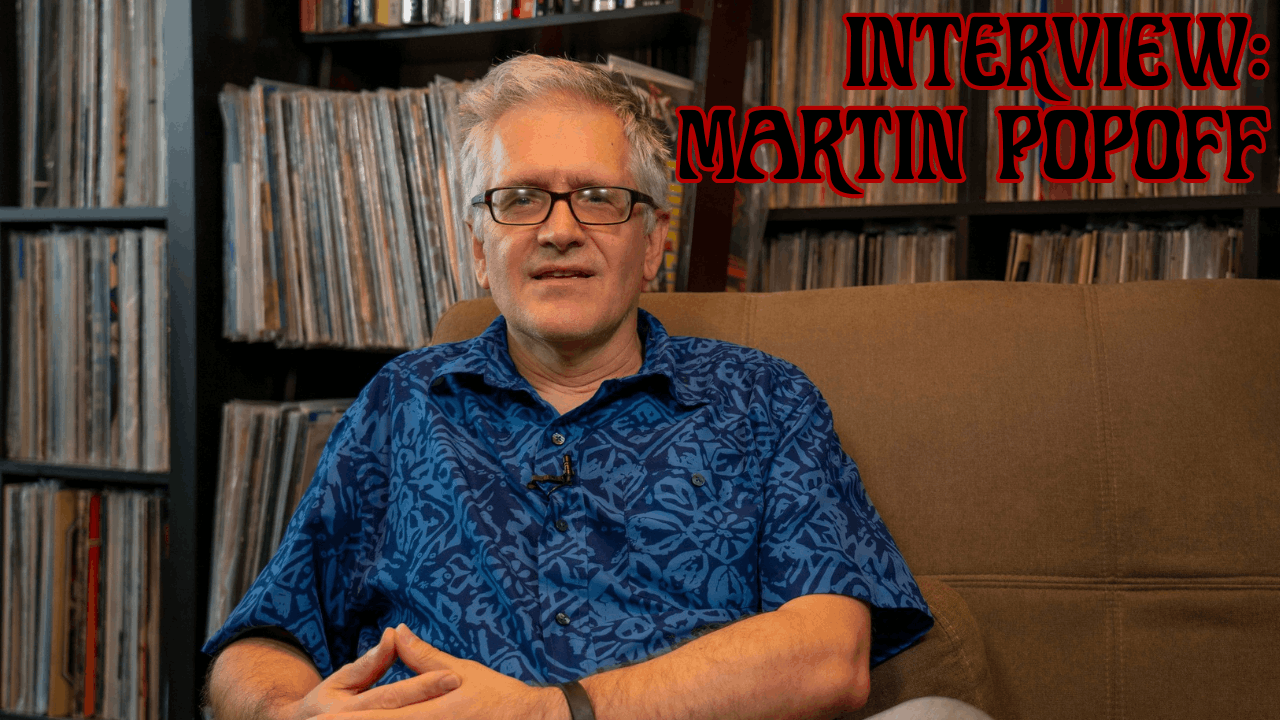
Last week I published my review of Martin Popoff’s latest book, Kiss ’76. It’s an excellent book and a great read for any fans of Kiss who love learning about the history of the band, particularly at the height of their fame. Previously on the blog I’ve reviewed his books Van Halen at 50, Iron Maiden: Album by Album, and Judas Priest: Album by Album. And there’s more books where that came from!
Martin Popoff is an incredibly prolific music journalist who has written over 7,900 reviews and 135 books, including The Collector’s Guide to Heavy Metal series, Ye Olde Metal series, and multiple rock biographies and coffee table books. He also served as the Editor-in-Chief of Brave Words & Bloody Knuckles, one of Canada’s most famous heavy metal publications. He has contributed to music publications such as Revolver, Guitar World, Goldmine, Record Collector, braveworlds.com, lollipop.com, and hardradio.com.
Besides writing, he is also a YouTuber and podcaster, known for the series History in 5 Songs as well as The Contrarians (friend of the blog Grant Arthur is one of the co-hosts and I co-host The Warehaus Acid Test). He also was a researcher on the great documentary Rush: Beyond The Lighted Stage.
We’re very lucky to have Martin Popoff on the blog to talk about his writing and the book Kiss ’76. Without further ado, here’s the interview:
Angie Moon: What was it like growing up in the 70s listening to hard rock and heavy metal as it was coming out?
Martin Popoff: I grew up in a small town called Trail, British Columbia, and we had a lot of record stores, though, you know, this is a town of about 12,000 people. We had Spokane, Washington, two hours away; Vancouver, eight hours or seven; yeah, eight hours away at that point. So we had access to these places, Creem Magazine, Circus Magazine, kept up with all that. The one thing I remember is until the New Wave of British Heavy Metal, there really wasn’t a lot of hard rock and heavy metal around. So it was a lot of who are, who are the usual suspects here, Black Sabbath, Led Zeppelin, Nazareth, Blue Öyster Cult, and Bachman Turner Overdrive. Eventually, AC/DC, of course Kiss, Aerosmith, Ted Nugent.
So there were really not that many albums, and you could eventually suss everything out, that kind of thing. But it was great. You’d go down to the store, pick it up, you’d sit there and study the the covers over and over, read all the liner notes. You’d salivate over the ads in Circus and Creem and all that. It was cool.
We’re just crazy, crazy music fans, and me and a couple other buddies were as well. And, you know, I’m 62 now, born in ’63 and I would say by maybe eight years old, nine years old, I was well on my way. And we were kind of nutty obsessives by easily 10 years old. 1973, I definitely remember new releases from ’73 and ’74 in fact, Kiss was bought as a new release by one of us, myself or a buddy, but we were getting that as that record was coming into town and and learning about Kiss that way.
Angie Moon: What makes heavy metal special to you?
Martin Popoff: I would say just the excitement of it, the mechanics, the distortion, the extreme vocals, the pushing of air through vocals, the fast, energetic drumming. I became a drummer pretty quickly. At that point to me, I always say, one analogy I make is heavy metal is like a bunch of guys crowding around the raised hood of a hot car and just admiring the engine. You just like, kind of the mechanics of the way it’s put together. It is exciting. And, yeah, just energetic, good music. It just seems, boy, we just did a long podcast episode about this, but this idea of perfect music, I talk about, you know, prog and jazz, but even kind of boardroom pop and and heavy metal, it sounds like if you were to make music to impress people, heavy metal would kind of be one of those, you think of punk or post punk, or more abstract forms of music, grunge, where you know, you could tell that there’s an aesthetic to it. It might be a little more abstract and close to realism. Heavy Metal, to me, feels a little bit like that kind of music that that is. It sounds like music that could impress anybody kind of thing.
Angie Moon: How did you get started as a music journalist?
Martin Popoff: First, I wrote a book called Riff Kills Man! 25 Years of Recorded Hard Rock and Heavy Metal and I had moved to Toronto at that point. There’s a buddy, Tim Anderson. He’s running the heavy metal department at HMV. I quickly hooked up with him right around that time. There was M.E.A.T. magazine written by another buddy, Drew Masters, that was kind of on its way out. Tim started doing this thing called Brave Bits out of the store, and then it became Brave Words & Bloody Knuckles magazine in May of 1994, and we were off to the races.
We were reviewing stuff, getting sent free CDs, getting interviews. So that’s when I ramped up 1994 through to 2000. In 2000 I quit my job. We had desktop publishing, print broking. Businesspeople don’t even know what desktop publishing is anymore, of course, but print broking, I had moved here, I started with Xerox, Moved here with Xerox. So in 2000, I went full time, and that’s when the books started picking up. I got 135 books or so now, but 2000 until 2008, I was second in charge at Brave Words, Editor-in-Chief, from 2000 to 2008 and then with the crash, the print magazine went away, and the site kept going and kept doing stuff.
Angie Moon: How did you get into the music of Kiss?
Martin Popoff: I bought the first album as a new release. Loved that cover. Thought it was a heavy album, heavy Slade, like BTO, like album, Riff rock. It wasn’t as tricky or as intricate as Black Sabbath or Deep Purple or Uriah Heep, the British stuff, but we still loved it. And of course, you know the look of the band, and once we saw live pictures and stuff, that just drove us insane as kids, you know, we’re 10 years old at that point. 10, When Kiss Alive! came out, we were 12.
Angie Moon: What was like researching and writing Kiss ’76?
Martin Popoff: Kiss ’76, I loved it because this was an idea I had because I’d started seeing that there are more of these books out there these days that that look at a more defined period in time. And I love the fact that this is a celebration of the year 1976: all the TV shows we watched, sports stuff, you know, tragedies, plane crashes, warts and all, true crime, but you know more-so all of the bands that we loved besides Kiss in 1976. So just the great memory of that being probably the first super magical year for me as a kid.
So I was 13, and then I just thought this could make a good, focussed book. It’s a little different in that it’s not completely about Kiss, but I think Kiss fans will really like it, that it’s this novel approach, you know, month by month, and then everything that’s happening in and around Kiss and ’76 and this is their big year, you know, Alive! comes out at the tail end of ’75 then they put out Destroyer, which is widely considered their best album, and Rock and Roll Over and The Originals is in there. So this is kind of their big breakout year, right?
Angie Moon: What are your favourite albums of 1976?
Martin Popoff: Wow, I just did a Goldmine Top 20 about this. Aerosmith Rocks, certainly I like it more than any Kiss album. Black Sabbath, Technical Ecstasy, Blue Öyster Cult Agents of Fortune. What else do we have in there? Ted Nugent, Free-for-All. Certainly Kiss Rock And Roll Over and Destroyer. Rainbow Rising. That’s a huge one. First album we ever got where every single song was heavy. I remember that, Kiss, High Voltage (AC/DC), the international version of that came out in ’76 Queen A Day at the Races. Yeah, those are the main ones.
Angie Moon: How do you think music journalism has changed since the 90s?
Martin Popoff: Well, in the 90s, it was still all about print and free CDs. So physical product and so that made the business much bigger. It was a much bigger business. When you have trucks driving around full of plastic, delivering things in stores, and it’s like I say, all physical delivery, delivery to the stores, delivery from the stores. It’s just a much bigger business.
So back then, it was still all about magazines. The internet started. I remember very clearly. I, you know, pinned that as 1996, that’s when it started to change. But it took quite a while to change. So yeah, back then it was magazines and radio and what else, TV? Maybe not so much MTV at that point, but still, lots of magazines. So the business was essentially the same it was in the 70s and 80s, I would say, and probably even the late 60s.
But the way it’s changed a lot since then is physical product went away. So nobody’s getting free stuff anymore. You know, the internet allows lots of bands to just do their own journalism on their own sites or through YouTube, of course. And so people are writing for free. They’re writing for sites. They aren’t writing for physical magazines. There’s way more music out. I always say that music, you know, decade by decade, grew exponentially more than anything. I mean, there’s, there’s hundreds of thousands of records coming out, I think, every year. So it’s very nichey, of course, that causes us to all be in our specific bubbles.
But yeah, music journalism is, I guess, bottom line is, it’s writing for websites or doing YouTube videos. We do lots and lots and lots of music journalism, come to think of it, on YouTube videos. We’ve got a YouTube channel called The Contrarians. We’ve done over 1,000 videos. I’ve got an audio podcast where I’ve done 350 episodes of that, just yapping for half an hour. So that’s music journalism as well. So I would say YouTube is really the main source of music journalism, more so even than written interviews at websites.
Angie Moon: What does a typical day look like for you?
Martin Popoff: As a writer and podcaster, if something inspires me, I just turn on the mic in the camera and do a show, or I’m writing. You know, at my age, I have a problem with, you know, I’m definitely a morning person, and I start to fade badly, starting at around noon. So a typical day is try to get as much of your A priorities done between 7:30am and 10:30am I would say, before I start to fade. So that’s where I kind of do my writing. There’s always fires to put out, books, to proof, things to do, writing to do for Goldmine. So all of that kind of happens in that sort of sort of range. But yeah, I’m usually working on one or two books at once, so I’ve got various deadlines. But you know, these days, not selling as many books I’ve noticed in the last couple of months, even my podcast numbers are down a little. But the bright spot is our video channel seems to be growing a little bit. So I like plugging in shows there. I love getting comments and stuff, right? So I like the feedback.
Angie Moon: What is your proudest accomplishment as a writer?
Martin Popoff: Okay, I would say I really like the Who Invented Heavy Metal book that I did, which was 120,000 words ending in 1971, all about everything including the kitchen sink with the invention of metal. I really like the books I’ve done where I’ve examined every single song by a band and literally the entire catalog that way, like not interview intensive books. These are just books where I have to analyse. And I’ve done three of those, one on The Damned, one on The Clash, and one on Led Zeppelin. I really love the big, massive Bowie book I did. Bowie at 75, beautiful, beautiful design on that. I really liked doing a book on one album and getting this massive plush design done for that. That would have been the Pink Floyd Dark Side of the Moon book and The Who Quadrophenia book. Yeah, those ones.
Angie Moon: What have you been listening to lately?
Martin Popoff: I’ve been listening to a lot of post-punk and punk and getting into hardcore. So I’m stuck in that sort of, not even my usual stuck in. So maybe you might think I’m stuck in the 70s, but I’m more stuck these days in sort of 1981 to 1985 Siouxsie and the Banshees, The Jam, XTC, again, a lot of post punk. Echo and the Bunnymen, The Teardrop Explodes. But I do like UK hardcore, getting into a lot of that, maybe moving a little bit into even us punk from the early 80s. So that’s my main stuff.
Angie Moon: What advice do you have for aspiring music journalists?
Martin Popoff: I would say, do YouTube just, just start doing YouTube videos, start having a channel. Do these ranking shows like we do when a new release comes out? Do a long video of it, learn your editing skills. You know, our channel is still pretty bare bones, but a lot of people have done a lot of really nice work there.
But writing for sites as well. The beautiful thing is for the price of a Spotify subscription, you could have albums, certainly write on release date, and write something fast, and do reviews that way. So, you know, there’s no problem with getting music. There’s so much out there. You could become a specialist in things because it is so nichey. So, yeah, I would say, I would say, just cause you’re not going to get paid much for it from sites. You’re not going to get much free physical product anymore, but I think to make a living at it at all. I think the main thing that you should do is is grow a kick ass YouTube channel. So there you go.
You can follow Martin Popoff on his website, Facebook, and Instagram. Kiss ’76 comes out on 24 February.
Liked this blog post and want to support independent classic rock journalism? Donate to The Diversity of Classic Rock on Patreon or Paypal or follow me on Facebook, Bluesky, or Instagram, buy my book Crime of the Century, click the follow button on my website, leave a nice comment, send your music or classic rock related books for review, or donate your art and writing talents to the blog.
If you donate any amount to my Patreon or PayPal, you’ll get a Crime of the Century ebook, so it’s pay what you can! The best deal you’ll get on the book and you won’t find this deal anywhere else! I just want to give back to my readers and say thank you for your support.

Leave a Reply