

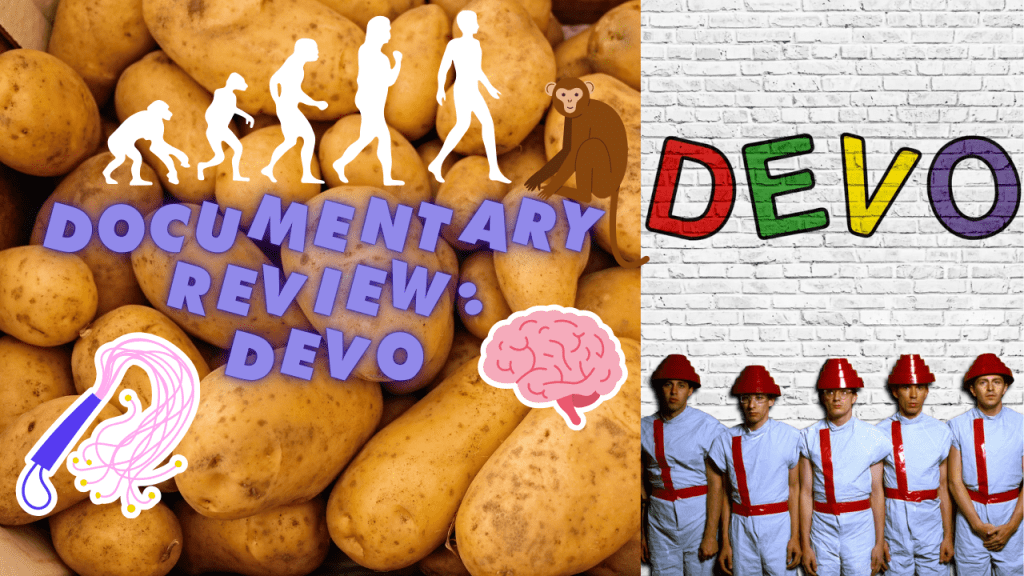
Today the new DEVO documentary started streaming on Netflix. As DEVO are one of the bands talked about in my classic rock and true crime nonfiction book, Crime of the Century: Classic Rock & True Crime, I was excited to hear the news that there’s a documentary about this new wave band that David Bowie once dubbed “the band of the future”. This Akron band with a cult following has not just one true crime connection, but two true crime connections. Members Gerald Casale, Mark Mothersbaugh, Bob Lewis were Kent State University art students and Casale was friends with Jeffrey Miller and Allison Krause, who were one of the four students who were killed on 4 May 1970 protesting the Vietnam War. The tragedy was part of the inspiration for their idea of “Devolution” where humanity had begun to regress (sounds like a predecessor of Idiocracy), hence the name DEVO. A little over a decade later, DEVO turned a poem by Reagan attempted assassin John Hinckley Jr into a song called “I Desire”. They’re a band with a fascinating story and I remember early on when promoting the book, author Ricky Tucker loved the chapter as a fan of DEVO and another big DEVO fan told me that he had never heard of the story until he read Crime of the Century.
I often find that rock and roll documentaries can be a bit Disneyfied, but as someone who loves to research I watch them anyway because I often find I learn something new and I like to give any classic rock related media a chance.
DEVO are considered a one-hit wonder and many people just know them for the danceable, catchy “Whip It”. However, they’re also considered a band that many autistics love (yay echolalia!) and quite a nerdy band, when you really get to know them. Mark Mothersbaugh introduced the band to this 1930s pamphlet called Jocko Homo Heavenbound, which has a devil on it with the word “Devolution” written on his chest.
Because of their quirkiness and weirdness’, they’re often misunderstood and have received many criticisms of being a fascist band, a fascist clown band, or a joke band. But the truth is they’re a lot deeper than that.
The documentary sets the scene talking about the milieu in which they’d grown up in, but it’s not the happy rose tinted picture perfect 1960s like you’d imagine, but rather a time that sounds really familiar to our own. Lots of technological progress with the space race, but a lot of turmoil socially with poverty, assassinations, war, riots, and racism. Sound familiar to our era of AI and the rise of far-right politics? The music of the 60s may paint a picture of an optimistic time, but that’s really just a coastal middle class hippie perspective, and DEVO started off in this bubble believing in all of that and getting involved in anti-war and anti-imperialism protests. They were bright eyed idealists hoping they could make a difference. Kent State marked the cultural death of 60s optimism and from there, we got the 70s with its dichotomy of rawness and realness on one side and cynical corporate rock on the other. Gerald Casale had become more angry and focused. He saw that we were closer to devolution than evolution. The intellectual conversations he had with his friends were like a phoenix rising from the ashes.
DEVO were from the industrial Rust Belt city of Akron, Ohio, which was starting to experience industrial decline. Their thoughts on the “Swinging Sixties” remind me a lot of Ray Davies’ view of the 60s, as I discussed in this blog post about leftist rock musicians. All of these utopian ideas were a fantasy and the cheery music was just a distraction from the problems in society.
DEVO’s art school background makes me think a lot of British rock bands who had art school alumni like Queen (Freddie Mercury), The Kinks (Ray Davies and Pete Quaife), The Who (Pete Townshend), Pink Floyd (Syd Barrett), The Pretty Things (Phil May), and The Beatles (John Lennon). And The Beatles comparison isn’t a crazy one because they even say it themselves that Ohio is kind of like Liverpool. This art school background shaped the music and the aesthetic and rock and roll is the full package. More than just music. Through Mark’s art of potatoes, they conceived the whole potato motif, which you’ll see on their album covers. They started calling each other “Spud”, used like “Comrade”. This motif would be seen on the Oh, No! It’s DEVO album cover that leaned into the whole “oh no not these guys again” thing that detractors would say.
Pop culture and 20th century art were huge inspirations to DEVO, especially Dadaism, brutalism, and minimalism. But they also were fascinated with Andy Warhol and his many artistic pursuits: painting, photography, filmmaking, and managing The Velvet Underground. DEVO weren’t just a band, but a whole concept. Movies Island of Lost Souls and Inherit The Wind with their zombie and monkey imagery were huge influences on their aesthetic.
They played their first show in 1973 at their alma mater Kent State University, featuring a monkey puppet and Krautrock like synths. The normie audience didn’t get their DIY performance art.
In the early days, before finding their cult audience, they often got heckled and booed for their out there sound, but in true punk rock fashion they remained confident and stuck to their artistic vision. They started their own record label Booji Boy Records (pronounced Boogie) and sent out demo tapes wherever they could. They played at CBGB in New York and while they were polarising, they gained a following with punk sounding songs like “Uncontrollable Urge” (which would be in the soundtrack of Wolf of Wall Street). John Lennon started singing “Yeah Yeah Yeah” close to Mark Mothersbaugh’s face and it was a dream come true because that refrain was inspired by “She Loves You” of course. Word of mouth spread and famous faces like Jack Nicholson, John Waters, Debbie Harry, Leonard Cohen, and Iggy Pop would show up at their shows. Neil Young later asked them to appear in his film Human Highway.
Remember that this was during the glam rock and disco era and DEVO weren’t exactly fashion icons. A lot of their style was inspired by their industrial surroundings, factories with everyone in identical workwear, cogs in the machine like in the movie Metropolis. So it’s no surprise that they would record their debut album at krautrock pioneer Conny Plank’s studio.
There was one rock star that would get their mission and that was the visionary David Bowie. But how would they get noticed? Music videos! So they submitted The Truth About De-Evolution to the Ann Arbor Film Festival and they won an award. Through this, they got senpai Bowie to notice them. This demonstrated that Devo were more than just a band, but a whole performance art project with a message.
David Bowie’s original plan was to produce DEVO, but because of other commitments he got his friend Brian Eno to produce their debut album. A great match considering Eno’s evolution from glam rock Roxy Music to the ambient and experimental sounds you know and love. DEVO were huge fans of the Berlin era, so it was a dream collab come true.
They first got a following in Europe, which was more hip and switched on than America. Richard Branson wanted to sign them to Virgin and Warner Brothers sued, and DEVO got screwed over due to having no manager or agents to protect them from the record industry big wigs. After getting a manager, they got on SNL and toured America. Even though they got a lot of promotion from Warner Brothers, they were frustrated with their lack of mainstream appeal. DEVO being DEVO, they refused to play the corporate game. But they’d better have a hit if they wanted to keep their record deal. A miracle came with the risqué “Whip It”, but the record label wanted another “Whip It”. Thanks to MTV, they really blew up with the video for it and for their backlog of music videos. Talk about tapping into a market! Thanks to their filmmaking background, it came naturally to them and they leaned into the “whip it” theme cracking the whips and taking inspiration from pinup magazines. It was a satirical commentary on consumerist fuckboys and Reaganism. In a funny parallel with Idiocracy, they called the album Freedom of Choice, taken from a Carl’s Jr billboard. This was also the era of the iconic flowerpot hats.
With the election of Reagan, it felt like history was repeating itself and DEVO were right about that. Take a look at any graph and notice the patterns of when shit starts hitting the fan and it’s pretty much That’s So Reagan!
In another parallel with The Beatles, they had a next level Sgt Pepper moment of sorts when they created a secret side project opening for themselves as Dove the Band of Love. Gotta love that wordplay! Or maybe it’s more of a Simon Dupree moment with The Moles. I mean, they were a sibling band just like DEVO.
In their next era, New Traditionalists, they wore JFK inspired wigs (which ironically got mistaken for Reagan hairdos), countering Reagan’s OG MAGA, which really was nostalgia for a fantasy America of the past. Screw that, rebel by creating new traditions!
Warner Brothers didn’t get another “Whip It” and weren’t thrilled with their art rock sound and aesthetic. The sad reality of being in a rock band signed to a major label is it’s like a hamster wheel.
Soon enough their unique selling proposition of music videos wasn’t so unique anymore and everyone followed their lead making flashy music videos with much bigger budgets. I mean how can you compete with Michael Jackson? One provocative video with a suggestive chip going through a doughnut and MTV were done with DEVO. Now that’s punk rock! As Jack Black said in School of Rock, “And there used to be a way to stick it to the Man. It was called rock and roll, but guess what, oh no, the Man ruined that too, with a little thing called MTV!”
All good things come to an end and DEVO were in a lull by the mid 80s. They felt like they’d become Spinal Tap. They broke up in 1991. That same year Mark Mothersbaugh moved on to compose the theme for the iconic Nickelodeon cartoon Rugrats (being a millennial, that was my first exposure to his work). From there, he continued composing, for TV and film. After some time they reunited and like fellow classic rock bands they became recognised as the legends they are with all the cultural references. Clearly DEVO did something right, still being talked about, standing the test of time.
It’s a great visual retrospective about the great audio-visual band DEVO with lots of historical context. To me, it’s not Disneyfied, but I think that’s the advantage of being a cult classic. A must watch for DEVO fans! History really repeats itself and DEVO are evergreen.
Liked this blog post and want to support my work and see more? Donate to The Diversity of Classic Rock on Patreon or Paypal or follow me on Facebook, Bluesky, or Instagram, buy my book Crime of the Century, click the follow button on my website, leave a nice comment, send your music or classic rock related books for review, or donate your art and writing talents to the blog. Thank you for your support! If you donate any amount of money to my Patreon or PayPal, you’ll get a Crime of the Century ebook, so it’s basically pay what you can! The best deal you’ll get on the book and you won’t find this deal anywhere else! I just want to give back to my readers and say thank you for your support.

 The Diversity of Classic Rock
Leave a comment