


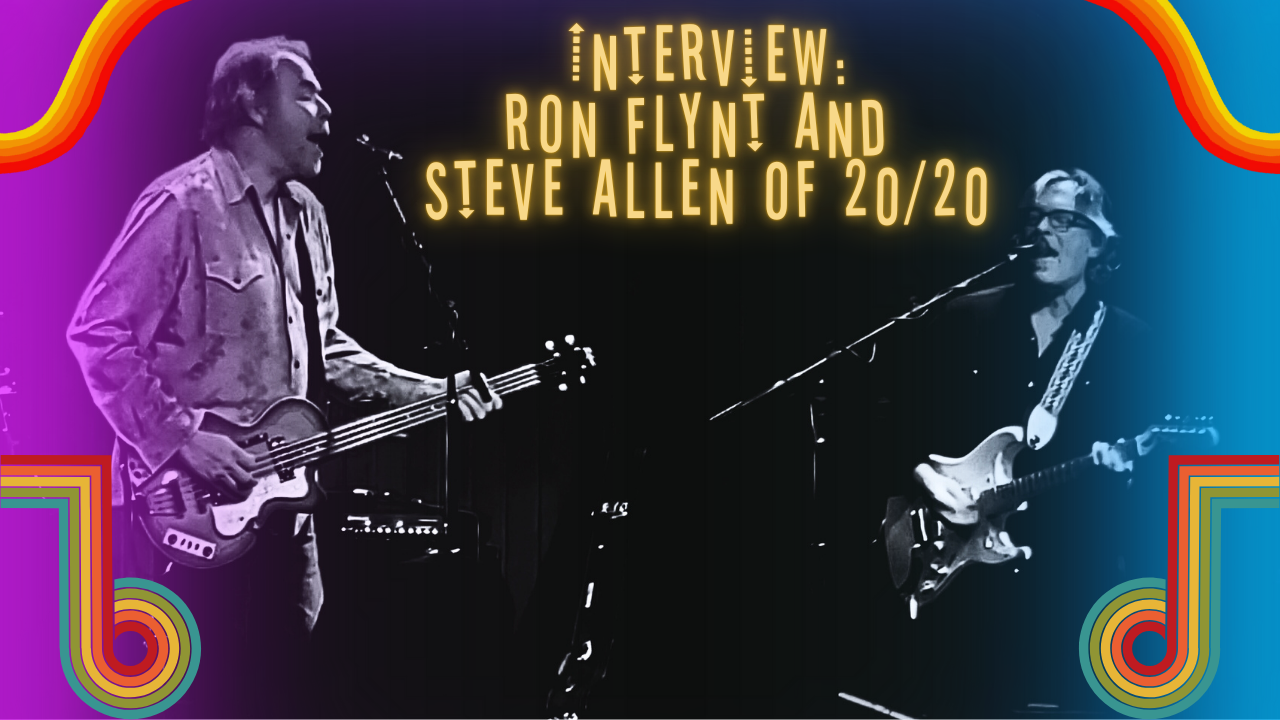
20/20 are a power pop band who were formed by Ron Flynt and Steve Allen, two friends from Tulsa, Oklahoma. The two made their way to California for bigger, better opportunities. In 1977, they signed a record deal with legendary power pop/punk rock label Bomp Records, named after the 1961 Barry Mann novelty doo-wop song “Who Put The Bomp”, and they released a single, “Giving It All” b/w “Under The Freeway”, with them before moving onto Portrait Records and releasing their 1979 self-titled debut and their 1981 sophomore album Look Out!. They had released one more album in the 80s, Sex Trap before breaking up. Forty years pass and they decide to reunite and record another album, this time with Texas-based Spyderpop Records, a partner label with Big Stir Records. That album is called Back To California and it’s coming out on 17 January 2025 on vinyl, CD, and streaming. For now, you can listen to the singles “Back to California” and “Laurel Canyon”, which you can stream below.
We’re very lucky to have Ron and Steve on the blog to talk about their story as musicians. It’s not every day you get to talk to musicians who made music during the classic rock era, so this is a real treat for me and for you too!
Angie: How did you get started as musicians?
Ron: Well, I first started playing music in church when I was a little kid. We had belonged to a small Baptist church and they would dragoon anyone that could play a little bit of an instrument to help with the Sunday services. And then after that, like a lot of people in my generation, when The Beatles played on Ed Sullivan in ’64, that was a real life changing experience for me and I’m sure that you must have heard this from a lot of people, because it was very impactful and then Steve and I met shortly thereafter playing baseball in the 5th grade and then we started playing together.
Angie: Awesome, so what was it like growing up in Tulsa?
Ron: Well, I imagine it was very much like most of the US. Tulsa’s a fairly cosmopolitan city. Large oil industry, lots of infrastructure support there. So, I imagine it was much like everywhere else. AM radio at the time was where you got most of the music. There were a few television channels, not like there is now. It was a peaceful growing up experience for me and for most of the white people in Oklahoma, that’s how it was. Maybe not so much for minorities.
Angie: How did you get into power pop?
Ron: Well, that’s kind of an interesting question, I don’t know that I ever really thought I was intentionally doing that. It was music that I liked at the time, when I was still in music school at Oklahoma State, there wasn’t actually a lot of the music that I really liked on the radio, but then a fellow Okie Dwight Twilley had a fairly large hit with the song “I’m On Fire” and a great record called Sincerely and that was different. It was sort of a game changer. In some ways it was like permission to play and write the kind of music that I really liked. Then there was Dwight and the Flaming Groovies and then there were a few other bands at the time and then by the time I moved to Los Angeles after I got out of music school, there were a lot of people fishing from that same pond, if you will. So, then the term power pop got retroactively applied to what Steve and I and Mike Gallo, the three of us were doing at the time.
Angie: What brought you to California?
Ron: Well, Steve. Steve moved to Los Angeles before I did. I was still in school and he had made a single “Giving It All b/w “Under The Freeway” and was just about done getting a deal with a little label called Bomp Records and by the time I got out of school that June, he and Mike Gallo had sort of already got the band started. I don’t know whether they had the name yet, maybe they did, but honestly I don’t remember. But when I moved out there, Steve was in a small apartment at Hollywood and Vine and they let me sleep on the floor there for a couple of days and then I got a place. Steve and I had already been playing together since we were in the 5th grade, all through middle school, high school, and university. So it wasn’t hard for us to start playing together.
Steve: I had not graduated college, but I had always been playing in bands and things and then everybody, my girlfriend went to England, I moved back to Tulsa for a minute and went, I gotta get out of here. It’s time for me to go on my own to California and just see what it’s like and see if I can get something going. So I went there with some songs and all of my gear, not having a real plan, blind ambition.
Angie: How did you get started as a musician and get into rock and roll?
Steve: I wanted to play the drums because of a band called The Ventures and I love surf music. It was the coolest thing, I was born in ’53, so it was the coolest thing then. And I heard the song “Telstar” by Joe Meek and [The Tornados].
Angie: Yeah! I wrote about him in my book. I write about classic rock and true crime and yeah that story’s crazy!
Steve: That song blew my mind as a child, it was like I felt it was made for me and all that sci-fi sound and the kazoo playing the solo, and I found out later that it was an organ. Anyway, all those kind of things, but there was a lot of Fabian and Bobby Rydell, that was what was going on. And then there would be a few rock and roll songs, love The Beach Boys and everything, but I really wanted to start playing guitar as soon as I saw The Beatles on Ed Sullivan, because that music just blew our minds. This is the cool thing, I had my cousin Billy’s little Silvertone guitar and so my parents took me for lessons down the street at a place called The Guitar House in Tulsa. At the group lesson the teacher was Eldon Shamblin from Bob Wills and his Texas Playboys and so I had a good teacher, is what I’m saying. And then it was trying to figure out songs on my own and then I hooked up with Ron and we both tried to figure out songs on our own. But I wanted to make music, that was the driving force.
Angie: What was California like in the 70s and 80s?
Steve: It was big (laughs)! It’s still big, but coming from Oklahoma, and we had both played all over the state, done what we thought we could do there. Like everybody went out to LA from Oklahoma and lots of other states, obviously, to try and make something happen. I had written a bunch of songs so I was pitching those around. It had been kinda dormant, I got there at the end of ’76 and because of The Ramones and bands from England like The Sex Pistols hadn’t even had a single out, it was all kinds of new things happening and then people in LA. Rodney on the Rocks, Rodney Bingenheimer had a lot to do with getting LA going into a new creative area, I think. But also navigating that town, going through all the stuff, crummy jobs for a while. That’s kind of what it was like.
Angie: So you’ve moved away from California, Ron’s in Texas, you’re in Tennessee. What brought you to these different places?
Steve: I was in LA for 15 years and then what brought me to Nashville, Tennessee was that my wife had a real job at Warner Brothers Records and she was able to get transferred to Nashville, which for me after 15 years in LA, I really miss the seasons and kinda what Oklahoma was like and I wanted to be in a new music town, so it worked out perfect.
Ron: I think I stayed in California for about seven years or so and when 20/20 had stopped playing, I didn’t really have a plan at all so moved back home to Broken Arrow and met my wife to be just a couple of weeks after landing there and then I guess we were in Oklahoma for a while and then we moved to Dallas, Texas, where we stayed for a couple of years and then we found our way to Austin in ’95 and Austin’s a great music town, it’s been really good for me. I have a recording studio, that’s my day job. And I guess I’ve had this thing, for I don’t know, been in this location for 20 years or so. Austin is full of people who make records so it’s been good to still play and be involved in the music business on the creative side. And Steve and I have made a couple of records on the in between the new one, Back to California that I think comes out the 17th of January. That was a lot of fun, it was great to be back in the studio with Steve again. For me, there’s nothing better than making music with Steve. Because he’s a great guitar player, great friend, great songwriter, a hell of a singer, a good studio guy. So it all lined up for us at that point.
Angie: What are your favourite songs on the album?
Ron: I don’t like any of Steve’s songs, nah I’m just kidding. I like most of them. I like all of them. I’m fond of “Back to California” and “Laurel Canyon” quite a bit. Steve, I don’t know, what’s your favourite song?
Steve: I like all of them too, like they’re our children. But we haven’t had it out there enough to see what enough people react to. So we’ve been picking the first two songs because we like them, for the first two singles. But I kinda thought one of the first songs we did, “Why Do I Hurt Myself”, I kinda thought people would jump on that, but no one has kinda specifically mentioned that one. So that’s just how it goes, you know? They mention different ones. But we both like them all.
Angie: What inspired the sound and lyrics of the album?
Ron: I think the sounds come from classic sounds, sounds of vintage guitars, vintage amplifiers, some vintage synthesisers. The vocal sound comes from a combination of Neve and microphones and mostly, mainly preamps. The idea in terms of the mix was to create a soundscape where the players inhabit a specific space in both the audio and the panning soundscape and then to have it be powerful and youthful sounding, I think that comes from our drummer. Our drummer is my son Ray and he’s been a great addition to the mix because he didn’t follow some of the rules that other people follow. He just played with this exuberance and this flash that contributed to the sound. The lyrics, Steve and I worked on the lyrics quite a bit. I think each one of the songs is a separate narrative. It’s not a concept record in that each song is related to the other, but each one is a person telling a story.
Angie: Let’s go back to the beginning. Tell me about your 1979 debut.
Steve: Wow, a lot of people think it was our best album, like a lot of bands, the first album has definitely made the most noise, but we had been a band for a couple of years and played a lot of shows and have gone through a lot of material and when you get to play material live in front of people you can kinda hone it down and realise ‘oh this part would do this’, change the arrangement a little bit. So that whole process, we had 20 or 30 songs to pick from and we were still writing so I think like a lot of bands, we got the best of our sound and we had already made some demos that we knew we could better. And we got to go to Sound City Studio, which is just phenomenal. It’s really famous, it’s like where Tom Petty recorded a lot of his records and he had just done Damn the Torpedos. Fleetwood Mac recorded some of those really big albums. So we knew we were in a first rate studio and in those days the only way you could really record was somebody putting up the money. We were with Portrait on the first album and so we had a great budget and we picked Earle Mankey who was a really good kinda off the wall, he’d worked with The Beach Boys and a lot of people and he was our producer and we really only had two or three weeks. I think we recorded for two and then they mixed it.
Ron: Right, I think it was a total of 18 days.
Steve: Yeah and they have a beautiful big room, that’s where we tracked and we even brought in some extra guitars. I got a photo of us lined up with them. So everything we had, the best of what we had we were able to put on that album and we had just gotten the Prophet-5 synthesiser that Chris Silagyi played and songs like “Yellow Pills”, it’s a little heavier featured and that was a new song. So I think that record for us, we’re still trying to, that’s kind of the bar (laughs), isn’t that something? Your first album, that’s the bar you;’re trying to get to later. That’s what I would say.
Angie: There were some lineup changes after the first album and the band had broken up afterwards, what led to these changes and the breakup?
Steve: Take it, Ron (laughs)!
Ron: Well, I’m not exactly sure what happened in terms of personnel changes. It’s certainly a very common tale over the years that people come and go. The most significant change, Mike Gallo and Steve were the founders of the band and Mike had a lot to do with the overall concept as much as there was one. We landed on Joel Turrisi, he was a good friend and a great drummer. He was a natural fit to start working on the second record. When you go on the road and we did some travelling, sometimes some folks like it, other folks don’t. Everyone in the music business it seems like is trying to scratch something of their own. Something that they can put their name to. So that probably explains some of the other personnel changes. To say that we broke up, I don’t know if we ever really broke up, we just kinda stopped. The music business has an ebb and flow to it and sometime you’re the hot thing and sometimes you’re not. Once things cool off it can be tricky to get things going again. So Steve and I, Steve may feel differently, but I don’t feel like we ever really broke up, we just stopped and did other things and then we got back together.
Steve: Yeah.
Angie: What inspired you guys to reunite and make new music again?
Steve: Part of that was, I think we both wanted to again and we just hadn’t felt the calling yet and then when, I guess in the middle of 2019 we realised oh yeah, 2020 has finally caught up with us. That was 41 years ago, but I guess we’ve been together since ’77 so we’ve been a little longer. And I’ve come out to Ron’s studio in Austin several times. We did a single for a small label, Lou Reed’s song “I Can’t Help It”, I think was it? So anyway, with 2020 coming up, people were asking us things and potential gigs were coming up. We thought well shoot, we might be playing a bit in the year 2020. I asked if he had any new material and he did and I did and so we both kind of were well let’s get together and see what we can write and start to play a little bit. So we did that in the fall of 2019. I think I came out there a couple of times and we laid down a lot of the basics for this album and then I came out a couple of more times and early 2020, when we continued to do that and we wrote a couple more tunes and we were booked to play The Roxy in LA in April of 2020 and then the pandemic hit in March. So I have a studio of my own, a small studio in Nashville. So we just said let’s make a whole album because were were thinking of doing a single and having a couple more songs, maybe an EP, but with that extra time we just kept writing and recording the current album.
Ron: Steve and I, we played a show with Dwight Twilley in California and Steve played me a couple of bits of new songs that were just great and it was inspiring for me that it felt like a little bit of a spark and then Steve and I playing with Dwight, that was a big deal for us too. It was so easy and it was some of the best, most fun gigs. I did a bunch of gigs with Dwight. The best, most fun ones were the ones I did with Steve.
Angie: How do you think you’ve evolved as musicians?
Steve: We’re both still trying to learn how to play better and progress, but because we’re both working musicians and I have a studio where I was producing and recording other people’s projects in Nashville, we both have learnt how to play more subtly. Like with 20/20 we were early 20s and the fun thing that was happening and all these different influences so we were more rockers and thrash rockers so with time going on and being a lifelong musician, the subtleties creep in and you maybe learn how to play a little more instruments too and so I think we’ve grown in that way where when you’re younger you’re hitting the guitar so hard you break strings. Later on you learn not to do that so you have more of a touch. If that’s what you mean in that respect, we are both more seasoned musicians.
Angie: What has changed about the music industry since you’ve started? What’s better? What’s worse?
Ron: Well, streaming services have had a huge impact on most musicians. Most musicians that make records. I’m not a Spotify guy, I prefer just to buy the music, but it’s a miracle to me that everybody all over the planet can have access to this vast library of music at their fingertips, at their beck and call. That’s great for a lot of people. Who it’s not great for is the working musician. The deal that was made between the majors and Spotify and the others is horrible for us and well, I’m talking about it, the sound of those streaming services is nowhere near the sound of a high quality CD or high quality piece of vinyl, it’s just not. And I think that one day, and maybe that day never comes, but maybe it comes soon, people will say, ‘I don’t want this mediocre sound. I have great gear at home to play music through. Maybe I’ll just start buying CDs and buying vinyl again and enjoy the tactile experience of music.’ So, it’s the big change I think.
Steve: What hasn’t changed is more of the question. Everything’s changed.
Angie: How did you get in touch with Big Stir?
Steve: Big Stir… Well we knew about Big Stir because they did a tribute album to 20/20 and they did a really great job and we’d never really had a tribute album done so it was great to hear all the different versions of our songs so I became more aware of them then and I knew that they really liked 20/20 and then Spyderpop Records is based out of Texas, so it’s really a combination of the two labels. So Spyderpop is the main label we’re signed to and Big Stir is the distribution part. And they work so hard, I’m impressed! I mean they’re on it! We have really the best of both worlds for the we’re called power pop bands, I think. And we had a lawyer who helped us figure out the best combination.
Ron: Yeah, the Big Stir guys, like Steve says, they’re on it and they’re energetic and they’re well known within the genre and the Spyderpop guys, they’ve gone out of their way to make the promotional tools available for the record and I couldn’t be happier. Even CBS, I never thought that they really, I think there are some people who like us and got it, but this situation, I couldn’t be happier, they’re both just terrific.
Angie: What do you think of young people getting into 70s and 80s music?
Steve: Come on (laughs)! Bring it on! Are they? I know that young people have gotten into, I’m in Nashville so there’s so many, when I first moved here so many young people were into early country music and really making those sounds come back to life and then that has changed. So in the rock world it seems like anything from the past that somebody thinks is cool or they like or they want to kinda recreate or bring back in a new way seems to be going on. So is there interest in that in your eyes?
Angie: Yeah, definitely. I’m 30 and I was in this community on Tumblr and then it moved to Instagram, of classic rock fans and it seems to be pretty big among young people, but I don’t think it’s mainstream or anything.
Steve: Right. Maybe that’s because we’re in an age where rock music has been out so long and so many different trends have come and gone that they kinda pick out, I’m sure Led Zeppelin bands just love that the most or whatever. We’re still Beatle kinda freaks at heart, the English Invasion hit us heaviest of anything.
Ron: There are new bands that are kinda going down that road and there are established bands that use those same influences like the Lemon Twigs, they are so poppy and so to me, right on it in those influences. And you have another act like Bleachers, those guys are working that same sort of positive vibe. So yeah I think there are a lot of young people really getting into it.
Angie: What is your proudest accomplishment as musicians?
Steve: To have been able to be a musician pretty much all my life and to have left behind some music that people still here who maybe ultimately will hear beyond our lifetimes, you know? That’s pretty good, huih?
Ron: I’m all the way with you. To be a working musician and support a family by being a musician is no small thing. I mean it’s hard under the best of circumstances, but it’s so incredibly rewarding when something happens and you get a little recognition or you’re able to go year after year paying the mortgage, keeping the lights on, that’s no small thing. And I get to play with somebody like Steve. Steve has always been the best guitarist that I know, and I know one or two. So that’s a proud achievement I think.
Angie: How often do you find musicians have to leave the industry and go back to day jobs?
Ron: Constantly.
Steve: Yeah. I’ve done it a couple of times, never too serious (laughs). There was a point where I was in LA and Ron had left and I had a little studio, but then I took a part time job at Warner Brothers where my wife worked and I had a baby. So real life, unless you’re on a certain level where you’re gonna be doing music no matter what, but every musician I know has to play different styles of music or go off or get a studio or do whatever, but you know, my mentor Eldon Shamblin of The Texas Playboys tuned pianos in Tulsa and he became a plumber for a while and then he was back on the road with Merle Haggard. So it can be that kind of journey and the exceptions of Bruce Springsteen and people like that or Cheap Trick, who never stopped really. There’s so many different levels.
Ron: I think to be a working musician today you kinda have to commit to it and not waver too much. I was working with a guy the other day, I guess he’s in his 60s, really talented and does well, but he says the reason why he does well is because he’s not fit for any other job. He couldn’t get a job at Home Depot, they wouldn’t hire him, he wouldn’t be happy, but he’s committed to it and as far as the nature of that commitment is you gotta go all the way in. You gotta be willing to drive 200 miles to make $200, which doesn’t sound like a good economic tradeoff but if you see what I mean, you just have to be committed. Also, I might get that it sounds like work, but it’s really not work. It’s wonderful, for me to get to come to work in a recording studio every day. I’m just the luckiest guy in the world.
Angie: What advice would you give musicians starting out today?
Ron: Well, I would say a good healthy dose of music theory, maybe a couple of business classes, and follow your heart, do what you believe in, lay off the drugs, go easy on the whiskey, and stick with it. Try to be the, what is that saying about? Buy the cheapest house on the best block in the neighbourhood. Try to work with musicians that are better than you. How does that sound Steve?
Steve: I think that sounds pretty good. I think it has to be like a calling. That you’re possessed to do. Those seem to be the guys that I get to play with some really great musicians here in Nashville and everybody on every level, whether they’re doing a day job and some of the time, but it’s a calling. You have to really be possessed. I think like a lot of things, like trying to be an actor or an artist or anything. It’s almost like that’s what you’re supposed to do this lifetime as much as you can and take it to the highest places you can. But just to fulfil that somehow, it’s kind of a general thing.
Ron: People say that if anyone can talk you out of doing it, then you’re not supposed to be doing it. You just have to possess like Steve says…
Angie: Very wise words indeed.
You can follow 20/20 on Facebook and you can read their bio on the Power Pop Hall of Fame.
Liked this blog post and want to support my work and see more? Donate to The Diversity of Classic Rock on Patreon or Paypal or follow me on Facebook, Bluesky or Instagram, buy my book Crime of the Century, click the follow button on my website, leave a nice comment, send your music or classic rock related books for review, or donate your art and writing talents to the blog. Thank you for your support! If you donate any amount of money to my Patreon or PayPal, you’ll get a Crime of the Century ebook, so it’s basically pay what you can! The best deal you’ll get on the book and you won’t find this deal anywhere else! I just want to give back to my readers and say thank you for your support.
Leave a Reply