


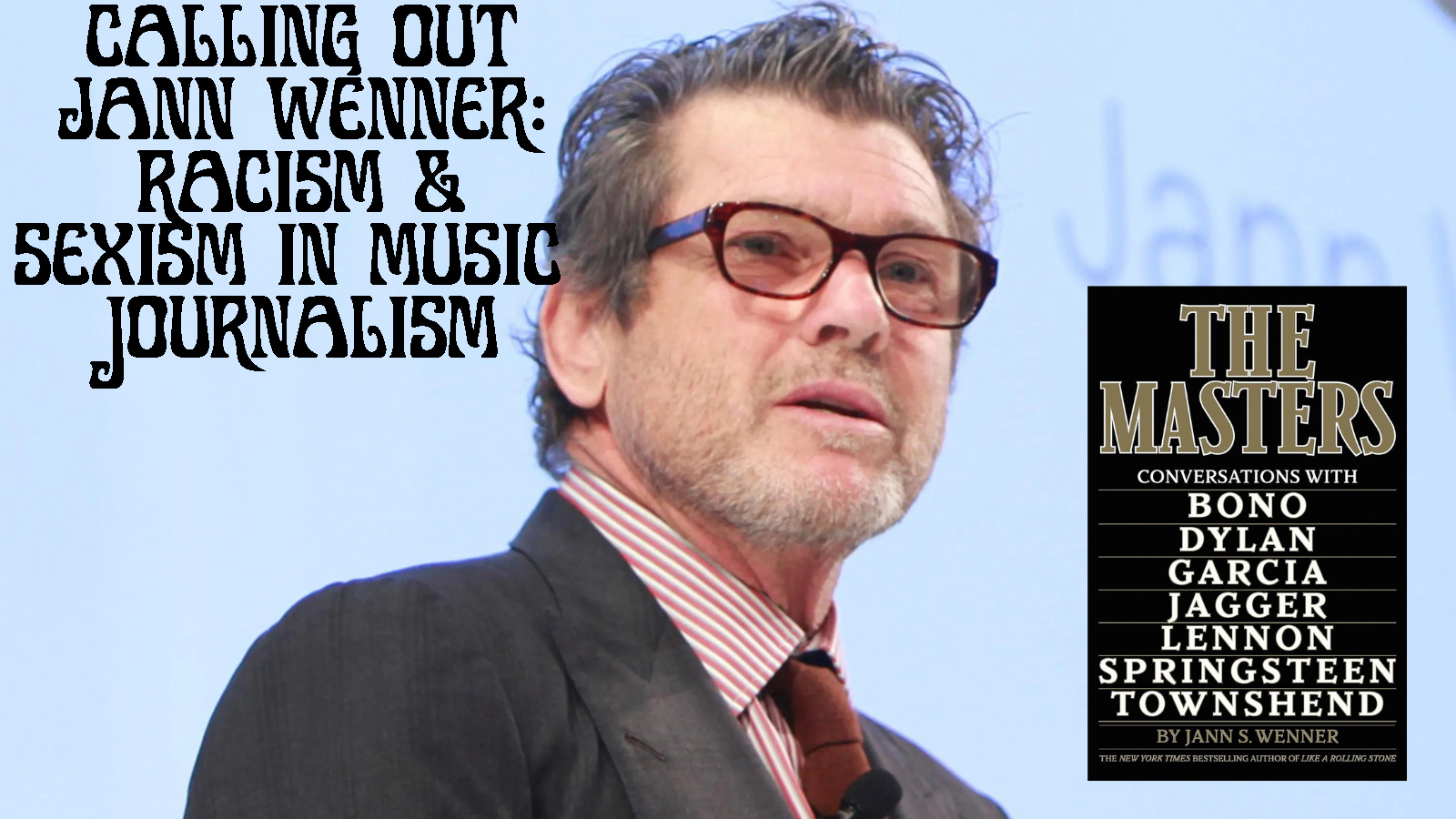
As a classic rock fan, I have had a lot of of criticisms of Rolling Stone magazine, the publication co-founded by Jann Wenner. He was also on the Rock and Roll Hall of Fame board, until he was removed from the board after this controversy. I never felt like either of these institutions were truly representative of all of classic rock (I wrote a whole series about Rock Hall snubs: part 1, part 2, part 3 – the latest instalment went viral earlier this year) and I always found their top 100 or whatever lists were full of snubs and they overrated and underrated a lot of musicians. I take their ranked lists about as seriously as The Grammys. I like what I like and I am confident in my opinions and music taste. To each their own, but I don’t really care much about what the narrow minded establishment have to say. Even after he left Rolling Stone in 2019, I still don’t like them. As part of the classic rock community on various social media platforms, I saw a lot of people talking about Jann Wenner’s sexist and racist attitudes as demonstrated in interviews done to promote his latest work, a book called The Masters, which is a collection of interviews he did with seven classic rock musicians over the years. Similar #OscarsSoWhite controversy, people noticed that the musicians included in this new book were very white and male. Naturally, New York Times journalist David Marchese asked Wenner why there were no female or black musicians mentioned in the book:
“There are seven subjects in the new book; seven white guys. In the introduction, you acknowledge that performers of colour and women performers are just not in your zeitgeist. Which to my mind is not plausible for Jann Wenner. Janis Joplin, Joni Mitchell, Stevie Nicks, Stevie Wonder, the list keeps going — not in your zeitgeist? What do you think is the deeper explanation for why you interviewed the subjects you interviewed and not other subjects?”
He responded with this:
“When I was referring to the zeitgeist, I was referring to Black performers, not to the female performers, OK? Just to get that accurate. The selection was not a deliberate selection. It was kind of intuitive over the years; it just fell together that way. The people had to meet a couple criteria, but it was just kind of my personal interest and love of them. Insofar as the women, just none of them were as articulate enough on this intellectual level.”
Marchese pushed back with “Oh, stop it. You’re telling me Joni Mitchell is not articulate enough on an intellectual level?” and Wenner dug himself into a deeper hole saying:
“It’s not that they’re not creative geniuses. It’s not that they’re inarticulate, although, go have a deep conversation with Grace Slick or Janis Joplin. Please, be my guest. You know, Joni was not a philosopher of rock ’n’ roll. She didn’t, in my mind, meet that test. Not by her work, not by other interviews she did. The people I interviewed were the kind of philosophers of rock. Of Black artists — you know, Stevie Wonder, genius, right? I suppose when you use a word as broad as “masters,” the fault is using that word. Maybe Marvin Gaye, or Curtis Mayfield? I mean, they just didn’t articulate at that level.”
When Marchese pushed back and said hey, you’re not giving black musicians a chance he said:
“I mean, look at what Pete Townshend was writing about, or Jagger, or any of them. They were deep things about a particular generation, a particular spirit and a particular attitude about rock ’n’ roll. Not that the others weren’t, but these were the ones that could really articulate it.”
When Marchese asked if it was maybe to do with his interests, he said:
“That was my No. 1 thing. The selection was intuitive. It was what I was interested in. You know, just for public relations sake, maybe I should have gone and found one Black and one woman artist to include here that didn’t measure up to that same historical standard, just to avert this kind of criticism. Which, I get it. I had a chance to do that. Maybe I’m old-fashioned and I don’t give a [expletive] or whatever. I wish in retrospect I could have interviewed Marvin Gaye. Maybe he’d have been the guy. Maybe Otis Redding, had he lived, would have been the guy.”
This is all very yikes to say the least: tokenising, minimising accomplishments, condescension. A foot in mouth, mask off moment, especially in the last quote. Very narrow minded, exactly what I’d expect from an old fogey stuck in his ways. Not a surprise that Rolling Stone and the Rock Hall suck. He made a crappy apology and tried to backpedal with:
“In my interview with The New York Times, I made comments that diminished the contributions, genius, and impact of Black and women artists and I apologise wholeheartedly for those remarks. The Masters is a collection of interviews I’ve done over the years that seemed to me to best represent an idea of rock ‘n’ roll’s impact on my world; they were not meant to represent the whole of music and it’s diverse and important originators but to reflect the high points of my career and interviews I felt illustrated the breadth and experience in that career.”
To quote The Brady Bunch: Sure, Jann. Sounds like a statement a crisis communications PR person wrote to attempt to damage control, but it was too late. One of those sorry I got caught. It’s lip service. It’s performative.
Rightfully so he was under fire for these comments with promotional events for his book being cancelled and him being kicked off the board for the Rock and Roll Hall of Fame. His book is still going to be released later this month and he’s filthy stinking rich, so don’t act like he’s completely cancelled. He’s being criticised rightfully and he’s experiencing the consequences of his actions.
Keith Boykin made a great response to his comments on Twitter that is worth giving a listen.
But first, let’s take a step back to understand the issue and I’ll chime in with my opinion.
My thoughts on The Masters
The book is a collection of interviews with seven musicians that Jann Wenner particularly likes, if I’m being charitable. Those musicians are Bono, Bob Dylan, Jerry Garcia, Mick Jagger, John Lennon, Bruce Springsteen, and Pete Townshend. I like most of these musicians (not a U2 fan sorry – Thin Lizzy are better! – and here’s a hot take, I could never get into the Grateful Dead), but I can definitely see how people are disappointed with how limited of a scope the book has and I definitely feel that way too as someone who writes about diversity in classic rock. The concept is giving white dad who likes classic rock. Nothing wrong with that I guess, write what you wanna write, it’s your prerogative, but I am just tired of seeing the same musicians being talked about ad nauseam. I want some variety and something fresh. I don’t listen to classic rock radio because it’s the same old playlist decided by some people in some corporate office, not true classic rock fans.
Classic rock radio, Rolling Stone, and the Rock Hall are definitely a limited view of the classic rock era. There is so much more to the 60s and 70s than these musicians and ones played on the radio and that is the reason that I started The Diversity of Classic Rock in the first place. I wanted to tell the stories that were less often told and talk about classic rock from a different angle and give a more comprehensive view of the era and introduce people to some deeper cuts and under-appreciated music. If there’s one takeaway that people get from this blog, it’s that classic rock is more diverse in people and sound than you may think. Women, non-white/mixed, LGBT, and disabled musicians have been in rock music from the start. Sister Rosetta Tharpe, Big Mama Thornton, Etta James, Chuck Berry, Bo Diddley, Little Richard, Fats Domino, Larry Williams, Little Willie John, James Brown, Frankie Lymon & The Teenagers, Screamin’ Jay Hawkins, Esquerita, Cliff Richard, Link Wray, Cherry Wainer, Kay Starr, Wanda Jackson, Les Paul & Mary Ford, Johnnie Ray, Bobby Marchan, Liberace, Johnny Mathis, Bill Haley, Ray Charles, Paul Anka, Dick Dale, Ritchie Valens, and many more. These musicians paved the way for the future generations of female, gay, and non-white/mixed musicians that would come in the 60s, 70s, 80s, and beyond.
In and of itself I don’t think a compilation of interviews with a select number of musicians that the journalist likes is a bad idea. Different people like different things. Not every classic rock book is going to be my or your cup of tea and that’s okay. If I get a hold of the book at the library, I might look at the interviews with Pete Townshend and John Lennon since they are two of my favourite songwriters of all time, but I wouldn’t purchase the book with my own money especially given the insensitive comments Wenner made. It especially hurts as a mixed race female classic rock historian, storyteller, commentator, and writer in a field that is male dominated. I’m sick of having to work twice as hard to get half as far – like women and people of colour have to be exceptional in order to be considered on the same level as a mediocre white man, if they’re lucky. It’s mad! Think about how many classic rock books are written by women compared to ones written by men. And then how many of the books written by women are about female musicians? I’m tired of being pigeonholed and tokenised. Just let me write what I want to write and don’t limit me! It’s insulting and condescending. He’s saying this as if Joni Mitchell, Grace Slick, Stevie Nicks, and Stevie Wonder aren’t alive. Sadly, Janis Joplin, Marvin Gaye, and Curtis Mayfield aren’t here to defend themselves. I don’t know how you can listen to What’s Going On and think that isn’t genius – that’s one of the best political albums of all time. I think it’s easily on the same tier as Tommy. I don’t know how you can purport yourself to be a classic rock expert and put these musicians down and say they’re not at the level of Bob Dylan, Mick Jagger, Pete Townshend, John Lennon, or Bruce Springsteen. I get that everyone has their favourites, but there’s no need to put other musicians down to support the ones you love. I’m sure the musicians he interviewed think (or thought, in the case of the ones who are no longer with us) very highly of female musicians and musicians of colour.
We can find the roots of this attitude in the historic and continued segregation of the pop charts. Ever since the Billboard Charts were a thing, you had the pop charts and the R&B charts with the pop charts being dominated by white musicians, with the occasional black musician getting a crossover hit and you had the R&B charts, which is where the black musicians’ records would go. The R&B charts also went by other names like the Harlem Hit Parade, Race Records, or Black Singles. But really what is the difference between the R&B and pop stuff? A lot of times I found a lot of influence from one in the other and vice versa. White musicians ripped off from black musicians and black musicians respond with their take on what white musicians were doing. There was cultural exchange going on and it increased after the British Invasion because British rock musicians cited black rock pioneers and R&B musicians as their biggest influences and from there, white American musicians got influenced by that and black musicians covered British rock songs and so on. What really is the difference? You notice it today. The R&B charts now are really just black pop stars and rappers. There’s nothing R&B about it. Beyonce is just as much a pop star as Taylor Swift. Rihanna is as much a pop star as Lana Del Rey. Janelle Monae is as much a pop star as Billie Eilish.
To minimise the black (and LGBT) influence on popular music is ahistorical and inaccurate. Look at the most successful songwriting teams of the 60s. You had Lennon & McCartney on top, but not far behind you had Holland/Dozier/Holland and Smokey Robinson of Motown. The Beatles and The Beach Boys definitely wrote songs for a generation, but so did Holland/Dozier/Holland. Easily I’d say Holland/Dozier/Holland are on the same tier of songwriters as Lennon, McCartney, Wilson, Jagger, Richards, Townshend, and Davies. They’re equals in my opinion. All brilliant.
Phil Lynott of Thin Lizzy was a published poet and in my opinion the greatest Irish writer of all time. Gil Scott-Heron was a poet and graduated with an MA in Creative Writing and was a lecturer at a university. Rose Simpson of the Incredible String Band also has a PhD. Jackie Fox of The Runaways worked as a lawyer. Sure Jann Wenner may not have interviewed them, but to say there aren’t any musicians of colour or women who are as articulate as the musicians he interviewed is absolute balderdash. Buffy Sainte-Marie is a Native American singer-songwriter, activist, and has a PhD.
Even then, formal education isn’t the be-all end all of intelligence and being articulate. David Bowie left school at 16 and if you watch or read any interview of him, you can easily tell how smart and well spoken he was and he also stood up for black musicians, calling out MTV for being racism towards black musicians.
How diverse is The Masters?
I don’t want to say there’s no diversity at all to be found in the list of 7 musicians. Yes, on the surface it’s all white men, but I think they definitely have more diversity than people think even if it’s not a complete picture of classic rock. Let’s take a look at sexuality, nationality, culture, age, and genre.
As far as sexuality goes, only one of them is openly bisexual and that is Pete Townshend (who walked back his coming out, but it’s safe to say he’s bisexual). Mick Jagger’s definitely bicurious. If we’re being generous, we could also say John Lennon might have been bisexual because Yoko Ono said it in an interview, but John never came out. However, who’s to say he mightn’t have come out in the 80s or 90s like some of his contemporaries did?
As for nationality, only three nationalities are represented: Irish, American, and British. Not surprising because non-Anglosphere musicians don’t really get much airplay unless they sing in English. The lone Irish musician is Bono, who was born in Dublin. The Americans are Bob Dylan (born in Minnesota), Jerry Garcia (born in California), and Bruce Springsteen (born in New Jersey). At least they were from different regions. The Britons are Mick Jagger, John Lennon, and Pete Townshend. All are English with two from the London area and one from Liverpool. No Welsh or Scottish musicians (not surprising).
As for culture: we see Irish represented a lot. Besides Bono, John Lennon, Pete Townshend, Bruce Springsteen, and Jerry Garcia are/were of Irish descent. Jerry Garcia was half Spanish, his father was from Galicia. He also had Swedish ancestry. Bob Dylan’s Jewish. Mick Jagger’s mother was born in Australia. Bruce Springsteen is part Italian and Dutch. This section feels like grasping at straws almost because I don’t know how much impact those cultures had on them. Some more than others. I don’t want to minimise Bob’s Jewish heritage or Jerry Garcia’s Hispanic heritage as a Hispanic Jew myself.
Age: the musicians were born between 1940 and 1960. I’d say they’re all boomers even if not all are technically boomers, boomers grew up on their music, and I guess older Gen X grew up on U2. Lennon was born in 1940, Dylan was born in 1941, Garcia was born in 1942, Jagger was born in 1943, Townshend was born in 1945, Springsteen was born in 1949, and Bono was born in 1960.
What genres and classic rock eras are represented? Most of these musicians were popular in the mid-late 60s, but they remained popular in the 70s, Springsteen was popular in the 70s and 80s, and Bono is 80s. Genres? British Invasion, beat music, power pop, folk rock, psychedelic rock, hard rock, Americana, post-punk, and alternative rock. Bob Dylan and The Beatles have really diverse discographies, to be fair. Kinda limited, but what do you expect from Jann Wenner?
How could Jann Wenner have handled it better?
I guess if he was intent on talking about just those 7 musicians he could have just said “Hey these are my favourites and that’s why I’m talking about them. They’re musicians I particularly like and they resonate with me most and that is that.” Nothing wrong with that. No need to put down women or musicians of colour. Not everything has to be diverse, but think before you speak.
Statements like his are why I do what I do and why I continue writing The Diversity of Classic Rock. I want to tell more classic rock stories and give you the most comprehensive guide to classic rock. The one I wish I had when I was getting into classic rock. Even if I never get Rolling Stone level fame, I hope this blog has been helpful, informative, and entertaining to someone. Thank you for all the support.
I think it’s about time to stop listening to Rolling Stone and the Rock Hall. They are not the gatekeepers of rock and roll. They’re not the be all end all of rock and roll. Thanks to the internet, we have a wider diversity of perspectives. It’s time to move on.
Loved this blog post and want to support and see more? Donate to The Diversity of Classic Rock on Patreon or Paypal or follow me on Facebook, Twitter, or Instagram, click the follow button on my website, leave a nice comment, send your music or classic rock related books for review, or donate your art and writing talents to the blog. Thank you for the support!
You can also download the Brave Browser and earn tokens that you can donate to your favourite creators (including me!), donate to charity, or you can keep them for yourself and redeem them for cash. The choice is yours! Thank you!

Leave a Reply to Jim S.Cancel reply