
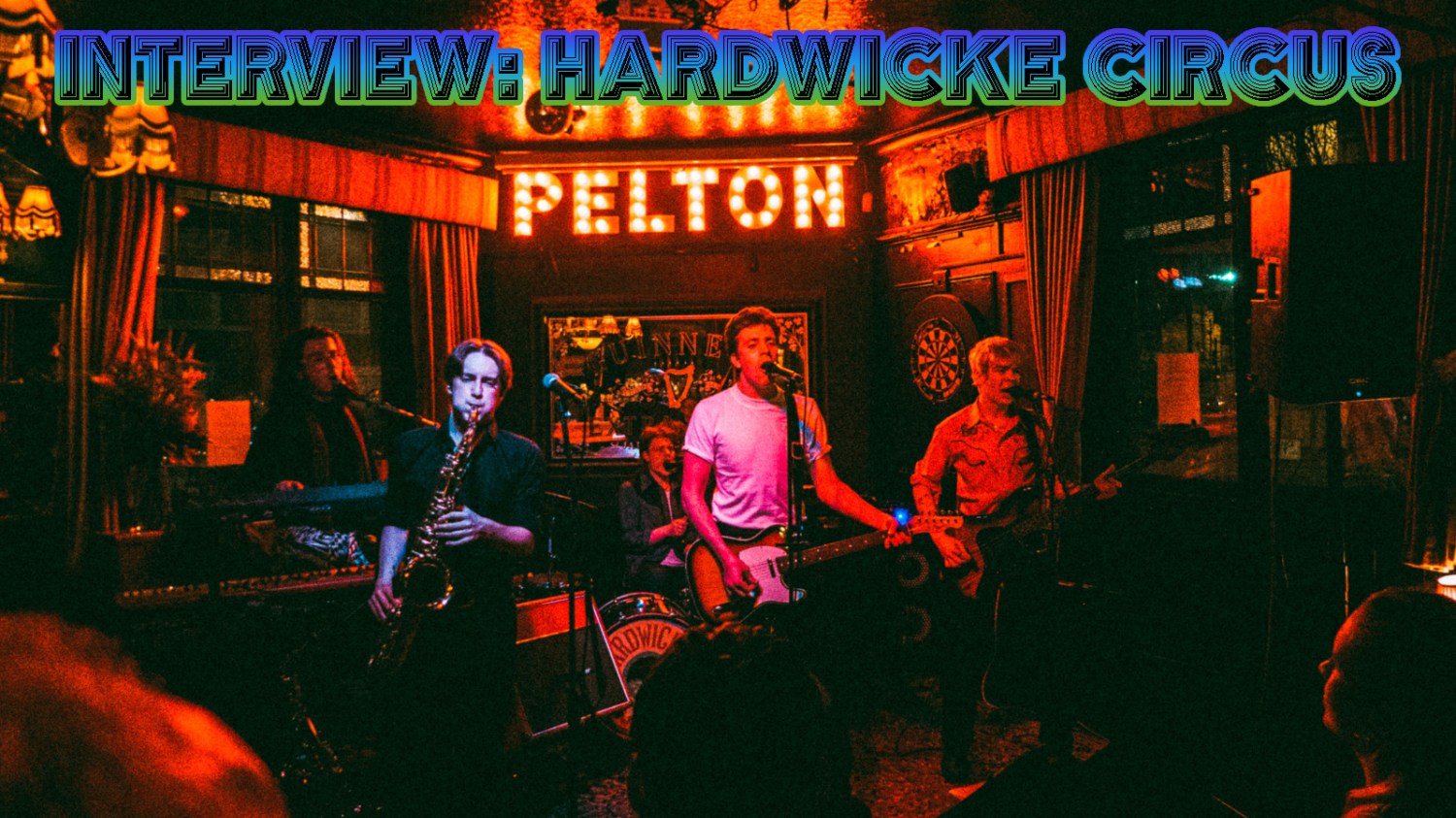

Hardwicke Circus are an accomplished classic rock inspired band from Carlisle, England, souding like a combination of Bruce Springsteen, Dexys Midnight Runners, and modern indie rock with bits of 60s folk, 70s punk, and 70s soul sprinkled in. They have released two studio albums, The Borderland and most recently, Fly The Flag. They also have released a live album At Her Majesty’s Pleasure recorded at a prison. They are a hardworking band and have played gigs all over the UK. Like many great bands, they were formed by two siblings, Jonny and Tommy Foster, who played music ever since they were young and turning that passion for music into a career, eschewing the typical going to college rite of passage and instead going on the road and making a name for themselves. A setback came when they were set to play the SXSW in 2020 – what could have been a big break, but because of the pandemic, that festival was cancelled. Still, they didn’t give up and they went from their touring band era to their recording band era and recorded The Borderland at a farmhouse in Yorkshire. Following in Johnny Cash’s footsteps, the band went on a prison tour, playing in 15 prisons in the UK and giving prisoners a feeling of hope. As we all know, music touches us and motivates us to keep going. Fly The Flag came out in June of this year and you can stream it now!
We’re lucky to have Jonny Foster from the band to talk about Hardwicke Circus and their journey. If you want to learn more about them, keep on reading!
Angie: How would you describe your music to a new listener?
Jonny: Somebody once described us as ‘Springsteen meets The Doors,’ which is a high accolade to live by. Hammond organ and saxophones hammer through a lot of the songs and we write about very ordinary day-to-day situations, so it’s not too much of a stretch to say that…. The saying goes that authors take small ideas and make them big, and songwriters take the biggest thoughts and put them into three minutes. You can hear that in the lyrics but also the music. Songs on Fly The Flag for instance range from Rhythm & Blues, Philadelphia Soul, straight down the line meat and potatoes Rock and more synth-based arrangements on “True Love & Near Misses”. It’s whatever you want it to be.
Angie: How did you get into classic rock and 60s and 70s soul music?
Jonny: We get turned on by songwriters. The anti-theatrical brigade. Naturally them instincts take you back to that period of time; Dylan, John Prine, Gordon Lightfoot. Even before that, all those Lee Dorsey/Allen Toussaint productions and Motown recordings have such a visceral energy we’ve seen replicated throughout them periods, performed by musicians on a circuit on another level. There’s a passion in them songs and in that attitude of time and it grabs you by the throat before it all got too corporate. That’s a language we understand.
Angie: What is the music scene like in Carlisle?
Jonny: I believe the great capital of London gets too much credit as the hub of the live music scenes. Quite often it’s oversaturated with the middle classes fapping off over blue-eyed post-apocalyptic jazz records rejected 60 years ago. Carlisle is the polar opposite. Music is very much treated as a luxury for much of the population and I totally get it. It’s an extreme kind of place, and I like extremes. They interest me way more than any of the supercilious crap I’ve alluded to already. It forces a growing number of bands to cast their own identity and that excites me. It might not be thriving like other cities but it’s definitely its own and we’re proud to be a part of it.
Angie: In what ways does your hometown shape your songwriting and band identity?
Jonny: I’m such a simp for the hometown but I really do believe in it. Fly The Flag, our new album, for example, is our testament to the positive power regional identity plays in shaping us. In ‘Our Town’ we talk about the deprivation many Northern towns are facing and the conflicting nature of being so detached from the rest of the country: “it’s a rough neck, blank cheque, silent howl, but I call it my town”. ’Night Train to London’ reflects our reluctance to even ‘get out’: “the ungodly hour, platform 4, steam trumpets reach Carlisle”. The album artwork by the contemporary British painter Humphrey Ocean is perhaps the clearest indication of our northern roots; the green and blue of Cumbria waving amongst Carlisle’s brutalist structure ‘the civic centre’.
Angie: How would you say your sound has evolved from your first album, The Borderland to this current album Fly The Flag?
Jonny: I’m reticent to land on that whole sound question because that’s the point of it evolving – it doesn’t actually land in one place, and I don’t want to think about it too much. I read this great quote which a friend shared online, something Picasso said: ‘I don’t search, I find’. And that sums it up perfectly, We’re constantly feeding ourselves different art and that allows us to gravitate to the natural place. The new destination. Organically.
Angie: Why was it like writing and recording Fly The Flag?
Jonny: Because of our hectic gig schedule, it was a very schizophrenic process in the sense that we’d perform four nights a week and then drive down to London for a few days recording. But it enhanced the album. Each song was treated as its own boss and so it allowed the music to go off in very extreme areas and from that I believe we have some really strong parts and arrangements. This process exposed all the places we need to go and the work we have to do.
Angie: What are your favourite songs on the album?
Jonny: I like ‘Bang My Head’ and ‘Can You Hear Me Now?’.
Angie: You recorded a live album at HMP Standford Hill, what was it like playing a live show there?
Jonny: It was an incredible experience, borderline religious in parts. We’d set up in the prison chapel and be met by 200 plus inmates with only three officers in the room. Of course, they’d have to lock us all in together – inmates, officers, ginger white boys with guitars – so you can only imagine the intensity of that moment when everyone realised what was going on. Then we started playing our songs and the reaction blew us away. Our songs resonated in a whole new light; the music developed a new direction. Inmates even jumped on stage to sing their songs for us, and we became their backing band. It was a real two-way connection, people from all walks of life finding a mutual place, brought together by the music. It demonstrated the positive power art can play. Upon leaving the jails we were told of improved wellbeing, we became pen-pals with many of the inmates and we had to go back.
Angie: Why did you play concerts at prisons, how did that come about?
Jonny: A very good man called Tim Cronin who worked inside UK jails arranging music, theatre, art classes, etc. discovered us at a show in Whitstable, South England and invited us.
Angie: Your manager, Dave Robinson has an interesting story, being around so many classic rockers and coming out of semi-retirement to manage you. How did he find out about the band and decide to manage you?
Jonny: His son Milo – unbeknown to us at the time – was in Camden Town going to a cracking chip shop across the road from a venue we were performing in that night. A pub called the Oxford Arms in the heart of Camden surrounded by all the tourist stalls. This was a gig we didn’t have that morning. It was our first trip to London, wide eyed and bushy tailed. We had gigs on the Thursday and Saturday, but on waking up Friday morning I was determined to get another gig that night. So I went around to 34 pubs asking for a gig – ‘thirty minutes before the DJ please’. About to give up with a moaning saxophone player behind me, I went into the 34th pub and the lady behind the bar says we could play. I rally the troops who at this point are scattered all over London, eating new food and seeing artwork that doesn’t exist in Carlisle. Anyways, we set up, got to 9pm and performed. In walks this guy with a camera who starts taking photographs. After the gig we exchanged numbers. Great I thought, we’ll have some photo evidence of our first trip to London. He asked if we’re playing in London again anytime soon and said he’d like to bring along his father. The next night we’re playing at The Dublin Castle on Parkway, and Milo comes along with his dad. We had a brief general chat, and drive home through the night, arriving at 8am to a text from Milo saying ‘my Dad is Dave Robinson, founder of Stiff Records’. That’s the luck fish and chips can bring.
Angie: You’ve been dubbed the hardest working group in the UK, what keeps you motivated?
Jonny: The music, the songs, the fans who are so supportive and always show up.
Angie: What are your live shows like?
Jonny: They’re the clearest snapshot of what the band actually is. A group of mates pushing each other to new places. It’s musical, intense and hilarious.
Angie: What have you been listening to lately?
Jonny: Creedence Clearwater Revival, The Grateful Dead, Steve Miller and The Band’s Rock of Ages.
Angie: What is your proudest accomplishment as a band?
Jonny: The prison tour is definitely up there. One guy said, ‘you made me forget where I was for an hour’. That’s the aim.
Angie: Any words for your fans?
Jonny: Money talks and people mumble.
You can follow Hardwicke Circus on Facebook, Instagram, Twitter, and their website.
Loved this blog post and want to support and see more? Donate to The Diversity of Classic Rock on Patreon or Paypal or follow me on Facebook, Twitter, or Instagram, click the follow button on my website, leave a nice comment, send your music or classic rock related books for review, or donate your art and writing talents to the blog. Thank you for the support!
You can also download the Brave Browser and earn tokens that you can donate to your favourite creators (including me!), donate to charity, or you can keep them for yourself and redeem them for cash. The choice is yours! Thank you!
 The Diversity of Classic Rock
[…] story), and Graham Parker. I also did some great interviews with up and coming British bands like Hardwicke Circus and The Crystal Teardrop and some great American classic rock inspired musicians like Michael […]
LikeLike