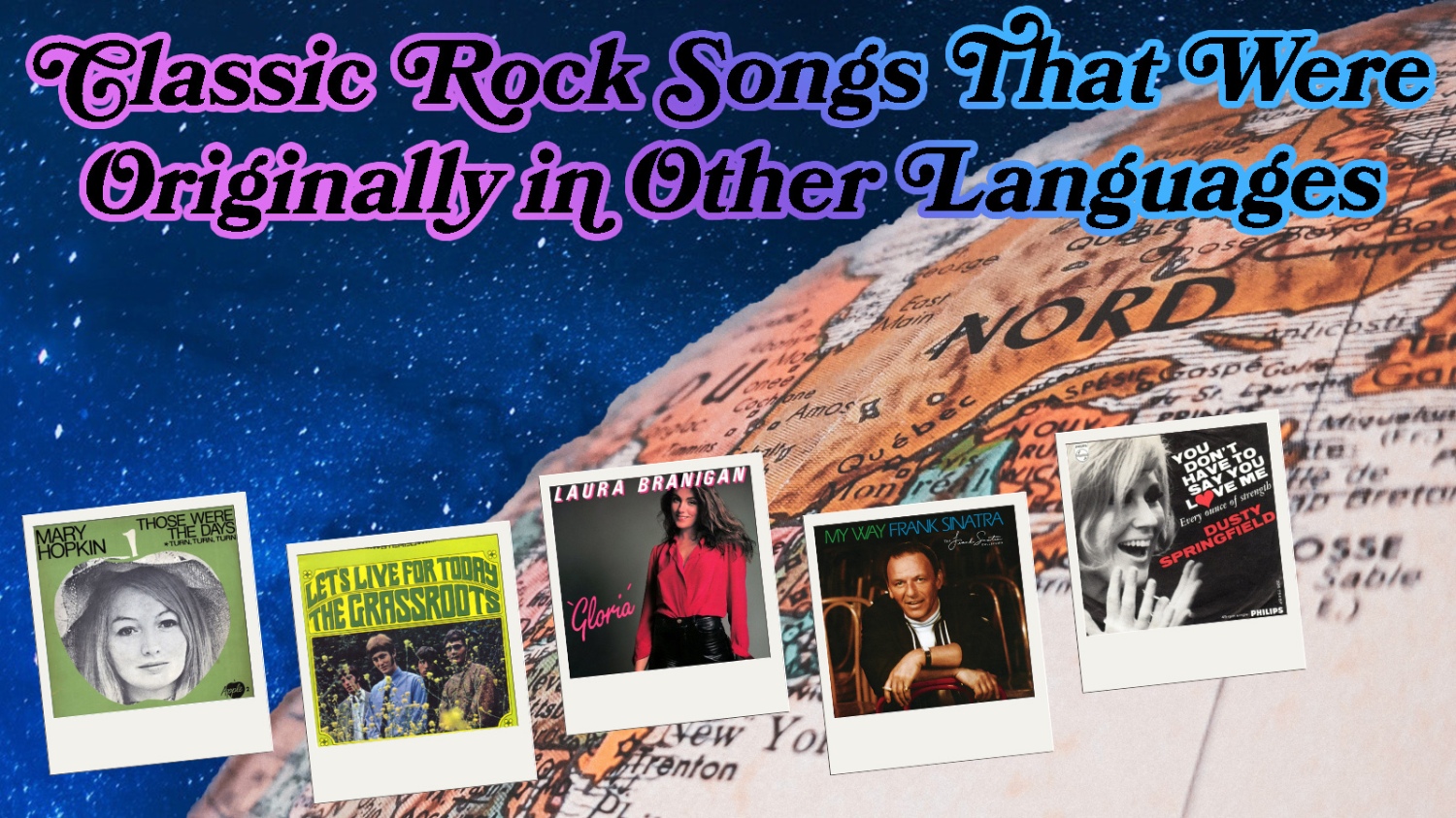

On The Diversity of Classic Rock, I like to talk about the diversity of sounds and influences of classic rock. People in the Anglosphere can be pretty Anglocentric with music and what I try to do on this blog is think globally and talk about music from the classic rock years from various countries. I wanted to write a blog post about classic rock and oldies songs that were originally in other languages. In other words, the English version you know and love is actually a cover! English may be the lingua franca of rock and roll, and it’s more often you’ll find musicians from other countries covering songs originally in English, but what about the reverse – English speaking musicians covering songs in other languages?
One thing that I learnt over the years is that world music and foreign language music has had some influence on classic rock. How? Well, in the United States, a lot of singers and songwriters came from recent immigrant backgrounds and from that, the culture of the old country had an influence on them. As well, in the classic rock era, a lot of musicians toured around the world and when you go to different countries, you meet musicians from those countries and listen to the radio and watch TV in those countries. In those days, popular culture wasn’t as homogenous so you got exposed to music that you wouldn’t hear as much back home. When doing research on Italian rock music, I found out that the Grass Roots song “Let’s Live For Today” was not an original by them, but rather it was originally written in Italian by a rock band made up of British expats called The Rokes. Whoa! So it got me thinking, how many more songs are just like that, we thought these were originally in English, but it turns out those were covers, translations of songs in different languages. Well, here’s a little blog post all about that.
One thing I won’t be including are songs by musicians who recorded English language versions later on like Nena with “99 Luftballons/99 Red Balloons”, PFM translating “È Festa” to “Celebration”, ABBA doing both a Swedish and English version of “Waterloo”, or Peter Schilling doing both German and English versions of “Major Tom”. I’m going to focus on covers by other musicians.
“Let’s Live For Today” by The Grass Roots (1967) is a cover of “Piangi Con Me” by The Rokes (1967) – Italian 🇮🇹
You probably know the English version of this song as popularised by LA psychedelic pop group The Grass Roots since it was a top 10 hit in America, but what you might not know is that “Let’s Live For Today” was originally in Italian. The original, “Piangi Con Me” (which translates to “cry with me”) was performed by a group of British expat musicians living in Italy called The Rokes, what a unique story there! “Big in Japan” is a common enough trope, but this is the first I’m hearing of “Big in Italy”. The song was written by vocalist and guitarist Shel Shapiro and songwriter Mogol (real name: Giulio Rapetti). The latter wrote Italian lyrics. Musically, the song is heavily influenced by The Drifters’ “I Count The Tears” which you can year in the “sha-la-la-la’s”. As the original band to perform the song, The Rokes wanted to get an English version of the song released first, but instead other groups beat them to it and had better marketing, the best known version of the song being by The Grass Roots, who were encouraged to record the song by someone at Dunhill Records who came across the Italian original and thought the English translation written by Michael Julien would resonate with men serving in the Vietnam War and I guess the hippies too. However, The Rokes did perform “Piangi Con Me” in English on German TV programme Beat Beat Beat. Shel Shapiro (the very tall one – he’s 6’4″!) is still living in Italy to this day and according to his website, he’s lived in Italy so long (about 60 years now) that his accent in English has changed so much, he sounds Italian when he speaks English. He is also an Italian citizen.
“Four An’Twenty Thousand Kisses” by Roy Young (1961) is a cover of “24.000 baci” by Adriano Celentano (1961) – Italian 🇮🇹
Adriano Celentano is one of Italy’s most famous pop singers and has sold 150 million albums worldwide. One of his most famous early hits was “24.000 baci”, which premiered at the Sanremo Music Festival in 1961 and is considered the first rock and roll song to ender the Sanremo Music Festival. Celentano’s performance was considered risque for the time because he performed part of the song with his back to the audience. The song was covered by musicians from the Anglosphere like Connie Francis, who sang it in Italian, and early British rock star Roy Young, who performed in Hamburg with The Beatles.
“I (Who Have Nothing)” by Ben E. King (1963) is a cover of “Uno Dei Tanti” by Joe Sentieri (1961) – Italian 🇮🇹
Once again, Mogol wrote the original lyrics of an Italian song that went on to be covered by multiple English speaking musicians. Carlo Donida wrote the music. Joe Sentieri performed the original version, which translates to “one of many”, and the Leiber/Stoller songwriting team translated it into English. The first English language version was performed by R&B singer Ben E. King. It peaked at #29 on the Billboard pop charts and #16 on the R&B charts. Other English language covers were recorded by Shirley Bassey, Tom Jones, Status Quo, and Sylvester.
“You Don’t Have To Say You Love Me” by Dusty Springfield (1966) is a cover of “Io che non vivo (senza te)” by Pino Donaggio and Vito Pallavicini (1965) – Italian 🇮🇹
Did you know that Dusty Springfield’s biggest hit was originally an Italian song? She topped the charts in her native UK in 1966 and reached #4 with “You Don’t Have To Say You Love Me”. The song was written by Pino Donaggio and Vito Pallavicini in 1965 and the title translates to “I who can’t live without you”. Once again, this was a song that was performed at the Sanremo Festival. The original topped the charts in Italy and was on the soundtrack of the Luchino Visconti film Vaghe stelle dell’Orsa, starring Claudia Cardinale. So how did Dusty come across this song? Well, she was at the Sanremo Festival in 1965 and she was moved by the song even though she didn’t speak Italian. It wasn’t a translation (English translation of the original Italian song here), and Vicki Wickham and Simon Napier-Bell went through a few ideas, thinking of calling it “I Don’t Love You”, “You Don’t Love Me”, and “You Don’t Have To Love Me” before settling on “You Don’t Have To Say You Love Me”. Other English speaking musicians covered it like Elvis and Cher.
“Suddenly You Love Me” by The Tremeloes (1968) is a cover of “Uno tranquillo” by Riccardo Del Turco (1967) – Italian 🇮🇹
Another British band who got a hit with a cover of an Italian song, and just like with Dusty Springfield, the lyrics are different in the English version – not a translation. The title of the original translates to “Quiet One”. It wasn’t Riccardo Del Turco’s biggest hit (that was “Figlio Unico”, which went top 10 in Italy), but it peaked at #21. Not only was there an English version by The Tremeloes that was a big international hit, there was also a French version recorded by American expat who made it big in France Joe Dassin as “Siffler sur la colline” (to whistle on the hill). “Suddenly You Love Me” is a great example of British bubblegum pop of the late 60s. There were even Dutch, Finnish, and Serbian versions recorded: Ben Cramer’s “Zai, Zai, Zai”, “Päättyneet on päivät” by Tapani Kansa, and “Nisam više taj” by Crni Biseri.
“If Paradise Is Half As Nice” by Amen Corner (1969) is a cover of “Il paradiso della vita” by Patty Pravo (1969) – Italian 🇮🇹
Amen Corner are one of Wales’ most famous rock bands and one of their biggest hits, “If Paradise Is Half As Nice” was a cover of an Italian song called “Il paradiso della vita”. Lucio Battisti wrote the original Italian lyrics and the original version was performed by Ambra Borelli, but it didn’t chart. However, a cover by Patty Pravo, one of Italy’s most famous pop stars, was a success, reaching the top 10 in Italy. Later, it was translated into English by Jack Fishman. At first it was offered to The Tremeloes, but they weren’t interested and so it was offered to Amen Corner and they recorded it and it topped the charts in the UK in 1969. They weren’t the only UK group to record a version of that song. The Dave Clark Five also did, but they only released it as a single in the US.
“Gloria” by Laura Branigan (1982) is a cover of “Gloria” by Umberto Tozzi (1979) – Italian 🇮🇹
You might know Laura Branigan’s version of “Gloria” from 1982, but you might not know that it was originally by Umberto Tozzi. He wrote the song with Giancarlo Bigazzi and his version was on the soundtrack for Wolf of Wall Street and was a hit in Mainland Europe. The original English translation was done by disgraced producer and songwriter Jonathan King, who previously worked with Genesis, 10cc, and The Bay City Rollers. In this version, the narrator is dreaming about an imaginary woman named Gloria. Laura Branigan recorded her version three years later, but with a translation by Trevor Veitch. A record producer named Jack White suggested she record a cover of Umberto Tozzi’s hit. Originally, she was going to swap the gender and switch the title of the song to “Mario”, but she and the producers didn’t like the result and so they stuck with the “Gloria” title and changed the theme to a character study of a girl who’s running too fast for her own steps. The song was a big hit, peaking at #2 in the US and it earned her a Grammy nomination. NHL team the St. Louis Blues used “Gloria” as their victory song.
“It’s Now Or Never” by Elvis Presley (1960) is a cover of “‘O sole mio” by Eduardo di Capua (1898) – Neapolitan 🇮🇹
Did you know one of Elvis’ biggest hits was originally in the Neapolitan language? The single sold 20 million copies, went number 1 in the US and UK, and was his biggest international hit. Where did Elvis get the idea to cover an Italian song? Well, when he was in the Army and stationed in Germany, he heard “There’s No Tomorrow” by Tony Martin on the radio and he was a fan of Mario Lanza, who popularised an old song called “‘O sole mio”, which translates to “my sun” or “my sunshine”. What’s the story of that song though? Well, the music was composed by Eduardo di Capua and Alfredo Mazzucchi in 1898 and recorded by a lot of musicians since then. When Barry White was in prison, he heard this song and credited it for changing his life because it inspired him to become a singer.
“Where Have All The Flowers Gone?” by Pete Seeger (1955) is a cover of a traditional Cossack song “Koloda-Duda” – Russian 🇷🇺
A fusion between Irish and Russian, Pete Seeger wrote “Where Have All The Flowers Gone” inspired by the lyrics of a traditional Cossack song “Koloda-Duda” and combined it with an Irish melody he got from a lumberjack. He found the lyrics: “Where are the flowers, the girls have plucked them. Where are the girls, they’ve all taken husbands. Where are the men, they’re all in the army.” in a book called And Quiet Flows The Don by Mikhail Sholokhov and then he wrote the song from there. In 1962, he published it in Sing Out!. It’s considered one of the best political folk songs and has been covered by many musicians like The Kingston Trio; Peter, Paul, and Mary; The Searchers; The Springfields; Bobby Darin; The Four Seasons; Joan Baez; Johnny Rivers; Harry Belafonte; Wes Montgomery; The Chambers Brothers; Roy Orbison; The Chambers Brothers; and Richie Havens.
“Midnight in Moscow” by Kenny Ball (1961) is a cover of “Подмоско́вные вечера́” (Moscow Nights) by Vladimir Troshin (1956) – Russian 🇷🇺
British jazz musician Kenny Ball covered this Soviet song composed by Vasily Solovyov-Sedoi with lyrics written by Mikhail Matusovsky. It was originally written as “Leningrad Nights”, but the Soviet Ministry of Culture requested they change it to “Moscow Nights”. Vladimir Troshin recorded the song for a documentary about the Spartakiad. The first word in the song is transliterated as Podmoskovye, which translates to Moscow Oblast, or the Moscow suburbs. It was a hit thanks to radio airplay. The song was covered by multiple musicians from outside the Soviet Union. Kenny Ball’s version topped the Billboard Adult Contemporary Charts in 1962. American folk group The Chad Mitchell Trio recorded a version in Russian that same year. Swedish pianist Jan Johansson and German composer James Last also recorded covers.
“The Carnival Is Over” by The Seekers (1965) is a cover of a Russian folk song from 1883 – Russian 🇷🇺
Australian folk band The Seekers covered an old Russian folk song about the Cossack ataman Stenka Razin and the peasant uprising of 1670-1671 set to a song called “Из-за острова на стрежень”. Dusty Springfield’s older brother Tom heard the song “Stenka Razin” while studying Russian in the National Service and he joined the Russian choir as part of the course and so he adapted the song by changing the time signature and expanding the song structure and wrote some new English lyrics. The single sold over a million copies in the UK and kept The Who’s “My Generation” from reaching #1. It also topped the charts in Australia and Ireland. Boney M also recorded a cover of it in 1982.
“Those Were The Days” by Mary Hopkin (1968) is a cover of “Дорогой длинною (By The Long Road)” by Tamara Tsereteli (1925) – Russian 🇷🇺
Did you know Mary Hopkin’s biggest hit has Russian roots? This young Welsh singer was signed to The Beatles’ record label Apple Records and was one of the first musicians to be signed to the label. She won the talent show Opportunity Knocks at just 18 years old and Twiggy recommended her to Paul McCartney. He produced her debut album Post Card and her debut single was a cover of an Russian song whose title translates to “By The Long Road”. It was translated by Jewish-American musician and playwright Eugene Raskin’s wife Francesca. Raskin grew up hearing the song and he was given the songwriting and copyright credit Paul McCartney heard Eugene Raskin play “Those Were The Days” at the Blue Angel club in London and he was interested in getting Mary Hopkin to cover it. Paul McCartney wanted the Moody Blues to record it, but they weren’t interested. Mary Hopkin recorded it and sang it like it was hers. The song was a big hit worldwide, topping the charts in the UK and all over Europe and reaching #2 in the US. She also recorded versions in Spanish, German, Italian, and French. Sandie Shaw also covered the song. The earliest recordings of the Russian song date back to the mid 1920s with Georgian singer Tamara Tsereteli and Ukrainian born Alexander Vertinsky recording the song. The song was also in 1953 comedy film Innocents in Paris with Russian Roma singer Ludmila Lopato singing it.
“White Dove” by The Scorpions (1994) is a cover of “Gyöngyhajú lány” by Omega (1969) – Hungarian 🇭🇺
Did you know The Scorpions’ “White Dove” is actually a cover of a Hungarian prog rock song from 1969, but with completely different lyrics to the same tune? It reached the top 20 in Switzerland and their native Germany. If you want an example of an Anglosphere musician referencing this song, Kanye West famously sampled “Gyöngyhajú lány” in his song “New Slaves” and had Frank Ocean sing over it. This really helped introduce this iconic Hungarian rock song to a young overseas audience. However, Kanye didn’t credit songwriter Gábor Presser and as a result Presser sued Kanye and they settled out of court for an undisclosed amount. What is the story of the original song though? Omega were formed in the 60s in Budapest and they started off singing covers of British rock songs. By 1967, Gábor Presser wanted to write original rock songs and so the band evolved. They went to England in 1968 and recorded an album in English called Omega: Red Star From Hungary for Decca Records. They re-recorded the album in Hungarian as Trombitás Frédi és a Rettenetes Emberek. In 1969, they released their album 10,000 lépés (10,000 paces) and their most famous song “Gyöngyhajú Lány” was on it. The song’s title translates to “The girl with the pearly hair”. It’s a very ahead of its time song with its hard rock and progressive rock sound. It became a hit in Hungary and other countries behind the Iron Curtain. The song was even covered in different languages like Polish, Czech, Serbian, Bulgarian, and Lithuanian. Omega themselves even recorded a version in English “Pearls in Her Hair” and in German “Perlen Im Haar”. The song has since been used in adverts for the video game This War of Mine, the film This Ain’t California, the Australian bank Westpac, and most recently in an advert for the French car company Citroën’s C5 Aircross hybrid. Easily this is one of my favourite rock songs, period. The violins are beautiful and always send shivers down my spine.
“Bésame Mucho” by The Beatles (1962) is a cover of “Besame Mucho” by Consuelo Velázquez (1940) – Spanish 🇲🇽
“Bésame Mucho” (translates to kiss me a lot) was one of the songs that The Beatles recorded for their Decca Records audition. While that song never ended up on any studio albums, a version they recorded at Abbey Road Studios was included on Anthology 1. “Bésame Mucho” is the most covered Spanish language song of all time. The original was released by Consuelo Velásquez in 1940. Interestingly enough, she wrote the song before she had her first kiss. Musically, the song was inspired by a piano piece called “Quejas, o la Maja y el Ruiseñor” from the 1911 suite Goyescas by Spanish composer Enrique Granados. Artists like Andy Russell, Ray Conniff, Frank Sinatra, and The Coasters covered the song too.
“Perfidia” by The Ventures (1960) is a cover of “Perfidia” by Lupita Palomera (1939) – Spanish 🇲🇽
While The Ventures’ version of the song is an instrumental, it still introduced “Perfidia” to American audiences with it reaching #15 on the Billboard charts. The song was written by Alberto Dominguez in 1939 and it was written in the perspective of a man whose lover had left him. Milton Leeds wrote English lyrics for “Perfidia”. Some English speaking musicians who covered the song include Nat King Cole, Phyllis Dillon, Ben E. King, The Shadows, and Linda Ronstadt.
“Sway” by Dean Martin (1954) is a cover of “¿Quién será” by Pablo Beltran Ruiz and his Orchestra (1953) – Spanish 🇲🇽
This Dean Martin hit was originally a big band/cha-cha-cha song from Mexico called “¿Quién será” (translates to “who will it be?”). It was written by Luis Demetrio and Pablo Beltran Ruiz. They wrote the song for Pedro Infante, who recorded his version in 1954. That same year, Dean Martin recorded an English language version of the song, with the lyrics written by Norman Gimbel. It was a top 20 hit in the US and a top 10 hit in the UK. Bobby Rydell also covered the song in 1960.
“It’s Impossible” by Perry Como (1970) is a cover of “Somos Novios” by Armando Manzanero (1968) – Spanish 🇲🇽
The original title of “It’s Impossible” is “Somos Novios”, which translates to we’re dating/we’re a couple. It’s one of the most popular boleros and it’s been covered many times. Perry Como’s version reached the top 10 in the US and UK, peaking at #10 in the US and #4 in the UK. Sid Wayne wrote the English lyrics and he wanted to give the song to Elvis, but instead gave it to Perry Como. It became one of his most popular and influential songs. It was nominated for the Song of the Year Grammy in 1971, but lost to Carole King’s “You’ve Got A Friend”.
“El Cóndor Pasa (If I Could)” by Simon & Garfunkel (1970) is a cover of “El Cóndor Pasa” by Daniel Alomia Robles – Spanish 🇵🇪
Paul Simon’s no stranger to taking influence from other cultures’ music. On their fifth and final studio album they covered Peruvian composer Daniel Alomia Robles’ “El Cóndor Pasa”, which translates to “The Condor Passes”. It is a song very important to Peruvian culture and in 2004, it was declared to be part of its national cultural heritage. It is also considered to be their second national anthem. “El Cóndor Pasa” was composed in 1913 and was based on traditional Andean music. Paul Simon first came across the song when he was in Paris and he had heard Los Incas performing it at the Theatre de l’Est parisien. He got to know the band and they toured together. The original is an instrumental, so no lyrics, but of the over 400 versions of this song 300 of them have lyrics. When Paul Simon wrote some English lyrics for the composition, he was erroneously told that it was a traditional Peruvian song, so no worries about copyright. Daniel Alomia Robles’ son Armando Robles Godoy successfully sued Paul Simon for royalties since the song had been copyrighted in the United States in 1933, so not public domain yet. There wasn’t bad blood, just a misunderstanding and in those days they didn’t have internet. Robles Godoy later said that “it was an almost friendly court case because Paul Simon was very respectful of other cultures. It was not carelessness on his part.”
“The Girl From Ipanema” by Astrud Gilberto (1964) is a cover of “Garota de Ipanema” by Pery Ribeiro (1962) – Portuguese 🇧🇷
On June 5, 2023 Astrud Gilberto passed away. The song that got her famous was “The Girl From Ipanema”, which was one of the songs that popularised the Brazilian genre of bossa nova. Sadly, she didn’t get royalties from the song, only receiving $120 as a session fee. This was her first ever professional recording. Stan Getz, who acted like he was the one who made Astrud Gilberto famous, but he didn’t give her the credit she deserved and he called the producer to ensure she didn’t get royalties and constantly treated her like crap. “The Girl From Ipanema” was a big hit and sold over 5 million copies and won the Grammy for Record of the Year in 1965 making history as the first woman to win that award. The original song was written in Portuguese and the first recording was by Pery Ribeiro. Antônio Carlos Jobim wrote the music and Vinícius de Moraes wrote the Portuguese lyrics. The English lyrics were written by Norman Gimbel, who wrote English language lyrics for multiple songs originally in Portuguese, as well as other languages. Some other bossa nova standards that he translated to English include “Summer Samba” (“Samba de Verão”), “How Insensitive” (“Insensatez“), “Drinking-Water” (“Água de beber”), and “Meditation” (“Meditação”).
“Beyond the Sea” by Bobby Darin (1959) is a cover of “La Mer” by Charles Trenet (1946) – French 🇫🇷
“Beyond the Sea” was originally in French and was written as an ode to the sea, but when Jack Lawrence translated it into English, he turned it into a love song. Before Bobby Darin’s version came out in 1959, there were a couple instrumental versions of the song released by American musicians, Benny Goodman and Roger Williams. Harry James’ 1947 version had English vocals. Bobby Darin’s version was successful, reaching #6 on the Billboard Hot 100 and #8 in the UK. R&B singer George Benson released a version of the song in 1985.
“La Vie en rose” by Grace Jones (1977) is a cover of “La Vie en rose” by Édith Piaf (1947) – French 🇫🇷
Thirty years after Edith Piaf released “La Vie en rose” (translation: “life in pink”), Grace Jones covered the song in a disco style, mostly in French, but with a verse in English written by Mack David. The original version of the song was written in 1945 and released as a single in 1947. Édith Piaf wrote the lyrics and Louiguy wrote the music. A few years later, the song crossed the pond to the United States, where seven versions of the song made the Billboard charts. Artists like Tony Martin, Paul Weston, Bing Crosby, Ralph Flanagan, Victor Young, Dean Martin, and Louis Armstrong covered it. The song is one of the most famous French songs and became Piaf’s signature song. The same year Grace Jones released her cover, Bette Midler covered it too. Grace Jones’ version went gold in Italy, where it reached #3, and reached the top 10 in the American dance charts. It was also a big hit in the Netherlands, reaching #4.
“Let It Be Me” by The Everly Brothers (1960) is a cover of “Je t’appartiens” by Gilbert Bécaud (1955) – French 🇫🇷
One of a couple Gilbert Bécaud songs translated to English. It was originally recorded in 1955 and Pierre Delanoë wrote the lyrics while Bécaud wrote the music. The first English language cover was done by Jill Corey in 1957 with lyrics written by Manny Curtis. In 1959, The Everly Brothers released their version, which popularised the song in the English speaking world, with it peaking at #7 in the US. After that, musicians like Andy Williams, Herb Alpert, Jerry Butler & Betty Everett (this version reached #5 in the US and topped the R&B charts), The Shadows, Sonny & Cher, Skeeter Davis, Nancy Sinatra, Manfred Mann, Tom Jones, Bob Dylan, and Elvis, among others covered the song.
“The Day The Rains Came” by Jane Morgan (1958) is a cover of “Le jour où la pluie viendra” by Gilbert Bécaud (1957) – French 🇫🇷
Jane Morgan’s English version of “Le jour où la pluie viendra” topped the British charts in 1958 and reached #4 in Canada and #7 in Norway. Meanwhile in the US, an instrumental by Raymond Lefèvre made the top 20. Once again, this was a Bécaud/Delanoë composition. At the time of its release it did well in Belgium, reaching #3 in Wallonia and #20 in Flanders.
“If You Go Away” by Shirley Bassey (1967) is a cover of “Ne me quitte pas” by Jacques Brel (1959) – French 🇫🇷/🇧🇪
This pop standard “If You Go Away” is a translation of Jacques Brel’s “Ne me quitte pas” (translation: “don’t leave me”). The English lyrics were written by Rod McKuen. There are some differences lyrically between the two different versions with the original French version having the narrator beg his lover not to leave him, while the English contrasts what would happen if the lover leaves or if they stay. Terry Jacks and Damita Jo also covered the song, but the most famous version was by Shirley Bassey.
“I Will Follow Him” by Peggy March (1963) is a cover of “Chariot” by Franck Pourcel (1961) – French 🇫🇷
While it was originally an instrumental, the original lyrics of “Chariot” were in French. The song was written by Franck Pourcel and Paul Mauriat. In 1962, Petula Clark sang a version in French called “Chariot”, which topped the charts in Wallonia, reached #2 in France, and #8 in Flanders. She also recorded an English version, which did well in Denmark. Norman Gimbel wrote the English lyrics. However, the best known English version was by Little Peggy March, who recorded the song when she was only 14 years old. This version topped the charts in the United States and made her the youngest female singer to top the charts. This song was also in the soundtrack for the Kenneth Anger film Scorpio Rising. Percy Faith also recorded an instrumental version of the song and it was successful.
“What Now My Love” by Sonny & Cher (1966) is a cover of “Et maintenant” by Gilbert Bécaud (1961) – French 🇫🇷
“Et maintenant” translates to “and now”. Once again this was a Bécaud/Delanoë composition. The lyrics were translated to English by Carl Sigman. Musically, it is influenced by Ravel’s Boléro. This song has been covered by many English speaking musicians like Jane Morgan, Shirley Bassey, Ben E. King, and Mitch Ryder, and many others but the most successful version was by Sonny & Cher, which was a top 20 hit in the US and UK. Elvis Presley also covered the song at his famous Aloha From Hawaii concert in 1973.
“Seasons in the Sun” by Terry Jacks (1973) is a cover of “Le Moribund” by Jacques Brel (1961) – French 🇫🇷/🇧🇪
One of a bunch of Jacques Brel songs that got translated to English. Canadian musician Terry Jacks got an international hit in 1974 with “Seasons in the Sun”, which was a translation of Jacques Brel’s “Le Moribund” (translates to “the dying man”), which was about a man dying of a broken heart. The English lyrics were written by American poet Rod McKuen. The Kingston Trio covered the song in 1964 and Terry Jacks based his cover on that version, but changed the lyrics to be less macabre, giving the song a bittersweet ending with the man dying peacefully, acknowledging his rights and wrongs. The Beach Boys also recorded a version in 1970, but it wasn’t released for 50 years. Terry Jacks’ version topped the charts in the US and the UK and other countries too.
“Chick Habit” by April March (1995) is a cover of “Laisser tomber les filles” by France Gall (1964) – French 🇫🇷
One of the best known Serge Gainsbourg compositions is “Laisser tomber les filles”, which roughly translates to “leave the girls alone”. He wrote the song for yé-yé singer France Gall and it was a major hit for her, reaching #4 in France. Decades later, American born Francophile singer April March covered the song in English with different lyrics as “Chick Habit”. The song was in the opening credits for But I’m A Cheerleader and the end credits of the Tarantino film Death Proof.
“It Must Be Him” by Vicki Carr (1967) is a cover of “Seul sur son étoile” by Gilbert Bécaud (1966) – French 🇫🇷
Mexican-American singer Vicki Carr recorded an English language cover of a Bécaud song “Seul sur son étoile” (translation: “alone on his star”). The original was co-written by Bécaud and Maurice Vidalin and the English lyrics were written by Mack David, the older brother of Hal David. Vicki Carr’s version reached #3 on the Billboard charts, #2 in the UK, and #1 in Australia. She also recorded versions in Spanish and Italian.
“Alright, Alright, Alright” by Mungo Jerry (1973) is a cover of “Et Moi, et moi, et moi” by Jacques Dutronc (1966) – French 🇫🇷
Jacques Dutronc’s British R&B inspired song “Et moi, et moi, et moi” was covered by Mungo Jerry seven years later as “Alright, Alright, Alright” (definitely not an direct translation). Americans might think of Mungo Jerry as a one hit wonder because “In The Summertime” was their only US hit, but they had quite a few other hits in the UK, and one of them was this Jacques Dutronc cover.
“Jackie” by Scott Walker (1967) is a cover of “La Chanson de Jacky” by Jacques Brel (1966) – French 🇫🇷/🇧🇪
Scott Walker was one of those musicians who was bigger in the UK than his birthplace of the US, to the point where people thought he was British. Before going solo, he was the lead singer of The Walker Brothers. “Jackie” was one of his best known songs, but did you know it was a cover of a Jacques Brel song? With a shortened title and the lyrics translated to English by Mort Shuman, Scott Walker reached #22 on the British charts. The translation isn’t always direct, but when the lyrics are changed, the lyrics still retain the mood of the original. Because of lyrics that mentioned “queers” and references to opium dens, the song was considered controversial and was banned by the BBC, making it difficult to move up the charts. The year after Scott Walker’s cover came out, an off-Broadway musical called Jacques Brel is Alive and Well and Living in Paris came out. “Jackie” is one of the songs performed in that musical. David Bowie loved that musical and said the cast recording was one of his favourite albums. “La Chanson de Jacky” is not the only Brel song that Walker covered. He also covered “Mathilde”, “Amsterdam”, and “Les filles et les chiens” (translation: “the girls and the dogs”).
“My Way” by Frank Sinatra (1969) is a cover of “Comme d’habitude” (1968) by Claude François – French 🇫🇷
Wait, one of Frank Sinatra’s most famous songs was actually a French song? Oui! As you can ell from the title, it is not a direct translation, with the original French translating to “as usual”. Even before Frank Sinatra sang it, David Bowie wrote English lyrics for Claude François’ song as “Even A Fool Learns to Love” as inspired by his time as a mime artist because Geoffrey Heath wanted him to write English lyrics for the song. It was rejected by French publishers because of his obscurity at the time (1968). The original song, composed by Jacques Revaux and with lyrics by Claude François and Gilles Thibaut, was about a couple falling out of love. It topped the charts in France. How did it get to America though? Well, when Paul Anka was on holiday in France, he heard the song and loved it and went to Paris to negotiated getting permission to translate the song to English and getting the rights and all that. He flew back to America and he had dinner with Frank Sinatra and some mob guys in Florida. Sometime during that dinner, Frank Sinatra said he’d had enough of the music business and he wanted to get out. Paul Anka went back to New York and after some time sitting on “Comme d’habitude”, he rewrote it as “My Way” with Frank Sinatra in mind, thinking what would he sing. When he finished he song, he called Frank Sinatra, who was in Vegas and told him he had a song for him. The rest is history. The song reached the top 5 in Canada, Ireland, and the UK and was #2 in the US on the Easy Listening charts. It became one of his signature songs, but he hated it because he found it self-serving and self-indulgent. Paul Anka also recorded a version. Two years later, David Bowie wrote “Life On Mars?” as a parody of “My Way”, saying in the Hunky Dory liner notes that it was “inspired by Frankie”. Elvis Presley covered the song in 1977 and Sid Vicious covered the song in 1978.
“My Boy” by Elvis Presley (1975) is a cover of “Parce que je t’aime, mon enfant” by Claude François (1970) – French 🇫🇷
Powerhouse songwriting team Phil Coulter and Bill Martin translated a Claude François song called “Parce que je t’aiome, mon enfant” (translation: “Because I love you, my child”) to “My Boy”. Before Elvis recorded it in 1973, Irish actor Richard Harris covered it and it peaked at #41 on the Billboard Hot 100 charts and #13 on the adult contemporary charts. Elvis Presley’s version topped the adult contemporary charts in the US and Canada and reached #5 in the UK.
“Amoureuse” by Kiki Dee (1973) is a cover of “Amoureuse” by Véronique Sanson (1972) – French 🇫🇷
Véronique Sanson, one of France’s first female singer-songwriters, wrote a song called “Amoureuse” that got popular in the UK and has been covered in multiple languages and by musicians like Kiki Dee, Polly Brown, Olivia Newton-John, and Pete Townshend. Another English version of the song with lyrics by Patti Dahlstrom, “Emotion” was made famous by Helen Reddy. Kiki Dee’s version is the most famous version of the song in the UK and the English lyrics of that song were written by Gary Osborne. Elton John produced Kiki Dee’s version of the song, which peaked at #13 in the UK. The title translates to “woman in love” or “lover”.
“Solitaire” by Laura Branigan (1983) is a cover of “Solitaire” by Martine Clémenceau (1981) – French 🇫🇷
You thought Laura Branigan stopped at “Gloria”? Well, she was no one-hit wonder. She reached the top 10 in the US, Canada, and Australia with her version of Martine Clémenceau’s “Solitaire” (translation: lonely), which appropriate to the title, she wrote herself. The original lyrics were about a recluse locking themselves away in a time of nuclear war, while the English lyrics, written by Diane Warren, are a play on words with the card game.
Below is a playlist of the songs mentioned in this blog post:
Loved this blog post and want to support and see more? Donate to The Diversity of Classic Rock or follow me on Facebook, Twitter, or Instagram, click the follow button on my website, leave a nice comment, send your music or classic rock related books for review, or donate your art and writing talents to the blog. Thank you for the support!
You can also download the Brave Browser and earn tokens that you can donate to your favourite creators (including me!), donate to charity, or you can keep them for yourself and redeem them for cash. The choice is yours! Thank you!
 The Diversity of Classic Rock
[…] Meanwhile in the secular rock and roll world, Little Richard’s influence lived on in Esquerita’s cover of Buddy Holly’s “Maybe Baby” and Buddy Holly’s song “Well All Right” – the title coming from something Little Richard would say. Buddy Holly covered some Little Richard songs while on tour in the UK. Ritchie Valens “Ooh! My Head” was inspired by Little Richard’s “Ooh! My Soul”. Labelmate Larry Williams was frequently compared to Little Richard and he had great songs like “Dizzy Miss Lizzy” and “Slow Down”. Sadly though, he was arrested and spent a couple of years in jail in the early 60s. Even as far away as Italy, you heard his influence in songs like Adriano Celentano’s “42.000 baci” (Roy Young released an English cover, and I talk about this and English language covers of songs orig…). […]
LikeLike
[…] the 80s, a blog post about classic rock musicians who didn’t have children, a blog post about classic rock era songs that were originally in other languages, and a blog post talking about songs that I believe marked the beginning of the […]
LikeLike
[…] You’ll need to download the Hitster app and get a Spotify account to play. You can play with either a Free or Premium subscription. Depending on which country you’re in, there’s a different version of Hitster. Since I live in the UK, I have the British version of the game, but there are different versions for Spain, The Netherlands, Italy, Portugal, Germany, France, Australia, New Zealand, Canada, Mexico, and The United States. I have linked to all of the playlists so you can get an idea of all of the different songs in each version. No cheating! 😉 From a quick look at all of the playlists, a lot of the songs are the same across the different country variants with perhaps a few of your country’s favourites. Top 40 music worldwide is pretty Anglosphere-centric anyway. But there are some rare moments where Anglosphere musicians did English covers of songs originally in foreign languages. […]
LikeLike
[…] Walker, yes the same Scott Walker who did a version of Jacques Brel’s “Jackie”, released a goth album right at the start of gothic rock. The first four tracks: […]
LikeLike