


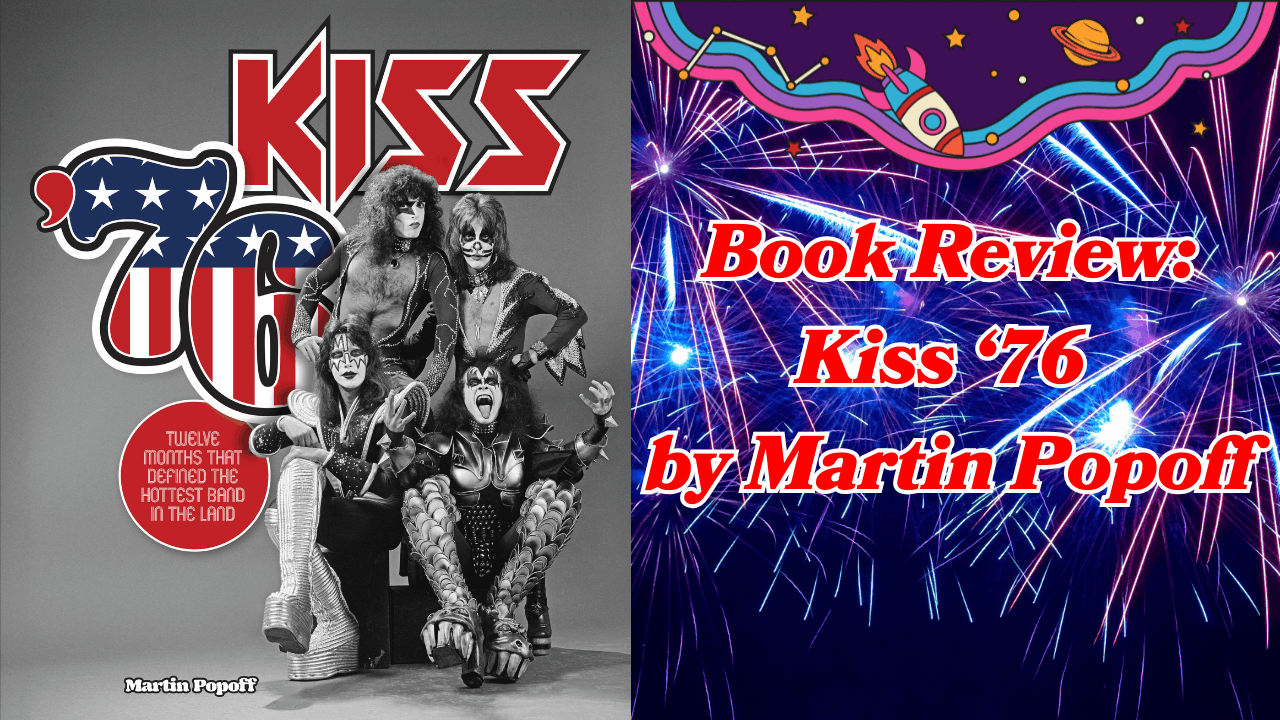
Disclosure: I received a review copy of this book from the publisher in exchange for my honest opinion.
Classic rock bands that have had a meteoric rise have their whirlwind of a year and that’s the most interesting year to study in their history. For The Beatles, it was 1964. For Kiss, it was 1976, which coincides with the United States bicentennial. If you’re looking for a book that talks about a year in the life of Kiss, eureka, you’ve found it! This book will take you on Kiss’ amazing journey through 1976, month by month. What better “tour guide” than the incredibly prolific rock journalist and music reviewer Martin Popoff? I’ve previously reviewed his books Van Halen at 50, Iron Maiden: Album by Album, and Judas Priest: Album by Album. I really enjoyed those and these were great guides for me to get into bands that I don’t listen to as much since I’m personally more of a 60s/early 70s person.
What might surprise you is I didn’t listen a lot to Kiss until reading this book, even though I listen to a lot of bands that are kind of like Kiss. I love Slade (who were the blueprint for Kiss). I love Queen. I love Thin Lizzy. I love Rush. But that’s not a bad thing when you’re reviewing books because I like getting an education and broadening my horizons when I read and it’s good to get all sorts of perspectives in book reviews. As you probably know I’m a coffee table book enjoyer and I love books that have unique angles.
What I especially love about Kiss ’76 is that not only is it well researched and detailed about what Kiss were up to in each month of 1976, it also contextualises the rise of Kiss and sets the scene for what was going on that year both in and out of music. Throughout the book you’ll see a ticker timeline of events both music and pop culture related as well as world news.
I also appreciate the list of all the tour dates and the maps showing where Kiss have played concerts in 1976. For the most part, they toured the US and Canada, but they also played some shows in the UK, France, Germany, Netherlands, Sweden, Denmark, Switzerland, and Belgium in May and June 1976. These tour dates spanned across three separate tours: Alive! (10 September 1975-28 March 1976), Destroyer (11 April 1976-12 September 1976), and Rock and Roll Over (24 November 1976-4 April 1977).
Kiss released two albums that year, Destroyer and Rock and Roll Over and in this book are track by track sections with detailed write ups of all the songs. With a rise in popularity comes renewed interest in the back catalogue so Kiss released a box set of their first three albums called Kiss – The Classics.
Finally in the back of the book is a Kiss discography for 1976, listing all the releases from that year and a 1976 timeline for Kiss, to sum up all the events. You can really see how busy of a year it was for them!
In short, this is a book made for Kiss fans and rock historians. This book is sure to make the Kiss fan in your life happy. They’ll appreciate the research and care that went into the writing and they’ll love all the pictures of the band in photoshoots, live in concert, and scans of memorabilia. This nostalgic book is so well designed from the cover to all the pages. Even as someone who is a newbie to Kiss, I’ve learnt a lot and what better way to introduce a new listener to them than to talk about what they were up to at the height of their fame?
Kiss ’76 comes out on 24 February.
Top 10 Takeaways from Kiss ’76
Top 10 takeaways are back again and because I didn’t know a whole lot about Kiss going into this, I’ll share what I’ve learnt from this book.
1. Kiss were late to the glam rock party, but they made a huge impact.
Glam Rock was huge in early 70s Britain, but the US didn’t have the same kind of glam rock fandom, that is until The New York Dolls, Alice Cooper, and Kiss. Their sound was a mix of Slade, Sweet, New York Dolls and hard rock like Bachman Turner Overdrive, pre-Neil Peart Rush, and Mountain.
2. Alive! was their breakthrough and it helped save Casablanca Records, who were on the verge of bankruptcy.
Kiss are well known for their outrageous image and that makes for an unforgettable live show. It’s no wonder that their commercial breakthrough was a live album, Alive! Casablanca Records for the most part are known for disco music, which means that Kiss stand out amongst their labelmates. Much like Mae West saved Paramount from bankruptcy in the 1930s with her witty, risqué sense of humour, Kiss saved Casablanca Records from bankruptcy through the success of Alive!
Like I said, Slade were the blueprint for Kiss and the title of this live album is a reference to the Wolverhampton glam rockers album Slade Alive! . Alive! was a double album with live versions of songs from Kiss, Hotter Than Hell, and Dressed To Kill from their concerts in Detroit, Cleveland, Davenport (Iowa), and Wildwood (New Jersey).
3. “Rock and Roll All Nite” was their first top 20 hit and became their signature song and closer at almost every concert from 1976 onwards.
Even if you’ve never heard of Kiss, you’ll know their song “Rock and Roll All Nite”, a great party song. It could be considered an early hair metal song. Inspired by Slade’s “Mama Weer All Crazee Now”. This single was important for their career because they didn’t really get radio airplay until this song came out.
Both the studio version from Dressed to Kill and a live version from Alive! were released as singles and it flipped back and forth between which was played more on radio.
4. “Beth” was their first top 10 hit, charting even higher than “Rock and Roll All Nite”.
It was a ballad written by Peter Criss originally as “Beck”, about a woman named Becky, for his previous band Chelsea, but changed the title to “Beth” so it wouldn’t be confused as being about Jeff Beck.
There’s an orchestra playing on this song, which isn’t unusual for the time period since symphonic rock was popular around this time. What is unusual though is that this is the only Kiss song to contain no instrumentals from the band.
5. Not only were Kiss inspired by glam and hard rock, but also poppier music.
One thing that I’ve noticed about a lot of classic rock bands is that their influences are a lot more varied than you’d think. Kiss made a lot of harder rocking songs, but they’ve also released ballads and some of their songs are influenced by some poppier music. Two examples given in the book: “Shout It Out Loud” from Destroyer was inspired by The Hollies’ “I Wanna Shout” (from Confessions of the Mind) and took inspiration from The Four Tops’ call and response. “Sweet Pain” took inspiration from The Troggs’ “Wild Thing”.
6. The album cover for Destroyer required a change of plans.
Sometimes your first choice doesn’t pan out, but the second choice ends up turning out well. Kiss wanted fantasy and comic book artist Frank Frazetta to do the cover art for Destroyer, but that option came with some issues. The cost was above Kiss’s budget and he wouldn’t allow Kiss to use the artwork for merch, a big problem because Kiss are all about merchandising, look at the Kiss Army. Frazetta famously did album artwork for bands like Herman’s Hermits (Both Sides of Herman’s Hermits), Dust (Hard Attack), Nazareth (Expect No Mercy), and Molly Hatchet (Molly Hatchet, Flirtin’ With Disaster, and Beatin’ The Odds).
One door closes, another door opens and instead Ken Kelly did the artwork. Ken was Frank Frazetta’s wife’s nephew. Going into it, he’d never heard their music, but when he went to one of their concerts, he said the performance blew him away and that they were larger than life. His design for Destroyer was to have the band dressed up in their signature stage wear, looking as if they were jumping out at the viewer.
Depending on the version of the album, the background is either buildings in flames or Kiss on top of a pile of rubble with more subtle destruction and a gradient of colours: indigo, red, and yellow. Apocalypse themed!
7. A 3 LP box set called Kiss – The Originals was released in the US, Canada, and Japan to capitalise on the newfound interest in Kiss’ back catalogue.
Any artist who has released multiple works knows that the more books, albums, films, etc you release, the greater the chances you’ll sell older releases. It’s all cumulative. Offering a box set makes it even easier to get all the old releases, especially for the completist fans.
8. Kiss used albums to promote signups for the Kiss Army and included some goodies like stickers and trading cards.
If you’re a marketing major and you love studying music promotion or you’re a marketing teacher, Kiss make an excellent case study in marketing.
Two teenage Kiss fans from Terre Haute, Indiana Bill Starkey and Jay Evans started calling themselves the Kiss Army because they wanted their local radio stations to play Kiss. DJs would shout out the Kiss Army and people who loved their music called in and asked how do we join the Kiss Army? Eventually Kiss found out they’ve got a budding fan club, so they got in touch and worked with them to promote a concert in Terre Haute. It sold out with over 10,000 fans in the audience and the Kiss Army became the official fan club.
For just $5 a year, fans got a set of pictures, a poster, a shirt with an iron on design, and a quarterly newsletter. The Kiss Army created community and helped to promote Kiss. Merch is a great way to promote a band and fans can easily spot each other and start conversations when they see a fellow fan wearing merch.
At its peak, the Kiss Army earned $5,000 a day and had over 100,000 members. The Kiss Army is still very much a thing today, but much more modernised and digital.
9. Kiss made an appearance on The Paul Lynde Halloween Special.
An unlikely match, right? Kiss’ manager Bill Aucoin was a bit sceptical of TV appearances, but it turned out to be a success for them. On that show, they performed “Detroit Rock City”, “Beth”, and “King of the Night Time World”. Other famous people who made appearances on The Paul Lynde Halloween Special include Margaret Hamilton (The Wicked Witch of the West), Billie Hayes (as Witchiepoo from H.R. Pufnstuf), Tim Conway (The Carol Burnett Show), Roz Kelly (Happy Days), Florence Henderson (The Brady Bunch), Betty White, and Donny and Marie Osmond.
10. Ace Frehley nearly got electrocuted at a concert in Florida in December 1976.
Electronics and pyrotechnics are rock concert staples and safety hazards. At their concert in Lakeland, Florida on 12 December 1976, Ace Frehley nearly got electrocuted from grabbing a railing that hadn’t been grounded (nearly dying!).
Thankfully Ace was revived backstage and because of the energy from the crowd, he was able to push through the pain from the burns on his fingertips and perform. Talk about mind over matter! From that point onwards, Kiss’ took extra care at concerts to prevent a similar incident. One thing they did was invest in radio microphones that made their guitars shock-proof. As well, Ace Frehley wrote “Shock Me” inspired by this near-death experience.
Click here to read my interview with author Martin Popoff.
Liked this blog post and want to support independent classic rock journalism? Donate to The Diversity of Classic Rock on Patreon or Paypal or follow me on Facebook, Bluesky, or Instagram, buy my book Crime of the Century, click the follow button on my website, leave a nice comment, send your music or classic rock related books for review, or donate your art and writing talents to the blog.
If you donate any amount to my Patreon or PayPal, you’ll get a Crime of the Century ebook, so it’s pay what you can! The best deal you’ll get on the book and you won’t find this deal anywhere else! I just want to give back to my readers and say thank you for your support.

Leave a Reply