


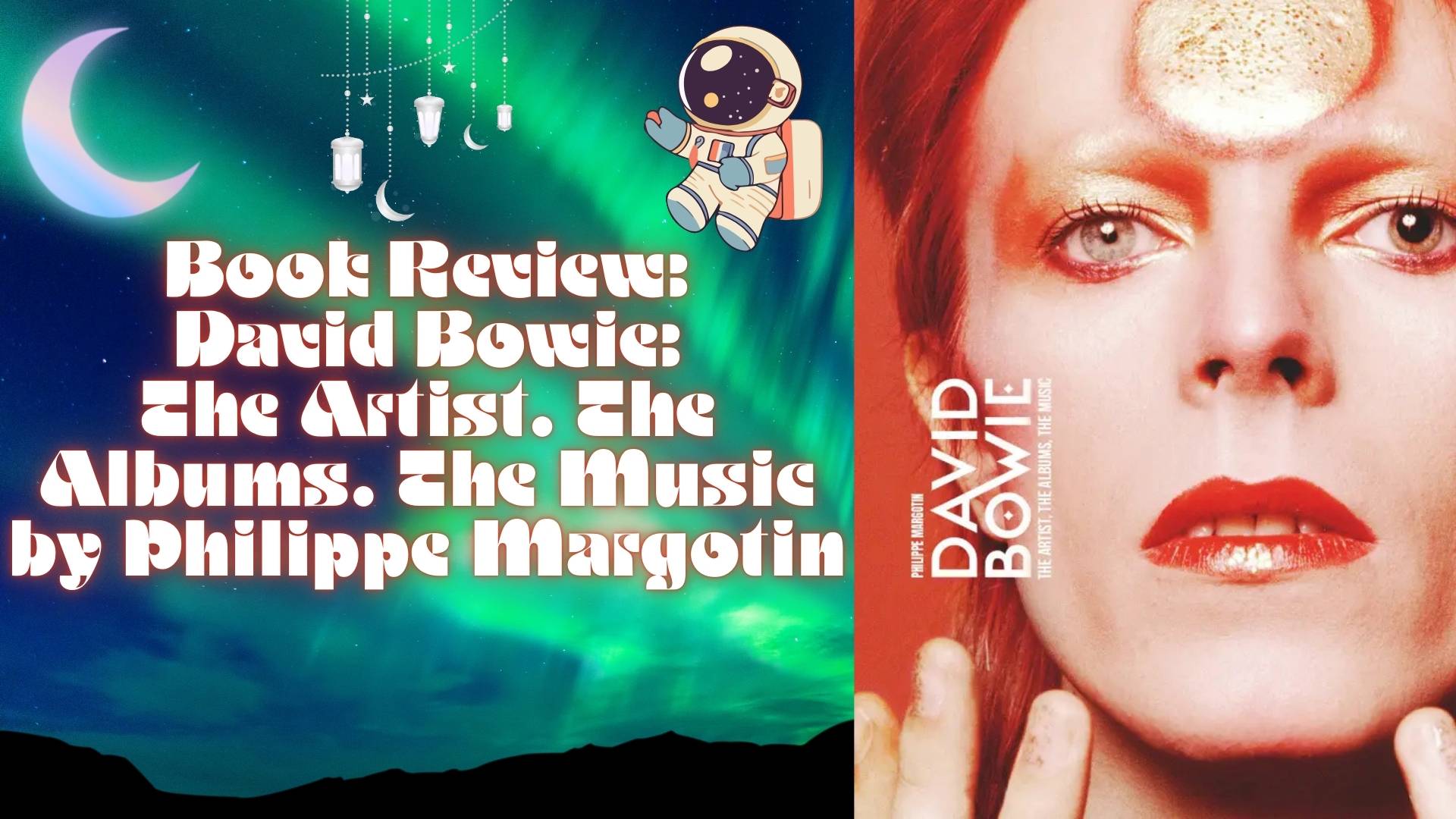
Disclosure: I received a review copy of this book through NetGalley in exchange for my honest opinion.
Recently I watched Velvet Goldmine because my internet was out because of maintenance being done in my area. I have this movie on my computer and it’s one of my favourites. It’s basically David Bowie: The Movie, but not exactly. If you’re a glam rock fan, you’ll love it because you won’t have to worry about inaccuracies or creative liberties because it’s fiction. The legally distinct entity Brian Slade has many similarities to Bowie, but also Jobriath. It’s obvious that Curt Wild is based on Iggy Pop, with a bit of Lou Reed’s backstory (the electroshock therapy). Jack Fairy is a Little Richard like figure, being the godfather of glam rock, not performing in the movie, but you see his presence there. The soundtrack is great and I love the costuming. It’s a great LGBT themed film overall.
I saw there’s a new book about David Bowie coming out and I’ve reviewed a couple of Bowie books in the past, one focusing on his later career from 1983-2016, a graphic novel about the Berlin era, as well as John Cambridge’s memoir (Cambridge was a drummer for David Bowie and was the one who introduced him to Mick Ronson). As someone who has a cat named Bowie, I was interested! Especially because it goes through his entire career. It’s been 10 years since David Bowie passed away so it makes sense that this retrospective of his career has come out this year. He was one of the great myth makers of rock and roll and before Madonna (a huge David Bowie fan herself) reinvented herself with every album, David Bowie was doing just that, always leaving fans wondering what’s he gonna do next?
My favourite years of David Bowie are the 70s of course, but I like books that span an artist’s whole career and life since I like learning as much as I can about my favourite musicians, especially about their upbringings and where they come from, since I find that really shapes who they are and the art they make.
This book was originally in French and has been translated into English.
Format wise, it reminds me a lot of my friend Paul Salley’s book Little Wing, which is a beautifully designed and written biography with many pictures. Each era has its own chapter and the book is divided as follows:
- 1947-1967: David Bowie’s upbringing and early musical pursuits in The Kon-Rads, Davie Jones and the King Bees, The Manish Boys, and The Lower Third. His self-title debut album came out in 1967.
- 1968-1971: David Bowie’s psych/folk era Space Oddity, The Man Who Sold The World, and Hunky Dory. “Space Oddity” was his breakthrough hit, but not initially. Fun fact: “Space Oddity” was not about the moon landing, even though it was released in time for it. The real inspiration was 2001: A Space Odyssey and Bowie feeling alienated. This wouldn’t be the only science fiction inspired song Bowie would make.
- 1972-1974: Glam Rock Bowie: Ziggy Stardust, Aladdin Sane, Pin Ups, and Diamond Dogs. Bowie dyed his hair red, cut it into a mullet and these were his peak years commercially and this is probably the Bowie era that comes to mind first for most people.
- 1975-1976: Blue-eyed soul and Thin White Duke Bowie. He performed “Golden Years” on Soul Train. The albums released in this year were the excellent albums Young Americans and Station to Station. He was really addicted to cocaine in these years.
- 1977-1979: The Berlin Trilogy: Low, Heroes, and The Lodger. Bowie worked with Iggy Pop and Brian Eno. Ambient and krautrock influences.
- 1980-1991: Art pop, New Romantics, MTV era. Let’s Dance was a big success. This was the time of “Modern Love”, “China Girl”, “Under Pressure”, and his duet with Mick Jagger – “Dancing in the Street”. He also was in the movies Absolute Beginners and Labyrinth. At the end of this era was Tin Machine, which got mixed reviews.
- 1992-2003: Experimental Bowie branching out into other genres like hip-hop, industrial, and electronica. This is also the era where enough time has passed that he starts to get those accolades for his career and impact on popular music.
- 2004-2016: Bowie returns to art rock. This chapter covers Bowie’s last two albums: The Next Day and Blackstar.
As the title says, the main focus is the music, not so much David Bowie’s personal life, which can be hard to cover during times when he was more reclusive. Most of the book is dedicated to Bowie’s peak creative years in the 70s.
Each chapter follows a structure of setting the scene and explaining what was going on in each Bowie era, includes a timeline of what was going on at the time both Bowie and non-Bowie related, has some sidebar mini-essays about various topics such as his influences (early rock and roll, cinema, music hall, 60s mod fashion, Andy Warhol’s Factory), important people in his life (Lindsay Kemp, Angie Bowie, Tony Defries, Mick Ronson, Toni Basil, Brian Eno, Iman), and things that he influenced (Glam Rock, New Romantics, Alternative Rock), before finally going into the track listing for each album and sharing information on the highlights of the albums. Including this context helps the reader understand the time period and how it shaped Bowie. I loved reading about how varied his influences were and I had a friend say this once about him, that he’s one of the most intelligent rock stars and he didn’t go to university, but you’d think he did because of the kinds of books he loved to read. Really shows the power of self-directed learning and how you’re more enthusiastic when you’re getting into books on your own terms, without a teacher lecturing and teaching to the test.
Because of how long David Bowie’s career was, this is not a book that goes into the ins and outs of every track, but more a guided tour with pictures of David Bowie’s career and some historical context peppered throughout. The writing takes a factual approach as opposed to an opinions approach. Some side projects like films are discussed, but the main focus is the music. It’s a great book for beginners looking to get into David Bowie who want to see pictures of all the eras. David Bowie’s a perfect musician to do that for because of how iconic his style was. Longtime fans who know the Bowie lore may not get much out of the book, but it is a well presented, well designed, and well researched book that Bowie fans will enjoy.
You can buy the book on Aurora Metro’s website.
Liked this blog post and want to support independent classic rock journalism? Donate to The Diversity of Classic Rock on Patreon or Paypal or follow me on Facebook, Bluesky, or Instagram, buy my book Crime of the Century, click the follow button on my website, leave a nice comment, send your music or classic rock related books for review, or donate your art and writing talents to the blog.
If you donate any amount to my Patreon or PayPal, you’ll get a Crime of the Century ebook, so it’s pay what you can! The best deal you’ll get on the book and you won’t find this deal anywhere else! I just want to give back to my readers and say thank you for your support.
Leave a Reply