


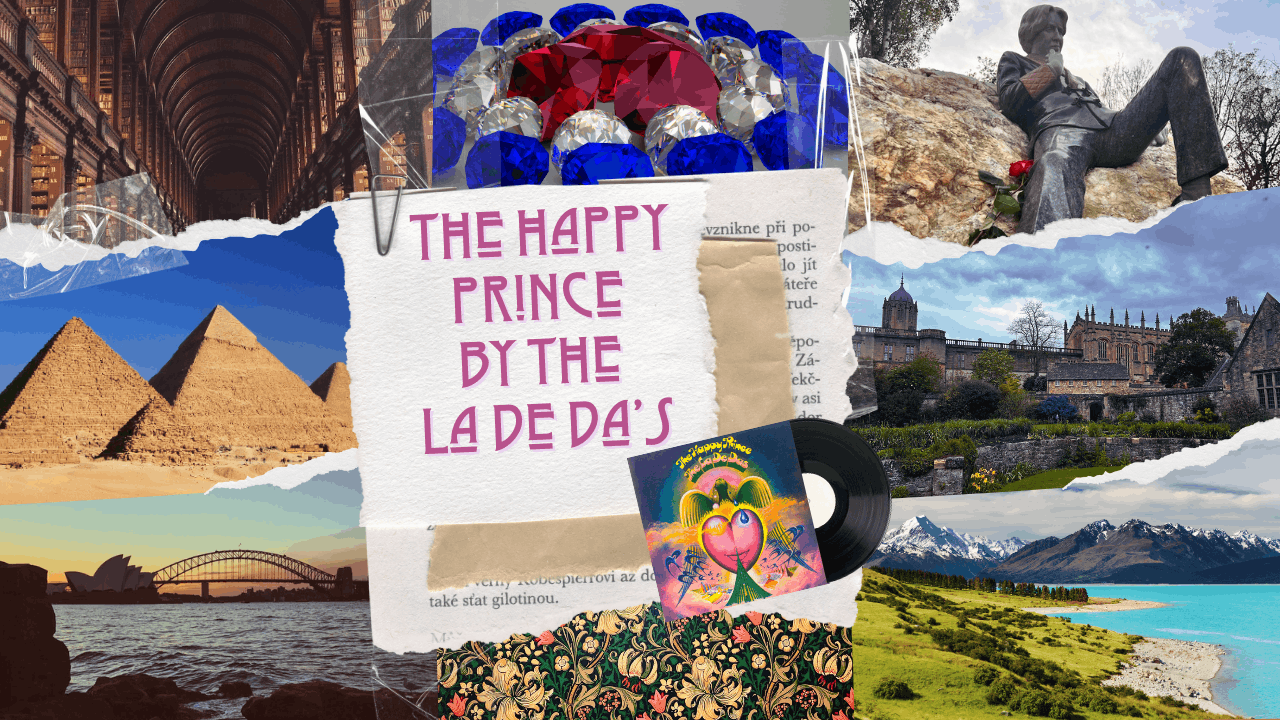
A few months ago I was on my friend Peter’s show Rock Daydream Nation to talk about a little-known concept album by a rock band from New Zealand called The La De Da’s. Most people won’t know who they are, but that’s okay! The point of this blog is to talk about lesser known classic rock bands alongside well known ones. You can watch the video below. To supplement the video here’s a companion blog where we talk about the La De Das, the early history of concept albums, and a little bit about Oscar Wilde’s impact on rock and roll, because it goes way beyond this album! If you’ve been following my blog for a while you might remember that I wrote a blog post about classic rock songs inspired by literature (and The Happy Prince is mentioned in it!). If you haven’t checked that one out, check it out! I talk about WB Yeats, Edgar Allan Poe, and Aldous Huxley.
The La De Da’s: From Garage Rock to Psychedelic Rock to Blues Rock
I’m a big garage and psychedelic rock fan. If I had to pick a favourite rock and roll era it’d have to be the mid-late 60s. I love the sound effects of psychedelia and I think it marked a change from the old style of rock and roll to a new heavier, more experimental sound. And the style that comes with that too? Just exquisite! Dandyism perfectly combines the polished, classic look of the mod with the hippie’s love of colour and nature.
From over a decade of researching rock and roll, I find the bands with the most staying power, therefore the ones who are elevated to “legend” status, are the ones who constantly innovate, grow, and change with the times. They’re not complacent or stagnant. They keep taking things to the next level and aren’t afraid to take chances and change up their sound. They often make moves that aren’t “safe”. When I think of 60s artists that had staying power, as in they’re talked about in classic rock spaces and have a lively fandom, I think of The Beatles, The Rolling Stones, The Beach Boys, The Who, The Kinks, The Hollies, and The Small Faces. These are all groups who evolved and refined their sound and image and kept pushing the envelope. They started off singing covers of R&B songs, but came into their own and developed their own distinct sound and style. Compare their first albums released in the 60s to their last albums released in the 60s and you’ll see how different they sound.
Competition was tough, as I’ve discussed in my blog posts where I analyse the pop charts in the US and UK. If you’re an international act there are challenges that come with that like getting visas for touring, which you need to promote your music. Because of how dominant American and British rock and roll acts are, it’s hard to break into those markets when you’re from another country, especially one where English isn’t the official language. Foreign artists were often seen as imitations of American and British artists and it’s hard for them to get a fair shake. There’s a phenomenon in Australia, New Zealand, and Canada called “cultural cringe”, where anything domestic is either seen as cringey, or good with qualifiers or comparisons. If you do end up getting big overseas, the British or Americans will “poach” you or you’ll move there full time. On top of that, you might be called a sellout if you make it big, an example of “tall poppy syndrome” or as Morrissey put it, “we hate it when our friends become successful“.
I suppose New Zealand’s answer to Australia’s Easybeats and England’s Small Faces and Status Quo were The La De Da’s. Like those groups, they went through their own evolution in sound going from playing covers to doing originals and finding their unique style. It may be hypocritical to go on about tall poppy syndrome and do just that by comparing, but it’s the best frame of reference I can give if you’re unfamiliar with their music. They were formed in 1963 in Te Atatū, near Auckland by teenagers Kevin Borich, Bret Neilsen, Trevor Wilson, and Phil Key. One of the cool things about this group is that lead singer Phil Key was Maori. In the 60s there weren’t a lot of multiracial rock groups.
Like other 60s rock bands, they changed their name a few times before settling on the one. Before they were the La De Da’s, they were The Mergers and The Gonks. Their biggest influences were The Shadows, Beatles, and Rolling Stones. They changed their name to the La De Da’s because Trevor Wilson’s mother thought that sounded nice, as opposed to something like The Criminals, which doesn’t sound very wholesome. I can’t imagine 1960s New Zealand was a progressive wonderland because The Pretty Things (who were even wilder than the Stones) toured New Zealand and caused a ruckus and supposedly got banned from touring the country. Maybe her instincts were right!
The La De Da’s first big break in their country came in 1966 with their cover of The Changin’ Times “How Is The Air Up There?”, which reached #4 on the New Zealand Listener’s Hit Parade. Love the fuzz guitar on this one! Word got out about this great garage rock single and it made its way to Australia, getting airplay in Sydney. They got even more success with their cover of John Mayall’s “On Top of the World”, peaking at #2. They finally got a #1 in 1967 in their home country with their cover of Bruce Channel’s “Hey! Baby!”, making history as the first New Zealand made record to top the charts in New Zealand.
About The Happy Prince by The La De Da’s
The La De Da’s wanted to take things to the next level, going beyond covers and garage/psychedelic rock. In 1967, Trevor Wilson came up with the idea to do a concept album based on Oscar Wilde’s children’s story The Happy Prince, which you could think of as the OG The Giving Tree. Instead of a tree giving its apples, branches, and trunk to a boy to help him, it’s a gilded statue of a prince giving its precious gemstones and gold leaf to the impoverished townspeople to help them out.
Not everyone was thrilled with the idea (only Bruce Howard was on his side), but he believed in the concept album idea because it would help them to get rid of the teenybopper image and be taken more seriously as artists. Rock operas sound way more artistic than pop singles. This did not end up like Pete Townshend’s Lifehouse. It would materialise two years later, but in the meantime they were touring Australia, trying to make a name for themselves there. Writer Adrian Rawlins was a fan of their work and encouraged them to finally record The Happy Prince. He would narrate between the songs, with this affected plummy English accent (my best guess is they were going for what Wilde may have sounded like). They also recorded this album in Australia, making history as the first concept album from down under.
I’m a huge fan of concept albums and a lot of times they’re great. This one, however, had its strong moments but there are some things about it that aren’t so great, and perhaps it’s because not everyone was enthusiastic about the project. The narration is cheesy and it’s a departure from their previous material with a pop-prog sound as opposed to rock and roll. Taking risks is great for art, but not always for your fans, who might feel alienated.
That said, I will always have respect for artists who get out of their comfort zone and try new things. The Small Faces’ Ogdens had a way better execution of the narration and The Moody Blues’ poetry in between songs is another example of good execution of spoken word interludes, but The La De Da’s missed the mark here.
Now that we’ve got the negatives out of the way, I really think the album shines in these songs: “Covered in Gold”, “Come And Fly With Me” (this one’s a real standout), “Winter Song” (the best song on the album), and “Civic Pride”. I also love the use of sitar in “Lullaby” and for some reason this song reminds me a bit of the Pretty Things’ “Death” and The Stone Roses’ “Elizabeth My Dear”. Overall I’d give this 3 stars out of 5. While I wouldn’t say this is an essential listen unless you’re a rock historian who is really into the history of concept albums, there are some good moments and the idea is neat. I’d also say this could be an interesting listen for English teachers and English majors.
After The Happy Prince, the La De Da’s went in a more blues rock, boogie rock kind of direction. A similar trajectory to Status Quo, who began as a psychedelic pop group and turned more blues rock, like “Pictures of Matchstick Men” vs “Down Down”, totally different sounds! Take a listen to Rock and Roll Sandwich and you’ll be like wait, this is the same band that did “How is the Air Up There”?
In Context: The History of Concept Albums and Rock Operas
Concept albums have their roots in song cycles, a set of songs meant to be performed as a whole package. But does that make every suite, soundtrack, or cast recording of a musical a concept album? No, we need a proper definition.
Most music critics say you need an overarching, unifying theme to make a concept album, be it narrative, instrumental, or lyrical. It’s a nice touch when the songs segue into each other.
Music sales went from sheet music and 78 rpms in the early 20th century to 7 inch singles and LPs in the late 1940s.
In the early years of rock and roll, so the 50s and early 60s, it was all about the single and albums were made up of a collection of singles released over time. That isn’t to say no one recorded albums. Woody Guthrie’s Dust Bowl Ballads is often cited as the first concept album and that came out in 1940. A breakthrough came in the 50s with the invention of the gatefold, which made buying records much more of an experience. The gatefold was a place where you could put photo collages, lyrics, artwork, and liner notes. In the case of a concept album, you could put lore in there. Concept albums were made for the LP, not formats with smaller packaging like a CD, 8-track, or cassette tape.
Before the album era, artists like Frank Sinatra, Nat King Cole, and Joe Meek tried their hand at concept albums. Sinatra’s 1955 album In The Wee Small Hours has themes of introspection, melancholy, and lost love. Nat King Cole’s 1960 album Wild Is Love tells a story of a man looking for love. The same year, Joe Meek released the space themed I Hear a New World. Another early concept album is Miles Davis’ Kind of Blue, released in 1959 and Sketches of Spain, released in 1960. While not exactly a concept album, more like a series of albums with themed titles, Miles Davis released a series of four albums to fulfil contractual obligations: Workin’, Cookin’, Relaxin’, and Steamin’ with the Miles Davis Quintet.
The concept album and the rock opera kind of go hand in hand. It’s a story you may have heard before, but in 1966-1967, you started to see the birth of the concept album and the rock opera. Albums like Pet Sounds and Sgt Pepper, the latter being even more of a concept since it has a uniform theme around the idea of The Beatles being a fake band Sgt Pepper’s Lonely Hearts Club Band. The Turtles released an album with a similar concept in 1968, The Turtles Present: The Battle of the Bands.
But even before Sgt Pepper there was The Who’s “A Quick One While He’s Away”, which is a song that tells the story of a woman whose husband has been gone for nearly a year and was due to come home, but he hasn’t come home yet. She’s sad and believes he’s dead. Ivor the Engine Driver comes by to make her feel alright, if you know what I mean. Her husband is on his way home and when he arrives she confesses to cheating on him with Ivor the Engine Driver. He forgives her.
This was just the first step in making the rock opera. In 1967, The Who released the classic concept album The Who Sell Out with the album being formatted like a mock radio broadcast with idents and adverts with jingles in between songs and the album cover depicting the band members doing ads for Heinz Baked Beans, Odorono, Medac, and the Charles Atlas dynamic tension course. This was the next step to making their 1969 classic rock opera Tommy. Also in 1969, The Kinks released their concept album Arthur, or the Decline and Fall of the British Empire. The Kinks would continue releasing concept albums in the 70s like Lola and the Preservation series.
The same year as The Who Sell Out was released, lead singer of Tomorrow Keith West’s “Excerpt from A Teenage Opera (Grocer Jack)” came out, reaching #2 on the UK pop charts. That rock opera album by Mark Wirtz and Tomorrow wouldn’t come out for another almost 30 years! Also in 1967 was Nirvana’s The Story of Simon Simopath, written by Patrick Campbell-Lyons and Alex Spyropoulos.
In the 70s, the concept album was adopted by many prog rock bands: Pink Floyd, Jethro Tull, Gentle Giant, Genesis, Yes, Rush, Aphrodite’s Child, Camel, Manfred Mann’s Earth Band, ELO, and ELP, to name a few. Outside of prog rock, you had Jesus Christ Superstar, The Who’s Quadrophenia, David Bowie’s Ziggy Stardust, Marvin Gaye’s What’s Going On, Parliament’s Mothership Connection, Meat Loaf’s Bat Out of Hell, and Alice Cooper’s Welcome To My Nightmare.
The challenge with a concept album is it’s supposed to be enjoyed in its entirety, but in today’s fast-paced, agile world, with little attention span, it’s no wonder concept albums have been on the decline. In order for a concept album to go anywhere commercially, the band either needs a dedicated fanbase or there needs to be a single that stands on its own. A lot of artists swapped albums for releasing singles. The move to digital made people go, what’s the point? Is music an experience anymore or is it just a product? Where’s the storytelling?
Oscar Wilde: The Godfather of the Peacock Revolution?
One of the things I’m most fascinated with is the 1960s revival of dandyism, also known as the Peacock Revolution, a short period of time in the late 60s when it was cool for men to dress flamboyantly in a way that is aristocratic, with a psychedelic edge. Where did this come from?
If we’re talking who started the Peacock Revolution as we know it in the 60s, that honour goes to two people: Christopher Gibbs, an antique dealer who was dubbed “The King of Chelsea” and considered to have invented Swinging London, and John Stephen, the King of Carnaby Street and outfitter of rock bands like the Stones, Who, Kinks, and Small Faces. Like the 19th century dandies, Gibbs loved travelling to North Africa to buy furnishings. Victorian dandies and hippies may have looked quite different, but they both had a love for decor and clothing from far away lands, North Africa, Middle East, and South Asia. Clothing designers like Michael Fish, Michael Rainey, and John Pearse influenced the direction of the Peacock Revolution, the style of the 60s rock and rollers and a big influence on 70s Glam Rock and 80s New Romantics.
What does a 60s dandy look like? Long hair, no facial hair (preferably), colourful clothing made of luxurious fabrics, and a feminine flair to their dressing and styling.
But where did this Peacock Revolution originate? Where did these guys get the idea to dress more feminine? None of this exists in a vacuum. It’s important to know your history so you can truly appreciate the art, music, and style you love. There were flamboyant dressers in the 50s like Elvis Presley, Liberace, Little Richard, James Brown. Before that you had the wrestler Gorgeous George. But they weren’t the first flamboyant dressers and it didn’t quite look like the flamboyance of the 60s, but I’d say it still influenced it. To find the origins, we gotta hit the rewind button and go to the early 19th century, the time of the Great Male Renunciation.
If you look throughout history, for the most part, menswear wasn’t boring grey suits. There was colour and personality. The shift to more neutral, utilitarian clothing was a working-class movement at first, but then a guy named Beau Brummell came along and made it “hip to be square” amongst the upper classes, forever changing menswear.
Here and there you’d get slightly more colourful dandies, but one dandy stood out from the rest, ticking more 60s dandy boxes than anyone else in the 19th century. That man was Oscar Wilde, who I describe as the Godfather of the Peacock Revolution. The most ahead of his time looking person I can think of, even more so than James Dean, who looked rock and roll before rock and roll.
Look at his famous 1882 photoshoot and you’ll see the style ancestor of the 60s rock star and the blueprint for the Peacock Revolution: long hair, velvet, capes, coats with fur lapels, cravats (Bonus: Lillie Langtry, yes the woman referred to in The Who’s “Pictures of Lily”, wore a brocade coat with fur trim that wouldn’t look out of place in the 70s). He served cunt so much in that picture they had to invent copyright for photography, I’m serious! Rock stars Phil May and Dave Davies copied that shoulder length centre-parted hairstyle in the mid-60s before it really became popular in the late 60s and early 70s. Dave Davies took it a step further and dressed like a dandy too. If Dave Davies perfectly copied the look, who perfectly copied the attitude? Morrissey, who I’d argue is the biggest fanboy.

The boutique Granny Takes a Trip even put one of Wilde’s quotes on their storefront in a speech bubble of Captain America reading: “One should either be a work of art, or wear a work of art.” I asked about this at the Granny Takes a Trip book signing event and here’s what Granny Takes a Trip founders Nigel Waymouth and John Pearse had to say (please ignore my cringey, awkward voice):
If you look at pictures of 60s dandy fashion you’ll see that the outfits look very Wildean, but with a bold, bright colour palette. Tangentially, Aubrey Beardsley’s artwork had a revival of interest in the 60s with an exhibition at the V&A in 1966. Both Beardsley and Wilde were from the decadence era, which was sex and drugs, minus the rock and roll since that wasn’t a thing yet.
The influence isn’t just what you can see. He was a notorious myth maker, making up stories about himself. Classic rockers like Bob Dylan, Keith Moon, and David Bowie would do that too. The dandy style he cultivated was counterculture, no one else dressed like that! Have a look at this 1880s fashion overview from FIT and compare the styles. Dandyism then was a Marty McFly moment: “I guess you guys aren’t ready for that yet, but your kids are gonna love it”. Or maybe it’s more like grandkids and great-grandkids. Someone had to lay the groundwork I guess!
While doing research for my next book, I stumbled upon this quote, Oscar Wilde’s take on smoking weed. This sounds like something Ringo Starr would say:
“It is quite exquisite: three puffs of smoke and then peace and love.”
I think what makes art truly beautiful is while our time on the planet may be short, as artists we can create something that lives forever and that should be the goal!
Liked this blog post and want to support independent classic rock journalism? Donate to The Diversity of Classic Rock on Patreon or Paypal or follow me on Facebook, Bluesky, or Instagram, buy my book Crime of the Century, click the follow button on my website, leave a nice comment, send your music or classic rock related books for review, or donate your art and writing talents to the blog.
If you donate any amount to my Patreon or PayPal, you’ll get a Crime of the Century ebook, so it’s pay what you can! The best deal you’ll get on the book and you won’t find this deal anywhere else! I just want to give back to my readers and say thank you for your support.
Leave a Reply