

I’ve been absent from my blog because I’ve been balancing two things, or trying my best to and absolutely failing. I’m working full time now and when I’m not working or playing video games to unwind, I’m working on the next Crime of the Century. My original plan was to write a sequel that was even more classic rock and true crime stories. But sometimes in life you gotta take the side quest instead of the main quest. Pardon me if this blog post is stream of consciousness and meandering through my crazy brain.
Writing Chapter 1 of Crime of the Century: Celebrity Trials
There were signs that I had to go the Celebrity Trials route. At book fairs, I found that not all classic rock fans love true crime and not all true crime fans love classic rock. If you were to do a Venn Diagram, that overlap in the middle would be small. However, most people are fascinated with celebrities of some sort, be it musicians, actors, athletes, writers, you name it. Everyone’s got a celebrity they like. I don’t know about everyone else, but I got my emotional support dead celebrities (right now it’s Viktor Tsoi and Buddy Holly). So there’s going to be a lot more overlap when writing about celebrity true crime.
When I was in Japan, I was reflecting over dinner about the future of my writing and while drunk on sake I declared the next book was going to be about celebrity trials. But there was an even bigger sign before all of this and we gotta rewind back to when pre-orders for Crime of the Century opened. It was a very emotional trip to visit family in Florida and I was overwhelmed and feeling a lot of self-doubt. Not to go all Jim Morrison or Joe Meek on you guys, but I saw a sign. Look I’m an atheist, but like was someone’s ghost trying to talk to me? I walked into my grandma’s flat and saw a vase of flowers on the table and I saw some green carnations. Was this destiny? A sign from the universe?
For the uninitiated, it’s an old timey gay symbol popularised by Oscar Wilde, a famous writer whose life had a tragic ending and was the first celebrity trial (at least in the modern era anyway). If you ever feel dumb, remember that Oscar Wilde was all like “hold my absinthe” when he decided to sue his boyfriend’s dad (the Marquess of Queensberry) for saying he was posing as gay. Like he thought he was gonna beat the gay allegations. Incredibly delulu, if he thought he was going to win. What’s really interesting to me anyway, as someone who is fascinated with numbers (trust me, there’s a lot of numerology in this planned book), you’ll notice that his trial was 100 years before the Trial of the Century, the murder trial of OJ Simpson. There are quite a few contenders for the Trial of the 21st Century: Michael Jackson, Phil Spector, Casey Anthony, and Amanda Knox. As someone who has been into true crime for over 20 years, I remember being glued to the TV watching the coverage of these trials and watching documentaries related to them. I’m not old, I’ve just been into true crime since I was in primary school. Now let’s think about one of my favourite movies, Back to the Future. Thirty years difference between the OJ Trial and the Diddy Trial.
You could say that the Oscar Wilde trial was the OJ Trial of its day, but I’d almost say it was the Diddy trial of its day – a more apt comparison and I’ll just say it in a meme. But it wouldn’t be fair to say Wilde was literally Diddy, he was more like James Charles, still not good. If you don’t know the whole story, stay innocent, my friend. It’s a cliche, but it’s true that history repeats itself.
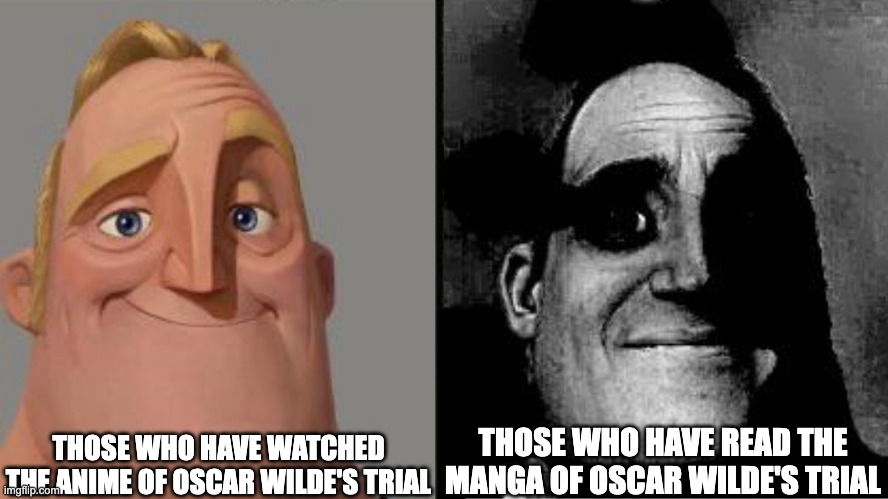
Remember how in English class the teacher would be all like “the movie doesn’t tell the entire story”. I fear your English teacher was right about this one. But don’t worry, the story’s not all dark and creepy. There were plenty of funny and interesting moments.
Hot take, but I think it’s important to present these celebrities who have done bad things as complicated, nuanced people. What cannot be taken away from Oscar Wilde is that he was a great writer and very influential in that field, as well as in fashion, like you could be a style icon and not be the best looking person in the room. As someone who is not very good looking, that really inspired me. What cannot be taken away from Diddy is that he was an influential rapper and an entrepreneur and mogul. That is no small feat, it was a lot of hard work and dedication. Portraying people as cartoon villains is propaganda I’m not falling for!
One of the things I learnt from watching documentaries and reading all about true crime is that the most dangerous people are the people you’d never suspect, the people who look the most ordinary, the most charming, incredibly generous, or successful and appearing to have a picture perfect life. It’s not glorifying them or downplaying their crimes to say that. It’s revisionism to paint abusers and predators as cartoon villains, and it actually hurts victims and survivors. It could be seen as victim blaming to be all like “how could they not have known they were so evil”? That’s what makes criminals even more dangerous than you’d think, you wouldn’t know from looking at them. Appearances can be deceiving. That is why I get so annoyed at people who go “I knew they were trouble as soon as they walked in the door.” Oh really? If you were so omniscient, why didn’t you speak up? You could have saved someone’s life! Easy to play Monday-morning Quarterback, hindsight is 20/20.
Anyway, every time another famous person’s name comes up like Sarah Bernhardt, Lillie Langtry, James McNeill Whistler, Bram Stoker, or Walt Whitman I’m like “is this a crossover episode?” While doing research I was like wait, there’s even a posthumous crossover episode with Aleister Crowley (I talked about him in the OG Crime of the Century when I talk about Jimmy Page and Kenneth Anger)?
Honestly, writing about this was no different for me than writing about classic rock, because famous people in the same era often cross paths and people will always be people no matter the era. My love of classic rock clearly influenced the writing style of this chapter (and well, everything I do).
One thing I’ll say about Wilde, there’s never a dull moment. He was much more of a meme than I was expecting and while writing this chapter I made joke after joke, while being very factual throughout. English majors are gonna hate me, but get a sense of humour.
If you were to take a drink every time I reference classic rock or some modern pop culture in this chapter, you’d be dead, so alternatively let’s make it an exercise game and you’ll be swole in no time. But I think that’s the best way to write about someone so witty, iconic, and ahead of his time. You look up wit in the dictionary and one of the definitions is being clever and funny. This meme is basically me writing this chapter:

You don’t have to be highbrow to be witty. It’s the art of talking seriously about lighthearted things and talking lightheartedly of serious things. Anyway, that was a crazy rabbit hole, but still not as crazy as JFK, that’s still #1. Let me know once this next book is done if you want me to do a post on the craziest celebrity true crime research rabbit holes I’ve fallen down.
Now I know all of this effort isn’t for nothing, as when I conducted a survey of my readers, the top celebrity trial that people wanted to read about was Oscar Wilde. Although if you wanna change the result, survey’s still open. Get the chance to shape the next Crime of the Century. The more who have their say, the better!
What is the appeal of the Celebrity Trial?
So, pretty much 130 years to the date of Oscar Wilde’s trial, the Diddy trial had begun. A celebrity trial is the ultimate true crime story in my opinion. On top of all the psychology behind why people commit crimes, there’s the celebrity star power element, it’s people you think you know, but really it’s just a parasocial relationship (not so much in the past, but you get what I mean). It’s a car crash that you can’t look away from. And oh boy did I get some deja vu moments when reading the news and developments of the Diddy trial. The US is a very unique country in that a lot of trials are recorded and a lot of high profile ones have been televised, namely OJ Simpson. In the US, for better or worse, laws are like a postcode lottery. Human rights are a postcode lottery too, but I digress. Federal court and Supreme Court trials are not televised or photographed or recorded at all. So it’s kinda like 1895 all over again, all you get are weird caricatures of people in the courtroom and journalists have to take handwritten notes.
My dad and I have had many discussions on celebrity culture and how the media covers celebrities and that was the origin of the idea for this book. When someone gets famous they get put on this pedestal and it gets built higher and higher and higher until it all comes down in one crash and people get schadenfreude when they see their downfall. The higher the pedestal, the bigger the downfall and the drama. If you’ve ever taken a creative writing class, you’ll know all about those story arc pyramids and celebrity trials and scandals very much fit into that rise and fall story arc.
Celebrity trials are a whole other layer of the psychology behind true crime because celebrities are so near and yet so far from us. They live in a different world from us. They have it all: talent, desirability, adoration, luxurious possessions, travelling around the world in style. It’s a one-in-a-million lifestyle and so many people covet it. Fame seems glamorous. So how can someone who has it all commit a crime? Why would you throw such a glamorous life away? That’s the question that kept popping up in my head as I researched Phil Spector and Jim Gordon in the OG Crime of the Century. Phil Spector was rich. Sure he was ugly, but he had so much money and success that it didn’t matter! Jim Gordon was a prolific session drummer and he played drums for anybody who was anybody. He was living every drummer’s dream.
Final thoughts on writing Chapter 1
Originally I was going to write the intro first since my style of writing is usually linear. I have a clear vision with this book and what I stories want to share with you and how I want to frame it, but I need to research all of these trials in order to best introduce the idea of the book. What I learn from 100 years of celebrity trials will inform the intro. In short, the 20th century is a century of so much change: socially (feminism, civil rights, gay liberation), artistically (look at how we went from Art Nouveau in the 1900s to Memphis Design, Grunge and Y2K in the 90s), and technologically (we went from silent films to the birth of the internet). Even more relevant things like forensic science developments and the use of DNA to solve cold cases and exonerate the innocent, that’s quite recent! Maybe I sound dumb for saying this, but the 20th century is my favourite time period to study because it’s relatable and it feels more real to me because videos and photographs had finally become widely adopted so even if you had never lived back then, you still feel like it’s a time that you’d lived through in a way, it feels weirdly familiar even though I wasn’t even a thought in my parents’ heads.
It’s a funny sounding sentence, but writing about Oscar Wilde was kind of like writing about Keith Moon. I thought I knew a lot going in. I thought this would be a piece of cake, I’ll bang this chapter out in no time and that was not the case, and not just because I have a day job. I’m a longtime Who fan and even I thought some of those urban legends about The Who (mainly Keith Moon through) were actually true, but really these were myths. Both of them loved to tell tall tales and mythmaking is a big part of fame and the marketing around celebrity, I mean look at Bob Dylan. Like with these crazy stories, does it really matter if it’s true or not? If people believe you did it like Keith Moon driving a car into a swimming pool or getting The Who banned from every Holiday Inn, isn’t that kind of the legend?
I also found a lot of similarities with the Bay City Rollers chapter of my book, where the story was a lot darker when you really do a research deep dive.
So yeah, I’m thinking once again about something my dad said about why he loves movies that are based on a true story, like biopics. Because it’s a story that isn’t just about these famous peoples’ work, but also about their interpersonal relationships, challenges, and just the human experience. I love a good story and real life has so many great stories. Movies are a huge influence on my writing style.
Anyway, that’s a little bit about what I’ve been up to. Hope you’re all doing well.
Love,
Angie
Liked this blog post and want to support my work and see more? Donate to The Diversity of Classic Rock on Patreon or Paypal or follow me on Facebook, Bluesky, or Instagram, buy my book Crime of the Century, click the follow button on my website, leave a nice comment, send your music or classic rock related books for review, or donate your art and writing talents to the blog. Thank you for your support! If you donate any amount of money to my Patreon or PayPal, you’ll get a Crime of the Century ebook, so it’s basically pay what you can! The best deal you’ll get on the book and you won’t find this deal anywhere else! I just want to give back to my readers and say thank you for your support.
 The Diversity of Classic Rock
[…] job and when I get the chance I’m working on my next book on the history of celebrity trials, which you can read a little bit about the process in this blog post. If you’re still awaiting that and haven’t read Crime of the Century, there’s a […]
LikeLike
[…] Victorian Era Chelsea was the stomping grounds of Dante Gabriel Rossetti, John Singer Sargent, and Oscar Wilde, the counterculture people of their day, so to speak. It’s got that artistic […]
LikeLike