


Disclosure: I received a review copy in exchange for my honest opinion
Background: Manchester’s Music Scenes 1960s-1980s
The UK has many vibrant music scenes across the country. One of the most iconic ones is that of Manchester in the 70s and 80s. Not that long ago I was in Manchester, so how fitting that I review this book about former Buzzcocks vocalist Howard Devoto’s band Magazine. Manchester has had a long history of excellence in pop and rock music. In the 60s, you had The Hollies, The Dakotas, Herman’s Hermits, Wayne Fontana & The Mindbenders, and Freddie and the Dreamers. Graham Gouldman made a name for himself as a songwriter before forming 10cc with childhood friends Lol Creme and Kevin Godley and Eric Stewart of Wayne Fontana & The Mindbenders. Stewart founded Strawberry Studios in 1968 with Peter Tattersall, a former road manager for Billy J. Kramer & The Dakotas. In the early 70s, you had 10cc and Barclay James Harvest, but in the late 70s Manchester really put itself on the map and it all started with just one gig – that was the pivotal moment for the Manchester music scene. The Sex Pistols played the Free Trade Hall to a small, but soon-to-be influential crowd of people including Buzzcocks’ Howard Devoto and Pete Shelley, Tony Wilson – creator of Factory Records, Peter Hook and Bernard Sumner of Joy Division/New Order, Morrissey of The Smiths, Mark E Smith of The Fall, and music journalist Paul Morley. While London still had a larger punk scene than Manchester, Manchester was the perfect environment for a DIY scene with less focus on commercialism than London. In January 1977, Buzzcocks released the Spiral Scratch EP, which made history as being the first independent label punk record. Pete Shelley said that the Manchester scene was less competitive and media oriented yet it was a desirable place for London bands to play because of its early involvement in punk.
All About Magazine
Not long after Spiral Scratch, Howard Devoto left to form post-punk band Magazine. They were influenced by legends like The Velvet Underground, David Bowie, Roxy Music, and Krautrock groups like Can and Kraftwerk. What made them stand out was their ability as musicians, heavy and loud sound, and their intellectualism, showing that you can be fun and smart. Before Gary Numan used synthesisers with the Tubeway Army, Magazine used synths and Moogs.
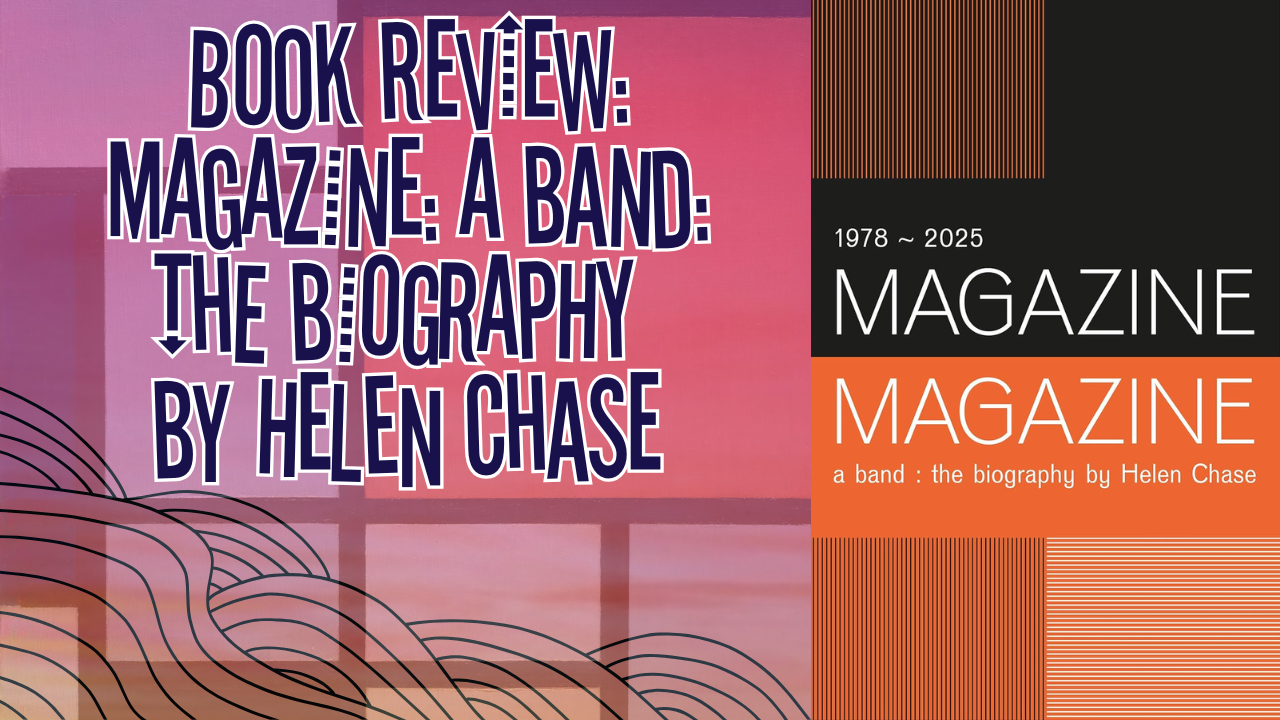
Magazine were only active for four years from 1977-1981 and while they had never made much money at all because of their mould-breaking, forward thinking sound, they had influenced artists like Simple Minds, Johnny Marr of The Smiths, Radiohead, and Red Hot Chili Peppers. This ~300 page long updated biography of the band tells their story and is the comprehensive tribute that they deserve, a deep dive into their history from humble beginnings to the classic lineup to their brief reformation in the 21st century. The original biography came out in 2009, but this updated version adds coverage of Magazine’s 2011 album No Thyself, their first album in 30 years.
In the first chapter, each band member is introduced to us, and not just the classic lineup, but also those who were important to Magazine’s history early on like Martin Jackson and Bob Dickinson. While Martin Jackson’s influences were more rock and roll, Bob Dickinson’s influences were actually not so much rock and roll, but rather classical, medieval, and experimental music, but he also liked The Clash and The Fall. Bob was fired early on because he was too academic in style, and while those influences definitely shaped the sound of the band, he wasn’t cut out for life on the road.
Howard Devoto formed Magazine in 1977 with Scottish-born guitarist John McGeoch, who was then an art student at Manchester Polytechnic. The two had met by chance through a friend named Malcolm Garrett. John had started playing guitar when he was 12 and got a guitar as a birthday present. His early influences were Jimi Hendrix, Cream, and Free. He would also go on to play in Siouxsie and the Banshees from 1980-1982. McGeoch wasn’t the only art student in the band, so was bassist Barry Adamson, who was mixed race and had attended Stockport Art College before dropping out to start a music career. Adamson felt like an outsider because of his mixed background and he wore it as a badge of pride, now that’s punk rock! The oldest member of the band, Dave Formula, was in 1960s mod/freakbeat band St Louis Union, who would frequently play The Twisted Wheel.
Finally, Howard Devoto, was not from Manchester, but actually born in Scunthorpe and raised in Nuneaton and Leeds before attending Bolton Institute of Technology in Manchester. Much like his bandmate Pete Shelley, whose name comes from Percy Bysshe Shelley, Devoto also loved literature and got into poetry thanks to Bob Dylan, Dylan Thomas, and Gerard Manley Hopkins. During a gap year, he worked at a record store and got into David Bowie, listening to Hunky Dory – the references to Warhol and Dylan caught his eye. Of course there’s a bit of Buzzcocks history mentioned in the book – much appreciated as a fan of the group, setting the scene for Magazine.
Devoto left Buzzcocks just as they were about to move forward because of differences from his bandmates. He had seen them as not taking things seriously and he had a lot of plans. Still, the split was amicable and he remained close to his former bandmates and even co-managed Buzzcocks for a time and co-written songs with Pete Shelley. After meeting McGeoch he placed a carefully worded ad in Virgin Records in Manchester, so he could get the right band members. It read something like: “Howard Devoto seeks other musicians to perform and record fast and slow music. Punk mentality not essential. Come woodwind, brass, or fire.” The band’s name hadn’t been picked yet. The reason for Magazine was it had a double meaning: a literary element and an association with guns, a bit of edginess. Soft and hard, and that’s what the band were going for, a mix of things. Because of Howard being a former Buzzcocks member there was a lot of interest in his new project early on. To stand out, he loved to experiment with fashion and makeup for a theatrical approach. At one show, a journalist noted that his appearance was very Dracula-like. Devoto’s songwriting was very literature influenced, inspired by the likes of Huysmans, Camus, and Dostoyevsky. Like a lot of other great songwriters, he carried around a notebook with him and would write down snippets of conversations and write songs based on that, much like a photographer is aware of their surroundings and finds something picturesque when normies don’t. That’s really the beauty of art, finding artistic things in everyday life.
Their 1978 debut single “Shot By Both Sides” just missed out on reaching the top 40, but had received praise from critics and it got them an appearance on Top of the Pops in February 1978. After that, they never came close to charting. Their follow-up single “The Light Pours Out of Me” took inspiration from the Glitter Band with a guitar riff and beat reminiscent of “Rock and Roll Part 2”. Devoto himself said that Television’s “Guiding Light” was a big influence on that song. As catchy as it is, it failed to chart. However, they got to tour Germany with the Patti Smith Group, their first and only time being an opening act. While it was cool to see new places, they didn’t like the fact that the audiences were apathetic about them because they were unknown in mainland Europe and they found Patti Smith difficult to work with and that she was only interested in one of their roadies, not so much them. Sounded like one of those never meet your heroes moments. There were silver linings like when they played in Berlin and Iggy Pop made an appearance and then took Magazine to a club and they had a great time. After returning from Europe, Magazine appeared on The Old Grey Whistle Test.
In 1979, Magazine released their sophomore album Secondhand Daylight, produced by Colin Thurston. Originally they wanted John Barry or Tony Visconti to produce them, but it wasn’t feasible to record in LA and they didn’t have the budget for Visconti, so they went with Thurston, who had co-engineered Heroes and Lust For Life with Tony Visconti. It was their first album with drummer John Doyle, who joined the band in October 1978. The album featured more keyboards than its predecessor and it confused critics, who called it wintry and too arty/pretentious, comparing it to Pink Floyd. However, Nick Kent of the NME loved it. Magazine went back on the road again, this time with Simple Minds opening for them and the crowds loved it.
However, happiness doesn’t pay the bills and the band were in dire straits financially. They changed management from Andrew Graham-Steward to Raf Edmonds, who had experience managing Richard Hell and the Voidoids. From there, Magazine went on their first US tour, a milestone for any British rock band. As Howard Devoto recalled, it was the furthest he’d been from home and things changed for him, with him taking responsibility for the more business side of things with Magazine, so other band members started contributing more creatively. He was still writing the lyrics on the next album The Correct Use of Soap, released in May 1980. However, travelling overseas gave the band some new inspirations and they started incorporating more apocalyptic, power, and political themes in their music. It would be their last album with John McGeoch, who left to play guitar for Siouxsie and the Banshees. Barry Adamson said he had a bit of an ego so it was a matter of time until he’d leave the band. At one point, he was playing in both bands and he wanted to come back to Magazine, but Siouxsie and The Banshees made a better offer. Another frustration at this time was working with producer Martin Hannett, who had produced Unknown Pleasures and Closer for Joy Division. He would often get band members arguing with each other and he was a control freak. They toured the US again, and then went on to tour Australia and New Zealand, new places for Magazine. They also toured with XTC.
Robin Simon replaced John McGeoch on the album Play, their second album released in 1980, but he didn’t stay for long because he was shy and hadn’t really brought any new ideas to the table, kind of just treating his time in the band as a job that you clock in and clock out of. Unfortunately, the departure of McGeoch was a major blow to the band and they couldn’t recover from it. They were stuck as a cult band, never a mainstream one. Ben Mandelson, a friend of Howard Devoto’s, replaced Robin Simon and played on their last album before breaking up, Magic, Murder, and the Weather, but he wasn’t a good fit either as his experience was more jazz, as Barry Adamson put it. Before the album was released, Howard Devoto called each of his bandmates telling them he was quitting the band. Losing the two founding members, that’s when you know it’s over. There were regrets afterwards about how Magazine had broken up and maybe they could have taken a hiatus instead of breaking up entirely.
There’s an entire chapter of the book dedicated to what became of the band members. Martin Jackson joined The Chameleons, Bob Dickinson lectured and wrote books, Ben Mandelson went into world music, John McGeoch struggled with drug and alcohol addictions – he and John Doyle joined The Armoury Show and McGeoch later joined Public Image Ltd, Barry Adamson worked with Nick Cave and the Bad Seeds, Howard Devoto released a solo album and formed a side project called Luxuria and then got a day job at a photographers’ agency taking a break from music in the 90s, and Dave Formula was in Visage (along with John McGeoch and Barry Adamson) and Ludus.
In 2009, Magazine reunited and by this point Howard had left his day job with doubts and anxieties about a reunion. You know that 30 year rule with music and nostalgia? Well, fans wanted a reunion and as time passes there are new generations of fans who weren’t around for a band’s heyday. John McGeoch passed away in 2004, but the rest of the band were still around. In February 2009 they played some sold-out shows. From there, they played festivals like Latitude and Electric Picnic. Noko, Howard Devoto’s partner in Luxuria, filled in for McGeoch when Jonny Greenwood of Radiohead turned it down because he was too overwhelmed to fill in the big shoes of his idol. Noko ended up becoming a band member and played on their 2011 album No Thyself. Because of the amazing reception, they felt like they had to record another album to keep the momentum going. For Howard, he didn’t want to be a tribute act only playing old material and he didn’t want to play any more shows after 2011. In the end, he was happy with how the reunion shows and album had turned out. In 2016 there was one more release on Record Store Day, a live EP of their reunion shows at Manchester Academy in 2009.
Final Thoughts on Magazine: A Band : The Biography
Overall, the book is a really comprehensive look at Magazine’s history and is very detailed with so many stories of their gigs and the recordings of their albums as well as the backgrounds of the band members. The story very much reminds me of the VH1 Behind The Music documentary series, isn’t that every rock band though? Anyway, if you’re a fan of that series and want to read something about Magazine in that Behind The Music format, then this book is perfect for you. As always I love how small of a world music scenes are and how everyone really knew each other and toured with each other.
While the book may seem long in its page count, it really doesn’t feel long-winded at all because there are many pictures of the band peppered throughout the book and there’s an index with lyrics, a chronological list of gigs, and Magazine’s discography, as well as an index for quick reference. Definitely a great gift for any fans of Magazine and if you haven’t listened to them, give them a listen because they’re post-punk pioneers!
Liked this blog post and want to support my work and see more? Donate to The Diversity of Classic Rock on Patreon or Paypal or follow me on Facebook, Bluesky, or Instagram, buy my book Crime of the Century, click the follow button on my website, leave a nice comment, send your music or classic rock related books for review, or donate your art and writing talents to the blog. Thank you for your support! If you donate any amount of money to my Patreon or PayPal, you’ll get a Crime of the Century ebook, so it’s basically pay what you can! The best deal you’ll get on the book and you won’t find this deal anywhere else! I just want to give back to my readers and say thank you for your support.
Leave a Reply