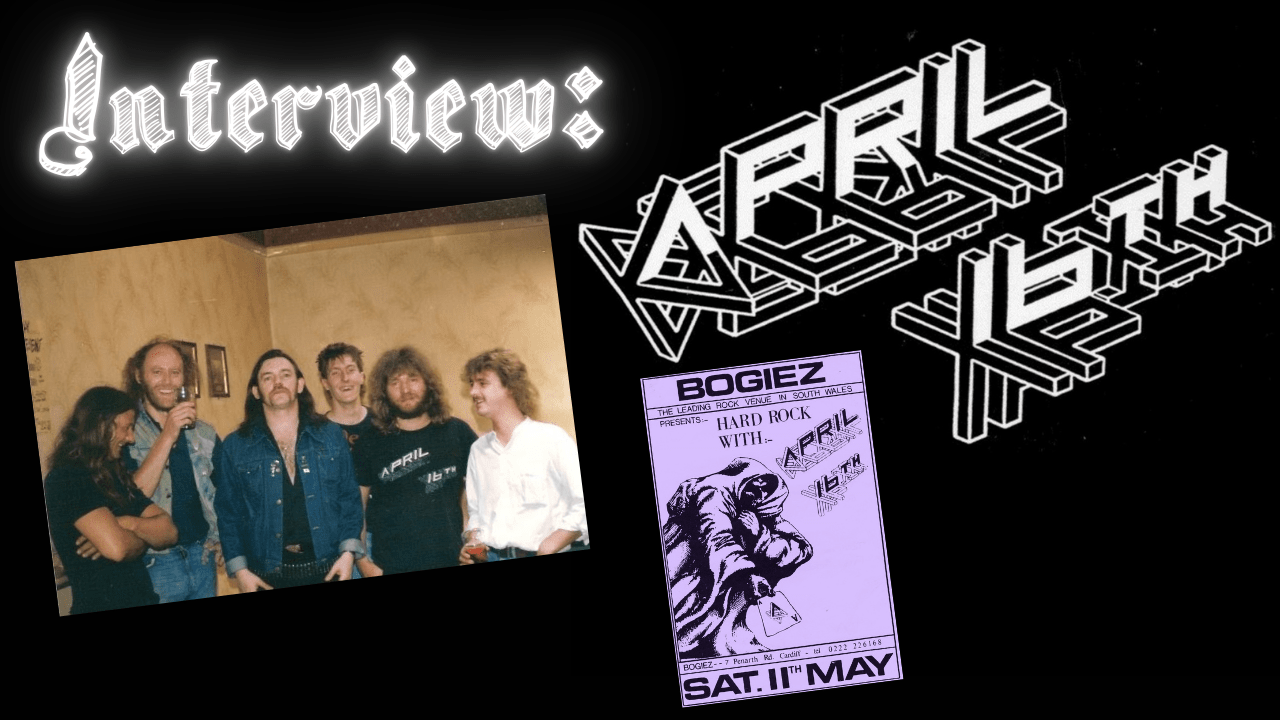

April 16th were a hard rock/heavy metal band formed in London in the 80s, active from 1985 to 1991. The lineup consisted of Dave Russell on vocals, John Fisher on drums, Eric Puffett on bass guitar (passed away from covid a few years ago, RIP), Chris Harris on rhythm guitar, and Lawrence Mills on lead guitar. They were one a band on the brink of success, working hard to make a name for themselves, but by the late 80s, the New Wave of British Heavy Metal (NWOBHM) was in decline and glam metal was in style, but not for long, because the 90s responded with grunge and Britpop. In the classic rock era competition was tough, but April 16th had some incredible achievements over their career like meeting Lemmy, playing at the famous Marquee Club in Soho, opening for Budgie, playing a festival supporting Uriah Heep and Rory Gallagher, and being featured in Kerrang! Magazine. One of the things that stood out to me about their story can be found on the cover of frontman Dave Russell’s memoir The Ghosts of April: “The life and times of the ugliest man in rock – living the dream isn’t always what it’s cracked up to be.”
Thanks to the internet, smaller rock bands from the past have found new audiences and virtually reunited with their fans, giving their music a new lease on life, so it’s a great opportunity and a pleasure to introduce you to April 16th. It’s an interesting, raw, real look at the realities of trying to make it in rock and roll while working a day job. You know that meme about how the parents of the members of “indie” bands are in blue on Wikipedia? It’s so true that money really makes the difference in the arts. So many creative minds are just stuck toiling in jobs for the rich man. Another painful truth is how glamorous the rock star or actor lifestyle is portrayed as, and that’s true for a tiny percentage of them. For most musicians, it’s a lot of work and much less money than expected, if they even make anything from it. To be brutally honest, you’re lucky to break even in creative fields. I recently saw this post on Threads that sums it up well:
“Beware of ‘making it.’…My mate’s band (5 of them) was signed to Virgin Records in the noughties. They were given a £250,000 advance, and even though they made 3 albums, had a cult following, played Glastonbury 3 years running, did songs for a major film, computer game and Nike tv advert, pretty much their whole career was paying back their advance. A major deal might seem great, but left them with nothing. Now they don’t even speak”
You can listen to Epitaph on Spotify, but if you prefer physical media, April 16th are happy to send 10 of my readers a copy of the CD, just get in contact with them and tell them Angie Moon sent you.
Without further ado, the interview. What I especially love about this one is how different everyone’s perspectives are and it shows how everyone’s got their own story.
Angie: How did April 16th get started?
Dave: We all kind of fell together through tenuous connection. We just kind of bumped into one another,
but with an almost unworldly surreal twist or two. Suggest reading the opening chapters of a book
about April 16th, entitled The Ghosts of April. All is explained in gory detail.
Chris: I mentioned to a neighbour that I was looking to form a band and he recommended a friend of his
(Lawrence). I then discovered this was Lawrence Mills, an old school classmate of mine whom I didn’t
even know played guitar. I arranged a meet at which Lawrence blew my face off with the opening
notes to what became our 1st track “Illusion”………. And April 16th was born.
John: I answered an ad on the rock paper “Sounds” and was offered the drumming position.
Lawrence: I hadn’t seen my old school mate Chris Harris since leaving school in the late 60s. I started working at a Comet Warehouse, where I was talking to a workmate there about how I was a guitar player looking for a band. He told me he lived a few doors down from Chris, so I went round with my guitar to play and have a chat and the discussion of forming a band happened from that point on.
Angie: What was it like growing up in London in the 60s and 70s?
Dave: In spite of what Gen Z might think, it was tough coming from a working class family living on a council estate in the sixties, but life was made more bearable with the discovery of so many different types of music. It was an escape. There was also a strong sense of community. There wasn’t much disposable income about; air travel was something for the rich and famous. But music was accessible for anyone with a transistor radio or a relatively newfangled invention called a television.
The seventies meant plenty of work was available and being paid wages, to spend on gigs, albums, beer and girls, and not necessarily in that order. The seventies were amazing, my favourite decade.
Chris: Those days felt very modern to me compared to earlier decades. Everything was new and groundbreaking.
John: The music of the 60s and 70s were really special and the scene in London’s Carnaby Street was where it was at.
Lawrence: I got a job in central London delivering telegrams in 1970. Unknown to me, our future lead singer, Dave Russell, worked in the same building and we soon hit it off, meeting up at lunchtime talking about bands, so it was great.
Angie: What bands influenced your sound the most?
Dave: I’m gonna be controversial and say I don’t think any particular band(s) influenced our sound. We had no intention of sounding like anyone else. We had our personal influences for sure, but individually we all contributed to our overall sound, of course. When we plugged in and played, the sound we made wasn’t an attempt to mimic someone else, it was purely organic.
Chris: I’d always dreamt of filthy dirty guitar sounds and suddenly Black Sabbath arrived and I’d found that sound. Add on some Groundhogs, Jethro Tull, Stray, UFO, etc. and I was in heaven.
John: For me it was the voice of Rod Stewart. He had this fantastic band called “Faces” behind him.
Lawrence: The bands that influenced me the most were bands such as Cream, Led Zeppelin, Black Sabbath and also bands with a touch of progressive rock to them such as Pink Floyd and King Crimson.
Angie: What makes the NWOBHM special to you?
Dave: NWOBHM was the most significant genre to hit rock music since the kids of the sixties heard the likes of Little Richard and Chuck Berry and the music coming from America in the fifties. It influenced and spawned the thrash metal bands which were emerging from the States, and its longevity, given the number of bands from that era that are still around, is a testament to its significance. I lost count of the number of bands I saw during the formative years, all varied in their style and sound, but falling under the banner of NWOBHM.
Chris: The NWOBHM was a response to the first wave by young people now old enough to offer their take on their heroes output. The first wave was a tectonic shift in the global music scene and the NWOBHM was the tsunami that followed.
John: The raw power, great musicians.
Lawrence: If I knew what NWOBHM stood for I could probably answer this question, but since I don’t…
Angie: Who are your favourite bands you’ve seen in concert?
Dave: Ah, live music. Some of the best gigs I’ve attended have been in small clubs, some of the worst in cavernous arenas. I couldn’t nail down a favourite band to see live. I was lucky enough to see most of the big hitters in the seventies, all amazing, and to this day I travel extensively, including internationally, to see bands, most of which the average music fan wouldn’t have heard of. Live music is at its purest in the moment of performance. A few cold beers, a decent band at volume in a 200-300 capacity, it’s magical and erotic and totally uplifting.
Chris: I’ve found that since becoming involved in live music as a band member myself that my interest in other bands has all but vanished. I don’t know what psychological condition could account for such irrational behaviour, but I’m glad to say that things are improving and recovery seems imminent.
John: My favourite band to watch live has to be Deep Purple, their drummer Ian Paice is phenomenal. Dio had a magical stage show.
Lawrence: The Pink Fairies, Nektar, Tangerine Dream, and Camel.
Angie: What were your favourite songs to perform live?
Dave: I think the best live songs of ours were the ones which were most enjoyed by our fans. To that end it would have to be “The Dealer”, “Don’t Drink”, “Clapham Wood”, and “Madagascar”, a personal favourite, which was regrettably never recorded.
Chris: “Sleepwalking”, “Thursday’s Child”, “Bloody Mary”, “Clapham Wood”, all of them really.
John: My favourite April 16th number has to be “Illusion”. The very first tune we rehearsed.
Lawrence: “Clapham Wood”, “Illusion”, “Thursday’s Child”, and “Don’t Drink”.
Angie: What was it like recording Cherry Jam and Sleepwalking?
Dave: It was all a bit intimidating, really, for me anyway. We were just everyday boys who found ourselves in this strange, professional environment. I never knew what ‘production’ was. Listening back to those sessions now, the production was a little underwhelming. Chris has managed to salvage a decent degree of respectability with the remastered ‘Epitaph’, and he deserves real credit for that, but overall as an experience, those sessions were exciting and slightly daunting. Our first demo as a collective was pretty good though. However, I don’t think any copies still exist.
Chris: Cherry Jam was basically a gig getting demo session really and our playing was wilder and more natural than the Sleepwalking session that was destined to become an official vinyl LP release. They were both long sessions but capturing the essence of each track was for the most part successful.
John: We went straight in and recording was quick. I felt a little nervous recording at first, but it all came together nicely.
Lawrence: Nervewracking!
Angie: What’s the story about Dave Russell being called “the ugliest man in rock”?
Dave: There was a ‘rock’ magazine called Kerrang!, which ran a weekly feature called ‘The ugliest man in rock’. Someone on their editorial team must have seen one of our flyers with a picture of the band on it and decided I would be the perfect specimen. I was, and still am, one of the ugliest people on earth to look at, but inside I’m a sensitive, caring soul, and I can be trusted around children and most animals. But on the plus side it got us some publicity.
Angie: What was it like playing the Marquee Club in the 80s?
Dave: For me it was the realisation of a dream. We played there several times, in the support slot on each occasion, but it was absolutely incredible. When the Marquee closed and moved to a new premises called The New Marquee, we played a headliner there, but it wasn’t a patch on the original venue. It was I suppose, the equivalent of a footballer playing at Wembley in the FA Cup Final.
Chris: One of our Marquee gigs was a Saturday night headline slot. Two minutes before kick-off I went on stage via the backstage door. I was just placing the band’s set lists in convenient places for us all to see them. All of a sudden there was an enormous cheer as the crowd believed we were about to come on. The hairs on the back of my neck stood up and a chill ran down my spine. I’d never felt so proud of us as I did at that moment…….. I really believed we’d finally arrived.
John: Playing the Marquee was a dream come true. Just think of all the iconic bands that have played there.
Lawrence: It was surprisingly smaller than I thought it would be, but yeah, I enjoyed it a lot.
Angie: What were the biggest challenges you faced as a band?
Dave: Firstly, trying to get a decent break. Our style and appearance were perhaps seen as unoriginal, given the number of bands that chose to wear make-up and costumes at the time. Our music was also seen as a bit retro, coming from the previous well trodden path of blues based biker festivals, which may have been true, but when we broke up we had progressed with some well crafted songs which were far removed from that tag. Secondly, we didn’t get to record those later songs.
Chris: Financing our promotion and the costs of hiring purposefully over-sized P.A’s and mega light rigs were terminally destructive.
John: For me, the biggest challenges were trying to get more press releases. It was like banging your head against a brick wall.
Lawrence: Doing a day job and gigging after a full day’s work and then not getting paid a fortune for the time and effort being put into it.
Angie: Is there anything you wish you had done differently knowing what you know now?
Dave: We should have taken it more seriously. Nothing in particular, but everything within our scope of potential. The foundations were there, but we were all working full time, and sometimes channelling the required energy and effort into our development was overlooked. Looking back I see too many ‘what ifs’. But hindsight is ….etc, etc.
Chris: When we ran out of money trying to put on ever more expensive shows – instead of splitting up I wish we had temporarily halted live shows to focus on recording, releasing, and succeeding with a new album(s). The larger audiences this might have attracted may have solved our money haemorrhaging gig costs problems.
John: Yes, good question, taken the whole business more seriously.
Lawrence: Instead of picking up a guitar at the age of 15, I would have demanded one on my first birthday and started practising then.
Angie: What did you do after the band broke up in 1991?
Dave: After continuing with Eric and John with a band called Ramp, we played one gig before love came calling and I moved to Norfolk to start a new life. I didn’t miss it at all at the time, although I really missed my former band mates, and still do. We had some good times together. You can’t go through what we did and not have an affinity with one another.
Chris: After a period of heart-ache I got the bug again and talked Lawrence into forming a new band with me. Like April 16th, this new band (Matrix) had a lot of promise and released a CD entitled Thrice Upon a Time. The new members though soon became tired of the slow road to success and abandoned ship.
John: We tried to keep April alive. Eric, Dave and I stayed together for a while. But when Dave left it was all over. Eric and I joined a new band but it was short lived.
Lawrence: After April 16th’s break up, me and Chris did one album and a couple of gigs under the band name of Matrix, which also had some bit of success. After that band split up, I did, for a while, keep in contact with Chris and did some home recordings with him until that petered out. Some years later I did some solo recordings at my own home. During this time, at my day job I got chatting to a workmate who played bass and over email we produced about 5 albums with his band that was called The Power of Mary.
Angie: What is your proudest accomplishment as a band?
Dave: Two things: Playing The Marquee in Wardour Street, and the Radio One session with Tommy Vance on The Friday Rock Show.
Chris: Being invited to record a session for the Friday Rock Show with Tommy Vance for BBC1 and to have lasted 5+ years on the front line surrounded by the big guns and budgets of major record labels and the bands they carried.
John: Seeing the release of our album Sleepwalking. To hold that product in my hands. What fantastic artwork for the cover. Love the Epitaph CD. Chris has done a wonderful job on that.
Lawrence: I think playing at the Marquee must be the highlight for our band, but playing at the Kent Custom Bike Show and also in France were also really good highlights as well.
Angie: What is your opinion on younger generations getting into rock music of the 60s, 70s, and 80s?
Dave: Good for them. They are the future! I love seeing young kids picking up guitars and cranking the riff from “Sad But True” [Metallica], or behind a drum kit smashing “Raining Blood” [Slayer]. And those things will stay with them forever, same as when I was 15 years old and hearing “Dazed and Confused” for the first time. It grabs you by the balls and never lets go. The rock and metal genre is easily the most exciting and creative of all types of music. And there are so many good bands out there. Something for everyone. When a younger person starts listening to the older bands from those decades it tells me they have good parents!
Chris: I’m encouraged but not surprised that the highly innovative bands of these decades still enthuse later generations. Long may this continue.
John: I love seeing/hearing the new generation of Rock fans enjoying my era of great music.
Lawrence: I’m all for it. Pleased to know they’re wanting something more than the overproduced, synthetic pop crap that’s about now. Good to know they want to keep it real.
You can follow April 16th on their website, Facebook group, and Bandcamp. There’s also some more information about them on Metal Archives.
Liked this blog post and want to support my work and see more? Donate to The Diversity of Classic Rock on Patreon or Paypal or follow me on Facebook, Bluesky, or Instagram, buy my book Crime of the Century, click the follow button on my website, leave a nice comment, send your music or classic rock related books for review, or donate your art and writing talents to the blog. Thank you for your support! If you donate any amount of money to my Patreon or PayPal, you’ll get a Crime of the Century ebook, so it’s basically pay what you can! The best deal you’ll get on the book and you won’t find this deal anywhere else! I just want to give back to my readers and say thank you for your support.
 The Diversity of Classic Rock