

The years 1963 and 1964 are some of the most interesting years. This is when I truly believed we went from one era, the 50s, to the next, the 60s. Of course it’s not as simple as the pop history explanation of how we went from the conformist 50s to the rebellious 60s since we had our fair share of rebellion in the 50s. I mean, you wouldn’t have the music of the 60s without the music that came before it. As someone obsessed with the 60s, the JFK Assassination and Beatlemania will forever be my Roman Empire. How many hours have I spent writing and reading about these topics, I don’t want to say. That would be embarrassing because I know I could do a lot more productive things than yap about my favourite era. I mean, when would this information come in handy? Trivial Pursuit? A pub quiz? Not like I can get rich off this special interest.
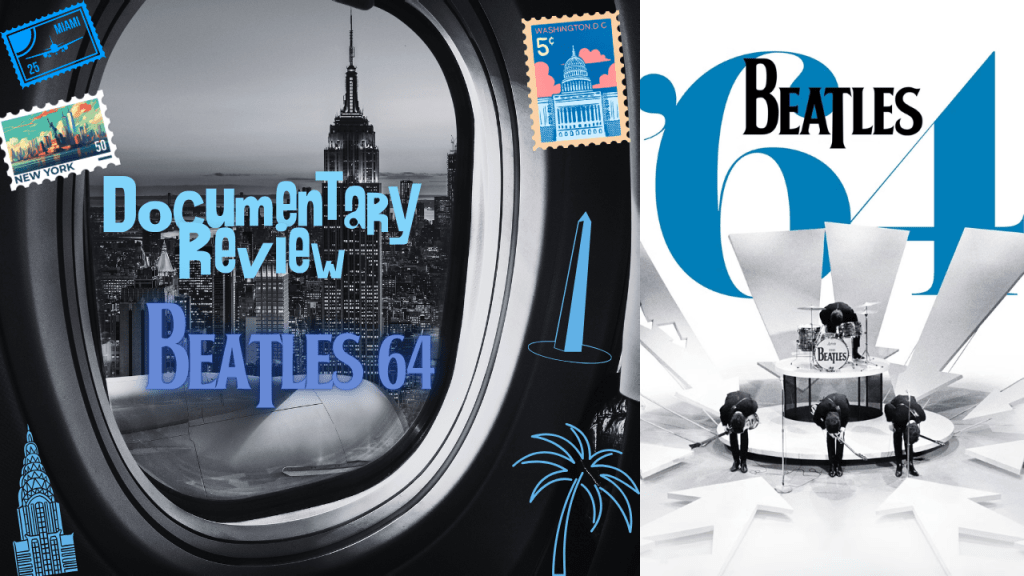
Like many others, I’ve been looking forward to this Martin Scorsese-produced Beatles documentary for ages. Martin Scorsese and making documentaries about classic rock, name a more iconic duo. He’s an incredible film director, one of my favourites and I don’t care if it’s a cliché, and it’s the cherry on top that he’s associated with classic rock from Woodstock to The Last Waltz (The Band) to No Direction Home (Bob Dylan) to Shine A Light (The Rolling Stones) to Rolling Thunder Revue (Bob Dylan) to Personality Crisis: One Night Only (David Johansen of The New York Dolls) to Beatles ’64. Living the dream! So I have high expectations, even though in previous reviews, I’ve had some mixed thoughts on some of the Disney+ Classic Rock documentaries. Like I found The Beach Boys documentary to be underwhelming as someone who knows a lot about their lore. And with Get Back, as much as I love The Beatles, maybe there is too much of a good thing with Get Back being like seven hours in total. I’m not sure if I want to watch seven hours focused on just one era. To be fair, I wouldn’t say Let It Be is my favourite Beatles album. There’s no such thing as a bad Beatles album, but if I were to do a tier list, I don’t think it would be S-tier for me. If I had to pick a favourite Beatles era, I’d say their material from 1964-1966 is my favourite. Partially because that’s what we’d listen to most at home. The early Beatles material holds a special place in my dad’s heart because that’s how he got into The Beatles. Like tens of millions of others, he and his three brothers and his two cousins were crowded around the TV watching The Ed Sullivan Show on 9 February 1964, a historic event that was part of The Beatles first visit to America. I actually have a distant relative who was in a famous Beatlemania photograph. She and some friends were in front of the Plaza Hotel hoping to catch a glimpse of a Beatle.
It was a two-week long whirlwind of an adventure across the East Coast of the United States, a lot of ground to cover and in that trip, they visited three amazing cities: New York City, Washington DC, and Miami, each beautiful in their own way. NYC and Miami have some of the most beautiful skylines I’ve ever seen and Washington DC is a city with such beautiful neoclassical architecture and great planning thanks to Pierre L’Enfant, whose work planning DC inspired plans for other capitals like Brasilia, New Delhi, and Canberra. Americans in other parts of the country would get their chance to see The Beatles live when they came back later in 1964 during the summer.
Beatlemania is something you could write a whole PhD thesis on and in a weird way, I felt like Beatles ’64 was a bit short and I would have liked a limited series detailing their adventures not just in New York, but also in Washington DC and Miami, instead of just one documentary. That would be more enjoyable watching for me, but just as important is good organisation and that’s what I felt that this documentary was lacking. Pacing and organisation was a bit weird and jumpy and I felt like I was getting whiplash with the back and forth, but maybe they want us to feel how The Beatles felt seeing all the hysteria around them and having to cover so much ground in such a short time. Not only was the organisation lacking for me, I think that there were way too many soundbites and interviews with (largely) nepo baby/posh fans and not so much with fellow musicians themselves. Then again, classic rockers are dying and getting new interviews with musicians who are pushing 80 or are approaching 90, let’s be real, is going to be difficult since there’s not many of them left. Which is why I believe it’s so important to interview them while they’re still here to remember their journeys for years to come. Maybe I sound old, but I miss when documentaries had narration. Not sure about this newer style of documentary. To me, it would have made sense if it had been broken up into featurettes and distributed on YouTube or TikTok. Also I need to add this: why is Beatles music post 1964 in this documentary? I get that “In My Life” is a great memorial song, but that was on Rubber Soul, which hadn’t even come out yet. So that kind of irked me because I think this was a great opportunity to have some deeper cuts from their early days in the documentary, but that’s just me being picky.
The documentary begins with a montage of clips of JFK to show what America was like before Beatlemania. It was a country in mourning, regardless of your political leaning. A very different time compared to today, that’s for sure. No matter where you are on the political spectrum, you gotta agree that JFK was a hero and one of our best presidents, definitely one of the most likeable ones. Weirdly, I have a feeling had he lived, he would have invited The Beatles to the White House. Would they have accepted the invite? Maybe, maybe not. It’s hard to say.
Still, I don’t regret watching this documentary because it had a lot of great moments and quotes in it and I especially love the inclusion of black history with a Beatles angle and that was my favourite part of the documentary. I loved hearing Ronnie Spector’s story of how the Ronettes were friends with The Beatles and they picked them up from their hotel and all went to Spanish Harlem where nobody recognised them and they got to see a different side of New York. I also enjoyed watching the vox pops of black Americans who were asked their opinion on The Beatles and you got a whole range of views: young girls who loved them, some young people who thought they were alright, and some guys saying they preferred jazz music. Something that I’ve always been frustrated with in social justice and left wing circles online is the inaccuracies and misinformation about rock music. Well-meaning people love to make the claim that The Beatles and Elvis Presley had stolen rock and roll from black Americans and the truth is that both acts had always acknowledged their influences. I do not believe that art can be culturally appropriated because it’s something that all can enjoy and anything creative is universal. I remember scrolling on Tumblr and I saw this super inaccurate post about how The Beatles were problematic because of cultural appropriation and they blamed John Lennon for the “appropriation” of Indian music, when really the one who was into Indian music was George Harrison, who ended up converting to Hinduism in his 20s and sitar legend Ravi Shankar famously had given him sitar lessons and always respected George for his genuine interest in Indian music and culture. If he was so offended by a British man being interested in Indian music, he would not have taught him how to play sitar. From my own experience talking to people from all over the world, if you show a genuine interest in their culture, usually they’re pretty happy to see it (unless they’re a party pooper lol)! If you’re gonna criticise The Beatles, at least get the facts right and maybe do a bit more reading before you make assumptions and jump to conclusions! Anyway, I’ll just share the quotes from Smokey Robinson because I think he said it so well:
“They were the first white group that I had ever heard in my life. The first white artist ever of their magnitude that I had ever heard in my life say, ‘Yeah, we grew up listening to black music. We love Motown. We listen to this person, this person.’ No other white artist had ever said that. Not anyone of magnitude until The Beatles said that.”
And I think something that a lot of people don’t realise is there was a lot of cultural exchange in the 60s between rock and roll musicians and R&B musicians and it’s really hard to say where the line is between the two. At what point is the R&B label just segregation, and that’s a question for today too. Rock stars covered a lot of soul and R&B and took inspiration from it and R&B and soul musicians did the same with rock and roll. Sam Cooke famously loved Bob Dylan’s “Blowin’ in the Wind”. The Supremes covered “I Feel Fine” and “Eight Days A Week” on TV. As seen in the documentary, The Beatles covered The Miracles’ “You Really Got a Hold On Me” and The Miracles’ covered The Beatles’ “Yesterday” in 1968 on The Ed Sullivan Show. Want more examples of Motown going Merseybeat, here’s an article full of examples.
The reality is that British musicians were much more influenced by black American R&B musicians than by homegrown acts. There’s a quote from John Lennon about British music not being anything worth listening to until Cliff Richard’s “Move It”, written by London-born Ian Samwell. Even then, it was quite obvious that Cliff Richard was extremely influenced by Elvis (so were his contemporaries like Marty Wilde and Billy Fury). Before that there was King of Skiffle Lonnie Donegan with “Rock Island Line”, but that was a cover of an American folk song commonly sung by prisoners. Meanwhile if you look at early American rock stars, many of them couldn’t admit they were influenced by black American musicians because racial tensions were very high in the US and concerts were still very much segregated in the 60s. The Beatles weren’t very political, but they ensured that their concerts were always integrated and they refused to play to segregated audiences.
Smokey Robinson also said this:
“The saving grace was the music because it gave those kids a common love. It gave them something that they both loved and they both enjoyed.”
It’s true! Music speaks to us all and it’s something we can all unite over. I’ve been in the classic rock fandom for a long time now and the people in it are really more diverse than you think and I’ll say it: the most passionate fans are often ones from Latin America. English isn’t even your first language and you go nuts over the music, that’s the sign of it being universal. Art really is for all to enjoy and even if you don’t speak the language, the beat, the rhythm, the sound, it can touch you.
One last Smokey Robinson quote:
“Music is the international language. It’s the barrier breaker.”
Sure, it’s easy to say that rock and roll was a distraction from what was going on, and maybe that’s true to an extent, but I don’t think we should underestimate the power of art to change people and inspire people.
While it was archive footage, I got a kick out of Little Richard throwing shade at Pat Boone for his snoozefest of a cover of “Tutti Frutti”. The Beatles were clearly not anything like Pat Boone. When they covered black musicians’ they did a lively tribute in their own way.
Overall, I don’t think this was a bad documentary, but it fell short of my expectations and I feel like it’s a repackaging of old footage with not much to add from today. If you’re a new fan, you’ll enjoy it and that’s awesome! Always happy to welcome new Beatles and classic rock fans. But I don’t think it’s one of the best Beatles documentaries I’ve watched. If I had to give it a star rating, I’d give it 3 out of 5 stars. I probably wouldn’t rewatch it, but I didn’t dread it. There were brilliant moments and I love the restored footage, but it was disorganised and some bits were kinda tired.
Liked this blog post and want to support my work and see more? Donate to The Diversity of Classic Rock on Patreon or Paypal or follow me on Facebook, Bluesky or Instagram, buy my book Crime of the Century, click the follow button on my website, leave a nice comment, send your music or classic rock related books for review, or donate your art and writing talents to the blog. Thank you for your support! If you donate any amount of money to my Patreon or PayPal, you’ll get a Crime of the Century ebook, so it’s basically pay what you can! The best deal you’ll get on the book and you won’t find this deal anywhere else! I just want to give back to my readers and say thank you for your support.


 The Diversity of Classic Rock
Leave a comment