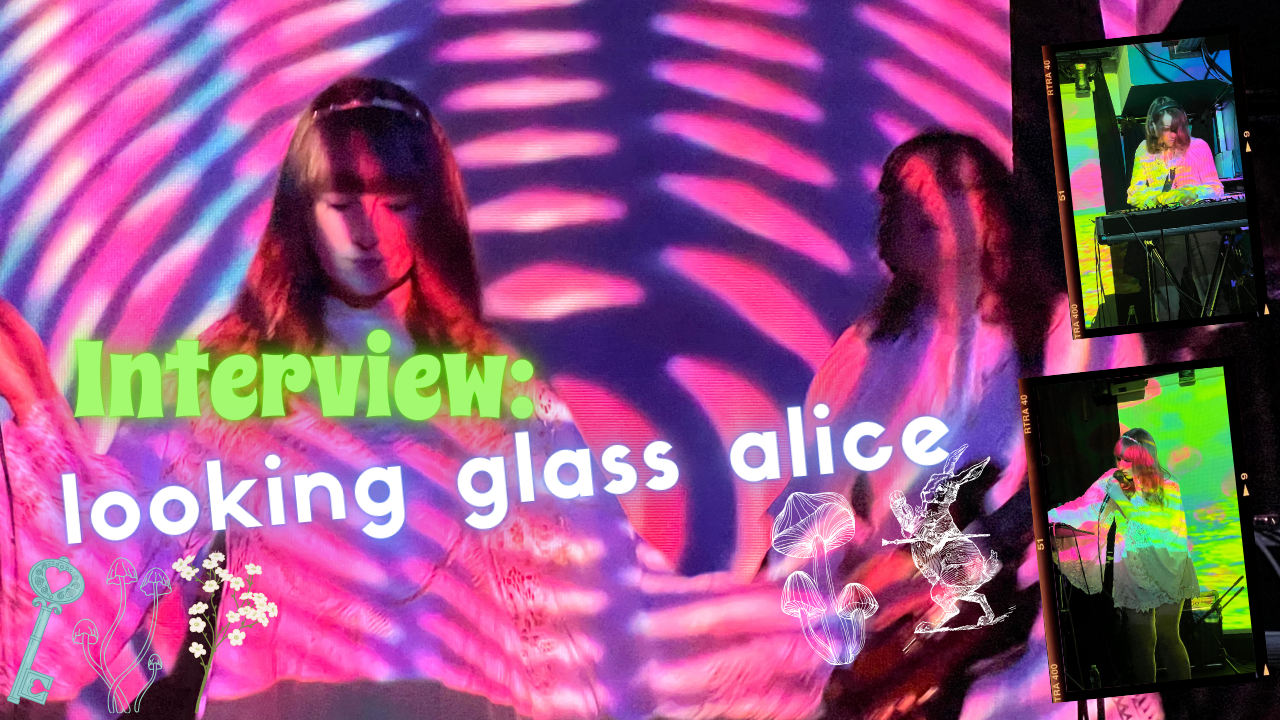

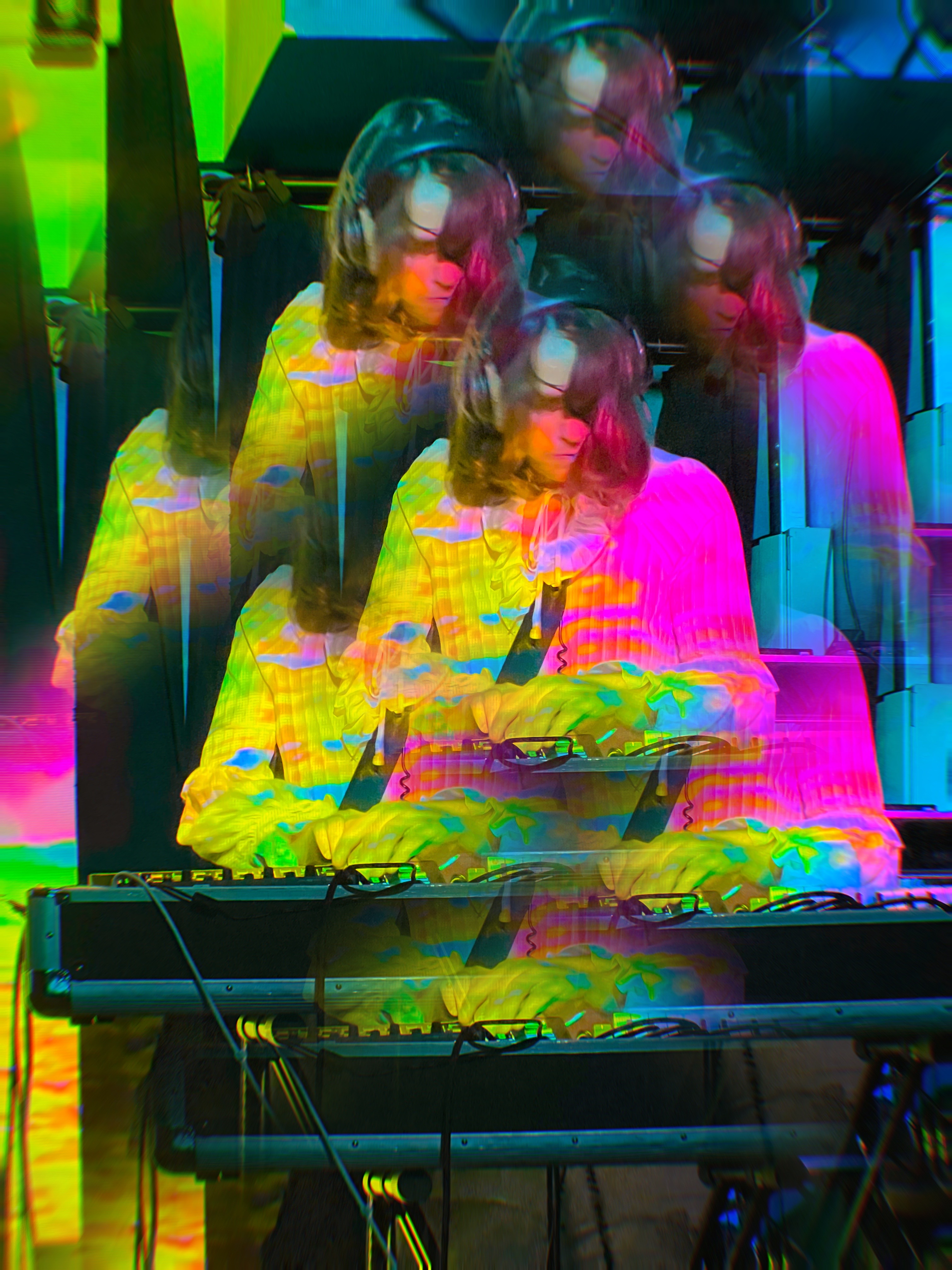
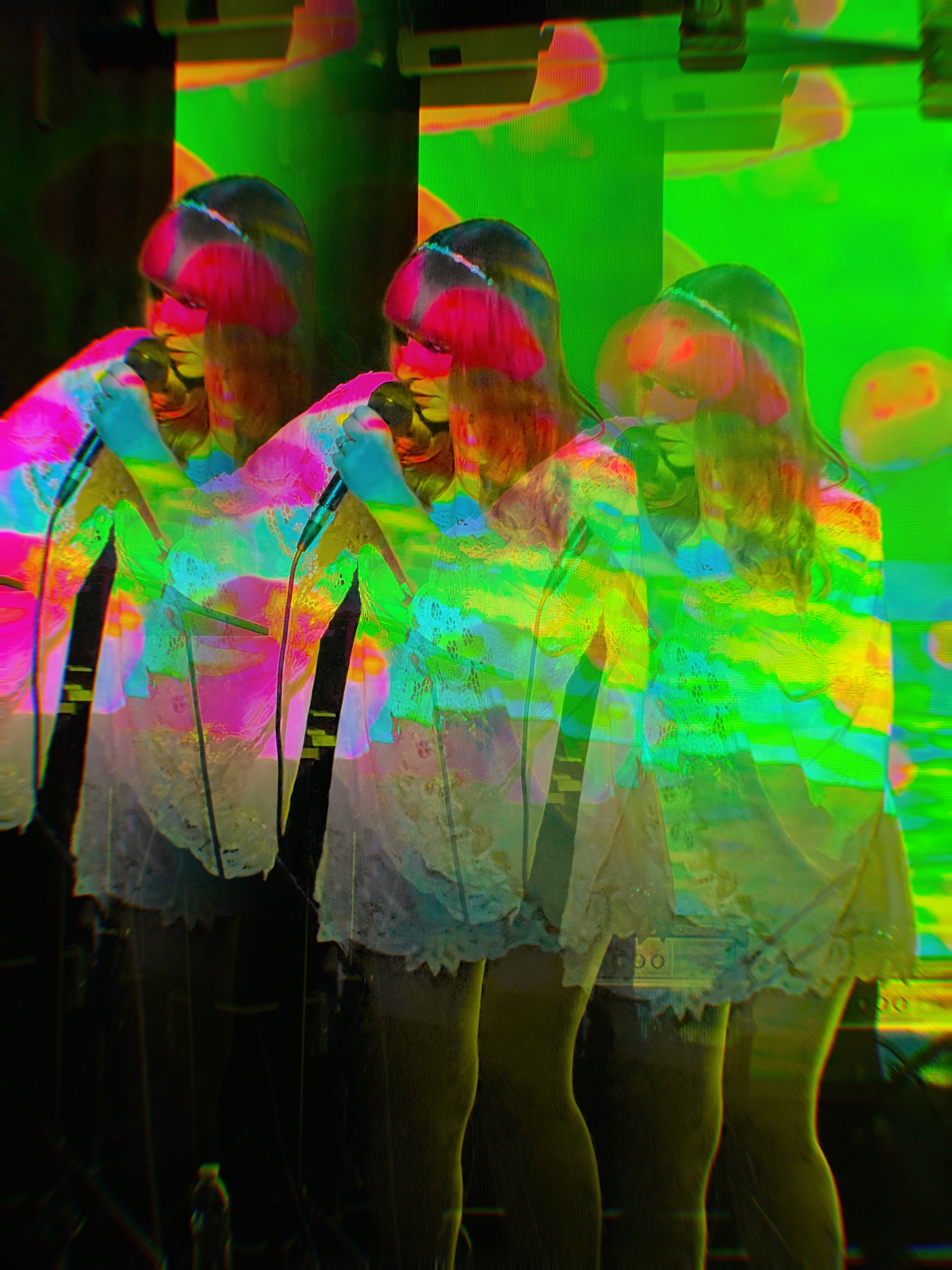
Looking Glass Alice are a psychedelic/electronic/pop group based in Hertford made up of husband and wife Alfie and Sarah. I’ve been following them for a long time, as we’re part of the vintage/classic rock community. I’ve always admired their style and their music is great. They are independent musicians who fund this project themselves and they have accomplished a lot ever since starting their musical careers just a few years ago during lockdown. Like many others, they were bored and wanted to do something fun and why not create something people will enjoy? And so Looking Glass Alice were born. They never like to stay stagnant and they eschew any comparisons to other musicians, so I’ll refrain from comparing them to anyone else. Without a doubt, there’s a lot of garage, psych, group sounds, and acid house influences in their sound and they’re not just limited to that. Some purists might be confused about the mixing of electronic and rock and roll, but there’s really more than one way to view psychedelia and in this thought provoking interview, we talk a bit about this and it might help open your mind to the idea that psychedelia is more than just the 60s. Looking Glass Alice’s set for this show was a nice mix of electronic and psychedelic with a flowing setlist that went from one song to the next, no chatter in between songs. Just great music. If you’re going to see Looking Glass Alice, keep in mind that every set is different and that’s the magic of it. Here are some photos from the gig plus one of me with Looking Glass Alice:


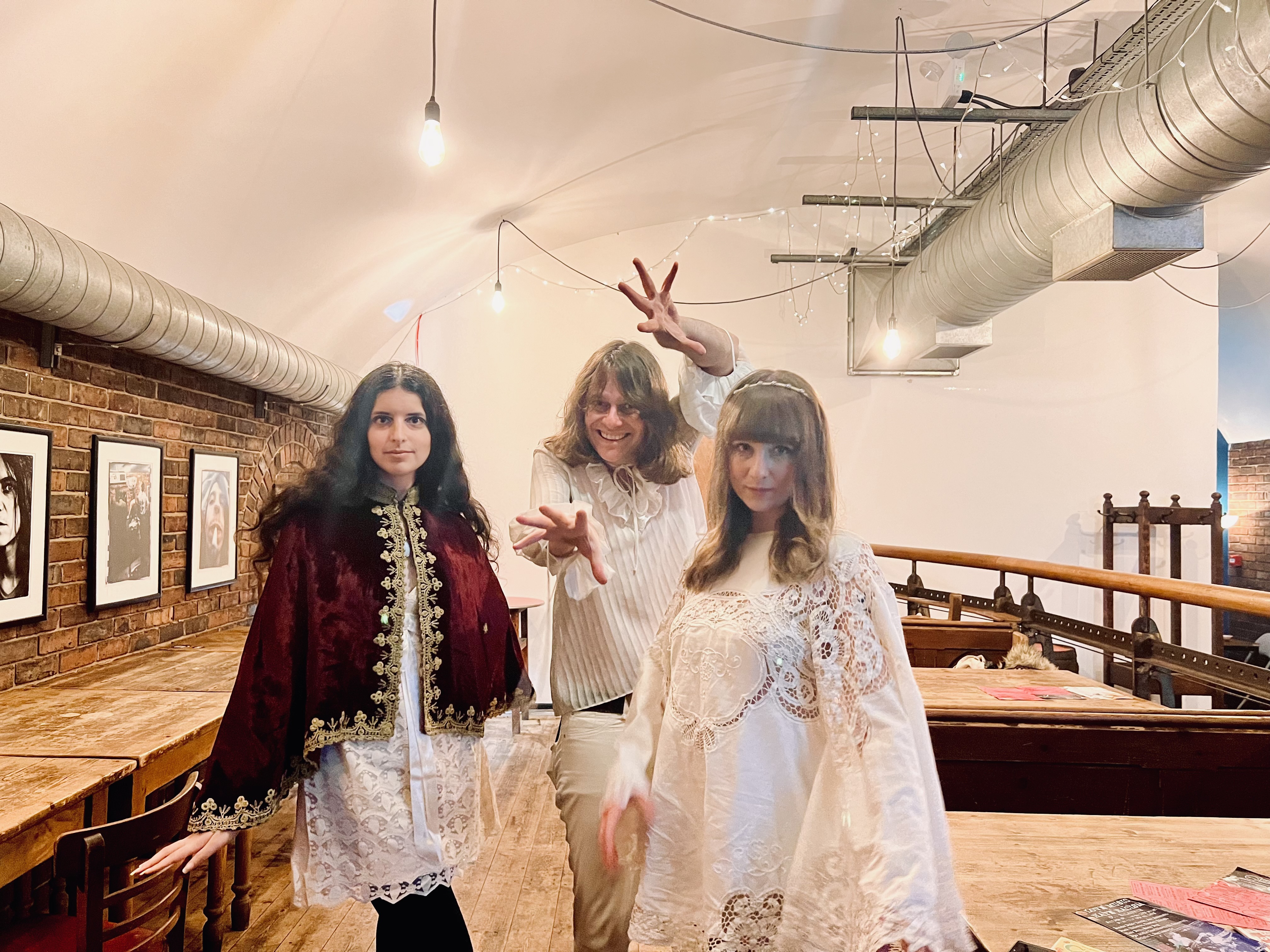
Looking Glass Alice opened for Birmingham based psychedelic/electronic duo Matters. The two groups met at Manchester Psych Fest. Matters’ approach to music is very DIY and they invest a lot of money into their shows. Before the gig, Alfie told me that they built the lighting rig themselves, and that really made the show come to life. Unlike Looking Glass Alice, there were no vocals.
A big thank you to Alfie and Sarah for putting me on the guest list and for their time in this really interesting interview. I hope you enjoy it! Here’s their latest release, a remix/cover of the Donovan classic “Season of the Witch”.
Interview: Alfie and Sarah of Looking Glass Alice
Angie: How would you describe your music to a new listener?
Alfie: We’ve always like gone for the like, bringing the two summers of love together. I feel like the moment someone else tries to describe our music back to me. Whenever ever that’s happened, I always get really offended by it, and I go back into my bubble and go, let’s do something completely different. (Sarah laughs) It’s almost like it’s fighting talk, like it’s a challenge. Let’s go and create something fresh. Let’s be unexpected.
Sarah: Yeah, so we’ve never actually done the same set twice.
Alfie: In last three years. There’s plenty of songs. There must be like, 12, 15 songs we’ve only played once. And like, the last time we played here, we were opening for Jane Weaver. And I think as well, because it was the Deliaphonic Festival we wanted to do something that was a little bit of an homage to Broadcast as well. And yeah, playing Birmingham, playing Coventry, that’s always like a special thing. There’s a lot of material that we’ve written that felt very inspired by, but was quite close to the edge of a lot of their things. And after that, it was beautifully, beautifully recognised, and people really loved it. We have the multi tracks, and we still put it out at some point, but at the same time, it’s kind of, it’s close to the bone when there’s, like, stories that end in tragedy.
Sarah: So it becomes so close with a lot of treasures those friends.
Alfie: Also like people who are big fans of theirs. And it’s just like we wanted it to be an homage rather than an emulation. I think that’s always something that’s important with music.
Sarah: Yeah, it’s a lot of emulation.
Alfie: I think in general, with bands, a lot of bands, when you’re first starting and starting to break it, people will come to you go, Oh, you’re the next such and such. And we were finding that with some, even some producers who absolutely adore would just try and link us into the Broadcast frame, which is beautiful because it’s one of our favourite bands, but at the same time you gotta be respected. You’ve got to be respectful. But also what we kind of learned from that as well, was to look into the process of how she wrote. She was really into automatic writing. A lot of the gigs that she went to really adored bands like Autechre and in the early 90s, they were one of the most challenging bands out there. They got in there in the middle of like the rave era in the UK, when the police were starting to shut down a lot of the illegal, massive, super raves that were happening, and Autechre had realised that there was this loophole in a lot of the legislation that the government brought in that if your music was generative and you could actually make sure that every time the music was played, it was slightly different. It would be a loophole for the rules, because they’d separated it so that you could have all night, sort of hippie festivals with acoustic guitars, let’s say all night. And they tried to separate that from what the rave scene was, but they left this loophole.
So Autechre, even in the early 90s, built all of this software that meant that every time that they went and performed, all their sequences were generative. And for me, realising people like Trish were really listening to these bands kind of made me realise what psychedelic music is, and what that idea is. It’s a driving force of trying to be different and trying to be challenging. I feel like that’s right at the core. If you ever go and listen to like Royal Festival Hall, or is it Queen Elizabeth Hall, types of Pink Floyd you listen to just how challenging the live music is, and all of that music’s in quad, and you’re thinking, what 1968, 1969 and they’re using oscillators and experimenting. You listen to Can and Can couldn’t afford synthesising.
It’s just a magical thing when bands back then were really trying, and they were working within their means. Like a lot of the Floyd, they didn’t have much of a budget, and so they didn’t actually make money out of a lot of the large shows they did, because they were spending so much on the equipment, on just trying to build rigs together. They built one of the first biggest, like PA systems, in the country, even before The Who did. Though a lot of these bands were challenging. That’s why I love seeing bands like Matters too. They built their whole lighting rig, they put together their whole systems, and write software for the music they produce, and kind of go. That’s true experimental, and it’s DIY. It’s punk!
Angie: How did Looking Glass Alice start?
Sarah: That was mid-lockdown. Something fun to do, wasn’t it? Alfie’s been trying to get me to sing for most of ever, forever, since we first started. It’s been a long time.
Alfie: It’s been a long time.
Sarah: And yeah, finally did, yeah, sounded pretty good. A friend of ours wanted to put a single out. And then we were like, Oh my god. Like, that’s amazing. We got booked for a show. We were like, oh, we need a band. So everything started coming together. And it’s just been a real adventure, hasn’t it? We’re sort of constantly reinventing ourselves and writing and producing more and having no boundaries has just been incredible.
Alfie: Lots of opportunities have kind of found themselves. We’ve been offered shows, and we’ve looked at the venues, looked at the lineup, and been like, oh well, we need some material that suits that. So we’ve gone and written, recorded, started putting out more things, and then we put out a couple of bootlegs at the start the year as remixes. And that just meant something. We got booked for more remixes. Things that we never sort of planned, if you know what I mean. It’s just like our parts kind of been defined in the stars by other people, and we just kind of go float from gig to gig, just having fun and producing and just keeping ourselves on our toes. I think it’s a big part of it. I think a big part of it is the moment that we think feel comfortable in knowing what a set is. We know it’s time to move on. There’s a little bit of that energy of risk taking that’s so important. So a compelling show, I think it can never become cabaret.
Angie: So I know that Alfie graduated from Imperial College London, and then Sarah, you do floral arrangements. So tell me about what you do besides music.
Sarah: Well, yeah, yeah, I do. I do really big floral design, so more like really large events, lots of work for various royal families and private houses, sort of like weird, next level stuff. I just did a crazy job on, like a yacht in the summer. Yeah, it’s all been a bit mad, but a lot of fun!
Alfie: I do a lot of research work into sort of high frequency communications and things. Quite a big company. They’re just really sweet people there. I found myself really lucky like, finishing my studies to find a role that I’m on kind of flexi time so I can pick my hours and things. And it’s left me a lot of space that if I wake up one morning I’m like, oh my god, I’ve got an idea for a track. I can take the time off to do that, and I’m really so fortunate.
Angie: What did you study?
Alfie: Electrical engineering. So it was kind of a mix of physics and maths. But I mean, it was born out of a conversation Sarah and I had, which was very musically driven. I was buying all these valve amps, valve radios, and plugging guitars into them are messing about. And at the same time, we put a needle on the record one day, and Sarah said to me, okay, so you’re telling me you’ve got 20,000 frequencies, and this is in stereo. Why is there only one needle? How does that work? And I was kind of like, (shrugs) no clue. And it just really excites me. And just, yeah.
Angie: How do you think that educational background influences your music?
Alfie: Just constantly. Because, like so much, what it did was about signal processing and thinking about the whole idea of electronics is just about sound and light and manipulating it in different ways, into useful ways, but also creative ways and interesting ways. And so yeah, I never thought about synthesis and audio processing in the same way before, in the same way that, yeah, I’ve made records in the past with other projects. I just think that it’s just taken a lot of the walls down that whatever I’m doing, rather than saying, Oh, this is the process. This is a song that needs a chorus now. It needs this many parts. It needs a drum break here. How long is it? Should it be three minutes, 20 rather than all these rules. And now, just like it’s just sound and light, let’s make an adventure in 45 minutes, like take people on a journey. It’s far more entertaining like that to just rip those walls away.
Angie: How did you originally get into classic rock and vintage clothing?
Alfie: You [Sarah] inspired me a lot.
Sarah: Yeah, we still grew up with a lot of it. Though I’ve definitely got hippie parents, super into all of that. But then, we were growing up when you were just starting to be able to torrent, loads of interesting stuff online and find even like through MySpace, just weird connections with loads of bands. And I sort of, like the first album I ever bought was that Nuggets album and then The Chocolate Watchband on vinyl. Yeah, when I was a kid, and I just went off on a tangent and just explored each of those bands, and they’re connected bands, and then just wonder, you can just go down endless rabbit holes. And we’re still finding new ones, aren’t we, which is really fun. And thanks to the internet, we’ve actually just befriended, a whole bunch of these people who are like 80 and are just in awe that people know their music now, really special. But yeah, we were buying vinyl and vintage clothes because it was cheap and, now, it’s crazy.
Alfie: Yeah, it’s gotten very elitist. I think record buying, the clothing thing, just the way social media portrays it as well. It’s kind of, it’s weird. We’ve kind of got the ethos for it. The fact that so many, either bands or like influencers, or all the rest of it. It’s just like new outfits every day. It’s so commercialised that it’s just, it’s very uncomfortable, because it’s not with the kind of direct feeling.
Sarah: Yeah, it’s not got the ethos, right?
Alfie: As much as you look at any of that footage of UFO and all the original stuff.
Sarah: They were definitely all rich kids too.
Alfie: If you ever, like, read about Pete Townsend talking about the dandy thing and the fact that they were just pushed into, like, his girlfriend’s clothes and things (Sarah laughs). It was just like they never had a connection with it. And so there was, like, whole sides of elitism, like in the dandy thing in the 60s too, but I don’t know. I feel like maybe there was them, but I feel like there’s an awful lot of hardship right now, and people are really, really struggling. So we find it quite uncomfortable when you look online and just the it’s…
Sarah: Just like weird consumerism, isn’t it? It’s just like, constant buy buy this, buy this, buy this.
Alfie: It’s something we’ve had to be careful of as well. We’re just wearing nice clothes and things you you find yourselves in. We did a gig in London where someone came up to me and said, I’d like your band better if you were playing a Rickenbacker (Sarah laughs). My jaw was on the floor, and it just that was the moment where I was just like, next gig, I’m bringing a 303.
Sarah: We’re playing acid house now (laughs).
Alfie: It’s getting too 60s. The audience is getting too cliche. Let’s scare some of them off. People are good fun. That’s the mad thing. Like reading the Chemical Brothers’ book recently, and they were talking about how one of their major influences was Lothar and the Hand People like amazing experiments with 60s psychedelic bands and their first tour. Talk about the original members from that band coming and seeing the Chemical Brothers and these guys from this 60s psych band were there, just like in tears, just hugging them, just going, this is the music we always wanted to create. Then it was just we didn’t have enough tracks. It’s like, in fact it’s the same journey for us is really important.
Angie: Who are your favourite psychedelic rock bands?
Sarah: The Human Expression and my favourite of all time.
Angie: That’s where you get your username from, Love At Psychedelic Velocity?
Sarah: Yeah! We got to meet their guitarist. His wife years ago was searching song names of theirs online, and my blog came up. Like it was that long ago, because it was called that then, and she sent me a message. And we stayed in touch, and we got to meet them when we went over to California. Like, interviewed Martin Eshelman. And I mean, like, the band don’t even have any of their own records, though, do they? Because it’s so, like, their stuff is just so, so wildly expensive.
Alfie: Years go by and it’s just like, we need to sell things to them. Yeah, The Painted Ship are a huge one.
Sarah: The Painted Ship, I love them!
Alfie: And a lot of their music was a lot, yes, it’s quite sad. There was a soundtrack they did in ’68 and there’s only a couple of songs that still exist from it. And that was incredibly psychedelic, quite an homage to, yeah, just the Pink Floyd thing. To go back to what we’re talking about, the Eshelman thing as well. Like, what I loved about what he said in the interview we did with him, was that when they first heard Pink Floyd’s “Arnold Layne” on the radio, their response was here’s a band who sound like us. It was like, I love this idea that there was something in the water that people were creating psychedelic bands independently in each country.
Sarah: Yeah, it’s wild!
Alfie: If you look at Japan you had bands like The Spiders, who are just like so important. Just every town had their own explorers, so special and The Fantastic Zoo, with Light Show, yeah, that’s only one record.
Sarah: Yeah, they’re all my favourites!
Alfie: Speed, like where the hell, yeah, I’ve known nothing about that record. Run Ray Light Show, that’s one of the greatest records ever.
Angie: I think there’s a lot of similarities between the psychedelic scene and these obsession with these old obscure records, just like the Northern Soul scene.
Alfie: Oh, absolutely. People really deep dive into it and it’s special. And we all come out with our own inspirations from that. And Joe from The Baron Four, he first turned me on to Fifty Foot Hose. And actually, I think he turned me on to The United States of America way back when. Oh, my god. Yeah, it’s a real exploration. When you first hear those records, and I spent all this time just inspired by it and trying to use that idea as a vision and then create something fresh. You’ve always got to be creating something fresh. Never move to emulation. That’s when you just fail. It stops being art and it starts being a commodity.
Angie: What influences Looking Glass Alice the most?
Alfie: Mark Flunder and Julian House, just hanging out with them.
Sarah: They’re heroes.
Alfie: I’ve never found a more inspirational pair.
Sarah: Every time we hang out we just come in with fresh ideas.
Alfie: They walk away with just like lists of records we’ve never heard, even just like silly things, like, they’ve turned us onto so much Morricone, so much John Barry. It’s just really beautiful music and just an ethic of just, I don’t know, I think until we moved to Hertford, there was kind of a feeling of just like, yeah, being in London, bands are so competitive. I don’t know, there’s this idea of crabs in buckets, everyone’s out to get each other. Moving to Hertford was such an opportunity to sort of slow down and listen, hear new things. Meet new people. Meet people with different ideas. Meet people who turn around and go, oh, yeah, I’ve listened to psychedelic music in my life and realised that their definition of psychedelic music was entirely different to ours and kind of go together was stronger. You know, diversity of thought is more important than anything, so special.
Angie: What was it like writing and recording your latest singles?
Alfie: So that’s [Season of the Witch] been a bit of a mad one in though. Yeah, that was born as kind of a remix and aesthetics. And one of the things that’s challenging with remixes, when you start with edits and samples of other people’s work like it gives you this massive challenge of when you go and rebuild parts and things that you’ve sampled, frankenstein together, stretched in all manner of different ways, you’re kind of like, what if I need to recreate this? I need to start from scratch. And you always have those references to go back to and go, Oh my god, the sample still sounds stronger, and it’s just an endless thing of just re-envisioning things. And sometimes you have to let go, and rather than going okay, I need to copy this sample in a perfect way. Instead, you have to go reinvent it. Let’s reinvent it. Let’s take chances on it. Let’s try things in different ways.
But I mean, something that we’ve changed in the approach we started working with Rod, who’s been managing us, and one of his things was, like, you’ve got a problem that you’re not really releasing much, why don’t you just start playing out a single a month? That’s kind of like, it’s a really cool idea. So we’re we’ve done a schedule for like, the next year of tracks, and I’m just there, just mixing, remixing, reproducing. And so now it’s like, it’s become like, an onslaught. It’s like, every week goes back, kind of like, need to get moving, to get something finished. And so that’s just a really special adventure.
Angie: I really like the fuzzy version of Syd Barrett’s “Octopus”, like that was amazing!
Sarah: Thank you! It was super fun! We love that!
Alfie: We we’ve always loved that song, and there’s so many tracks on that record that, I don’t know, it’s a personal thing. I kind of, I like the Soft Machine records, but I think I’m going to upset people. I think a lot of Kevin Ayers’ music is really wanky (Sarah laughs), and I feel like a lot of that record, a lot of those solo Syd records, just they sound like no one cares. It sounds like there’s no producer in the room. There’s no plan for an output other people like, I know people like, worship those records, but for me, it was hearing it and going, yeah, I felt like no one was on his side, and maybe I’ve painted completely the wrong picture. But that left me on this trail of going, what if it was produced as if it was a Floyd single? How would that be put together? So there we were, there like sampling, just like carousels and birds and mattings and piecing things together on tape and looping things on tape and just taking our own little adventure and just seeing where it ended up.
Angie: What are your favourite fuzz guitar songs?
Alfie: “We The People” is pretty good. “I Want Need Love You” by The Black Diamond. That’s one of my favourites. The Fanatics you adore, yes. Which is it? Isn’t it the one with The Zombies and the other side, which is it? But actually, like to be fair, like The Fingers are a Japanese band who have this single that never came out, originally called “I’m in Love”. Richard Norris compiled that and put that out. That’s one of my favourite ones ever, the fuzz that I used on all my records was a Shin-ei Japanese fuzz, and it’s the same one that even like the Jesus and Mary Chain had in the 80s, people were throwing them out. And that, for me, is one though, but it is the lairiest fuzz that there’s ever been. And since I bought that, I’ve never used anything else, it’s so nasty, just visceral and horrible and just aggressive with no soul to it. It’s so disgusting. And you just think people in Japan were making them in like ’68. What planet were they on when they were making this thing? It has like a siren setting. So it just squeals, and that’s all it does. Yeah? People are on a different adventure then. I think that’s the special thing.
Angie: Do you think that’s what makes the 60s magical?
Alfie: The boundless identity thing was special, I think.
Sarah: Yeah.
Angie: You recorded a Japanese version of “Spider”. So what music from Japan do you like?
Sarah: Group Sounds.
Alfie: The Fingers was really special, I think. Flower Travellin’ Band was where I kind of started with a lot of that stuff. Yeah, I always said, like, “Satori Part I” would be, like, my funeral song. I just it’s think one most evil fucked up records there ever was, until you start discovering more like Les Rallizes Dénudés and stuff. But I love all the pop as well. I love The Spiders. I love The Mops. I think a lot of their production is actually far better than a lot of the Western production. They just got working in stereo a lot better than we did. Like, it’s a real art, and I feel like if you ever buy a record from Japan or buy a book from Japan, it’s just the most wonderfully looked after thing that I’ve ever seen, this is always treated as artefacts.
And I think that’s part of a beautiful thing for me, is the fact that all the records I’ve got from Japan have been pretty much mint. So you just hear this music from a start. I was really lucky. I found this website online that was just like a record store in Japan selling a load of records, and they’re all about, at the time, four quid, five quid each. This must have been about 15 years ago, at the time we were living on baked beans for a month, but that’s about 400 quid, all just this box that we still have. We still play a lot of them now, occasionally we’ll do nights where we just do, let’s just do group sounds, because it’s wonderful, amazing music.
Angie: What is your proudest accomplishment as musicians?
Alfie: That we’re still going.
Sarah: Yeah, that’s really cool.
Alfie: I think it’s challenging. It’s difficult as an independent bandwidth. And I think when you’re trying to go your on your own, to just still be in there. I feel like that’s the only thing that stops bands is that they run out of money or they fall out.
Sarah: Yeah, that’s true.
Alfie: As long as you still in the game, you’re still driving down that road, you’re winning.
Sarah: People are coming. People are loving the music. It’s so, so nice. I love that so many people just showed up on a Sunday night in Coventry. It’s like the best thing. We love it. We’re really fortunate.
Angie: Absolutely. What are your plans for next year?
Alfie: We put out an album like, what four months ago? Yeah, we’re gonna do a track a month. But also we put out this thing called First Flights. That was kind of a compilation of where we started, which was the original album, which was kind of unadulterated.
Sarah: Yeah, so just as it is.
Alfie: Which was kind of very pop psych, and where we started, and now we’re kind of remixing those tracks ourselves and re-recording bits of them. I think there’s a lot of magic in the idea of a single as well. I think we’ll be on that direction for a long while.
Sarah: Yeah. It’s just really fun, right?
Alfie: Because with singles you can change direction each time. I think that’s a really special thing. With albums, you kind of have to do a voyage that sort of makes sense, and you have to talk about it and why it makes sense, even if it doesn’t make sense, yeah? So with with our sets, we put together something closer to an album, I think, but singles are really important to us.
You can follow Looking Glass Alice on their website, Facebook, Instagram, Bandcamp, YouTube, and Mixcloud.
Liked this blog post and want to support my work and see more? Donate to The Diversity of Classic Rock on Patreon or Paypal or follow me on Facebook, Bluesky or Instagram, buy my book Crime of the Century, click the follow button on my website, leave a nice comment, send your music or classic rock related books for review, or donate your art and writing talents to the blog. Thank you for your support! If you donate any amount of money to my Patreon or PayPal, you’ll get a Crime of the Century ebook, so it’s basically pay what you can! The best deal you’ll get on the book and you won’t find this deal anywhere else! I just want to give back to my readers and say thank you for your support.
 The Diversity of Classic Rock