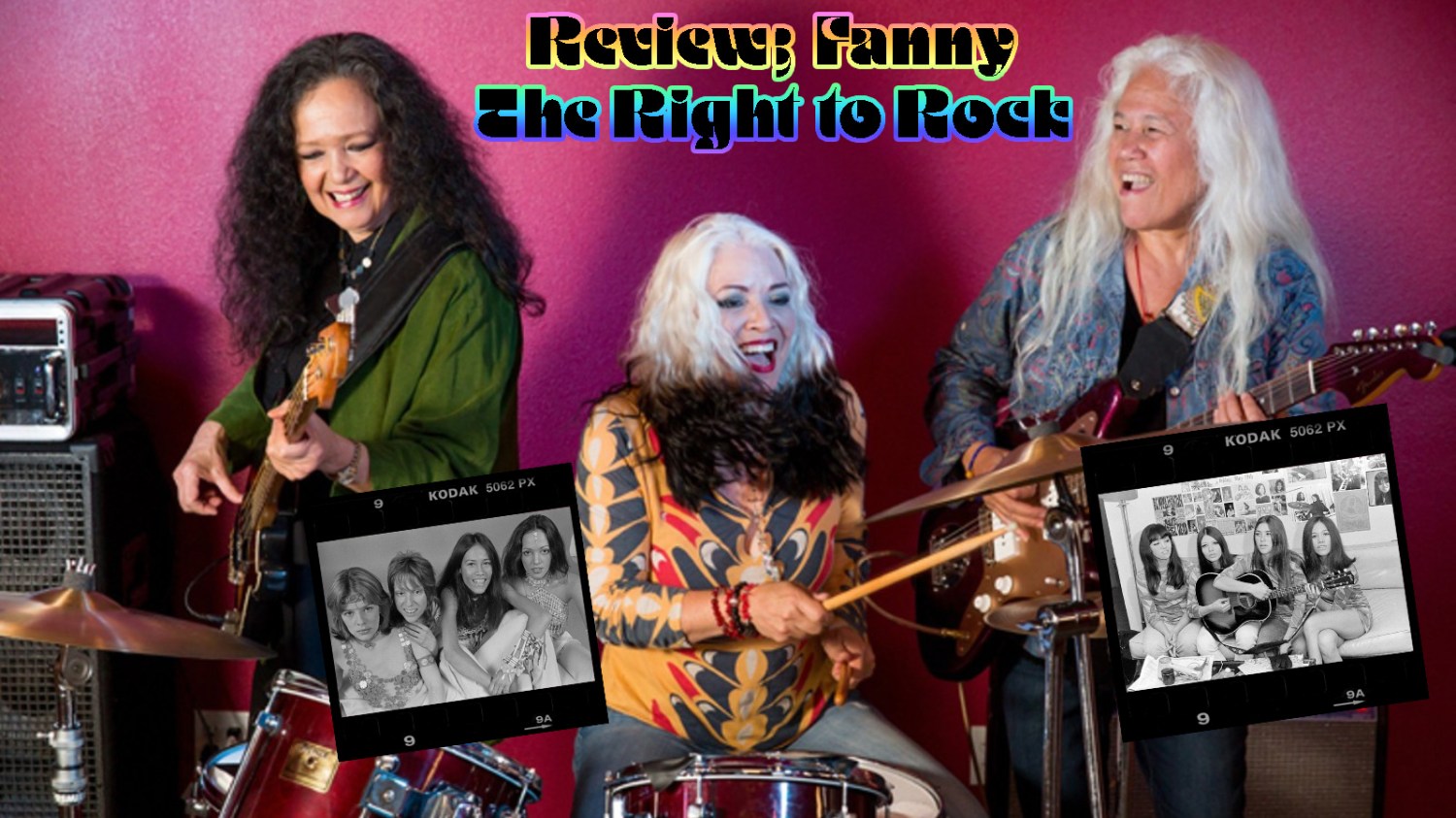

While at a friend’s house I was looking through what’s on BBC iPlayer and I stumbled upon a documentary that I’ve been meaning to watch called Fanny: The Right to Rock. I saw it promoted all over social media, but with a lot of social media being very America-focused, I couldn’t find this documentary being screened in Ireland (where I was living at the time the documentary came out) so I was leaving it on my “to-watch list” for the time being. If you live in a big city in America, you’re a lucky duck. I had a similar moment with the David Bowie Moonage Daydream documentary and had to wait for it to come out on Netflix because no cinema near me was showing it and I certainly wasn’t going to travel five hours to Dublin to see a movie, not worth it to me, sorry, even thought I adore David Bowie.
Speaking of David Bowie, he always liked to champion underrepresented groups in music and one of his favourites were Fanny, whom he said were “one of the most important bands in American rock”. Before all-girl rock bands like The Runaways, Girlschool, The Go-Gos, and The Bangles, there were Fanny, the first all-girl rock band to be signed to a major record label. While they didn’t get their dues at the time, they have finally gotten recognition as trailblazers after the fact and have earned praise from rock stars like David Bowie, Todd Rundgren, Joe Elliott, Cherie Currie, Kate Pierson, Bonnie Raitt, Jeff “Skunk” Baxter, and John Sebastian.
Not only were Fanny an all-girl rock band, they were an all-girl rock band led by two Filipina-American sisters with a mostly lesbian lineup. If any band was made for The Diversity of Classic Rock, it would be Fanny. They broke down barriers for women of colour and lesbian and bisexual women too, hence why the documentary is called The Right To Rock. They’re an underrated rock band and I think it’s important to show appreciation for them now, while the band members are still alive to see the praise and kind words.
This documentary was made around the time Fanny reunited as Fanny Walked The Earth and released a new album of the same name and it’s to promote the album and it’s a retrospective too that tells the story of the band from their beginnings in California in the 60s. Decades after they broke up, they got back together to break down more barriers, this time challenging ageism in the music industry. They never forgot their Filipina roots and you can see it on the album cover, which features a traditional Filipino tattoo motif.
Sisters June & Jean Millington were born in Manila, one year apart, to an American father and a Filipina mother. They moved to California in the early 60s and stood out and experienced a lot of racism and felt worthless and unseen. Like a lot of Filipinos, they grew up in a musical family and learned to play instruments and sing at a young age and as we all know, music is universal so they channelled their energy into something constructive and creative. They originally formed a band called The Svelts with their friend Brie Darling (Also known as Brie Brandt), who is also Filipina. Brie was in an early lineup of the band, but left because she had a baby, similar to the story of Signe Toly Anderson of Jefferson Airplane.
This group later changed their name to Wild Honey. What made them stand out was that they had more in common with male rock bands than all-girl vocal groups. They were bad-ass and played their own instruments. They wanted to make it in the music industry and for that they had to go from Sacramento to LA and while in LA, they played an open mic night at the Troubadour and by chance the secretary for music producer Richard Perry was there and loved what she heard and told her boss about it and he quickly signed them even though he’d never heard them. Unfortunately, it was because they were seen as a novelty, for being an all-girl band that played their own instruments and wrote their own songs and as you can expect they had arguments with the label over their image and they felt like they were put on the back burner and not as well-promoted as they should have been. There was really nothing like Fanny before them. Sure, there were some women in rock and roll, but they either didn’t write their own songs (if they were a solo act or a girl group), played in a band with men and were basically the token girl in the band, were a husband and wife duo, or they were in the backing band. Meanwhile with Fanny, no men and the women were the stars of the show and refused to conform to the the whole girly-girl cheesecake mould. Unsurprisingly and sadly, they dealt with a lot of sexism with audiences shouting sexist things or dismissing them as just a bunch of chicks, but the way they kept going was they worked hard, always gave 110%, and let their music and talent speak for itself. They were also tired of the constant questions about what it’s like to be a woman in music. All they wanted to do was play rock and roll and not be reduced to just women or pigeonholed.
The band were christened Fanny because they wanted a short and to the point name that made it clear that this was an all-girl rock band. Even though the name has a vulgar meaning in England, they still had a following there and the band members were so happy to follow in their idols’ footsteps. Original drummer Brie Darling tried to rejoin the band to play alongside new drummer Alice de Buhr, but producer Richard Perry fired her without consulting the band because he found it unnecessary to have two drummers. Alice de Buhr called this one of the biggest mistakes of Fanny’s career. They brought in a keyboard player Nickey Barclay, who declined to participate in the documentary and doesn’t like to talk about her time in Fanny. Typical of a lot of bands of the time period, the record label took advantage of them and didn’t pay them well, but you wouldn’t know from looking at their living situation at the time. In the early 70s, their record label rented the house that Hedy Lamarr used to live in and they called it Fanny Hill. It was like a sorority house with a jam session always going on. A sapphic rocker girl’s dream. Rock stars like Little Feat, The Band, Joe Cocker, Mick Jagger, and Bonnie Raitt would hang out there.
In the early 70s, it was a hectic schedule of record, rehearse, tour, and promote. They were constantly on the road opening for big rock bands like Humble Pie, Deep Purple, Slade, Jethro Tull, and many more. They gained a reputation for being a great live band and were dubbed America’s First Ladies of Rock. Still, the rock and roll journalism establishment had some sexist attitudes with Lester Bangs once saying that “women’s rock groups suck” and Frank Zappa saying that “guys come to hear the music and girls come to get laid.” Well, Fanny certainly proved those attitudes wrong. Their dream came true when they got to record at The Beatles’ Apple Studios in London with Geoff Emerick, who gave them more creative freedom. Still though, hard rock wasn’t chart music and Fanny’s music wasn’t “poppy” enough and they never got a chart hit while they were together and that frustrated the band. The rock and roll rat race led to them being exhausted and angry at each other and tensions grew in the band and they started to drift apart in 1973 after they recorded Mother’s Pride with Todd Rundgren as producer. There was so much that was promising of success for Fanny, so many things going for them, but they ran into bad luck and bad timing. They were really ahead of their time with their feminist, socially conscious lyrics, even though they were recording at the height of the second-wave feminist movement. They were riot grrrl before riot grrrl. June was tired of the band being told to dress skimpier and Alice left not long after. That left Jean and Nickey in the band, so they brought Brie back as a drummer and brought in Patti Quatro, sister of Suzi Quatro, on guitar. They recorded one album together, Rock and Roll Survivors, before splitting up. After their breakup they got one hit, “Butter Boy”
We come back to 2018 and Fanny are making one of David Bowie’s dreams come true even though he’s no longer around to see it, revivifying the band. Guesting on vocals are Cherie Currie of The Runaways and Alice Bag of The Bags. June Millington founded the Institute for Musical Arts in Goshen, Massachusetts with her partner Ann Hackler. It’s a music studio and they also run rock and roll summer camps for girls. I love how they continue to inspire new generations of female rockers and keep going. You’re never too old to make art! You’re gonna age no matter what, might as well live your life and create what you want to create and leave a legacy that way. Our lives are finite but art is something that lives on, you create something that lives for way longer than you do.
In a way I’d say Fanny were like a female sapphic version of The Kinks. Underrated sibling group with links to the LGBT community. Also, The Millington sisters were from a big family too, the oldest of 7 children (The Davies brothers were the youngest of 8 children). And unfortunately, one that has been struck by tragedy with younger sister Jean suffering a stroke just as the band were trying to promote an album. Dave Davies suffered a stroke in 2004 as he was promoting his album Bug.
Overall, I liked the documentary, but I wish it talked more about what the members of Fanny did in between their breakup in the 70s and the Walked The Earth album from 2018. June got involved in the women’s music movement and I would have liked to hear more about that and Fanny’s impact on the women’s music movement. June worked with the women’s music label Olivia Records at one point and it would have been cool to talk about that. Also I wish there was a mention of the riot grrrl movement, even though personally it’s not my cup of tea, it’s still an important part of women’s rock history and rock history in general.
While Fanny weren’t the first women in rock and roll, they were trailblazers and pioneers and I can say they along with all the other women in rock and roll who came before them gave women the right to rock. If you don’t listen to Fanny already, what are you doing? Start listening to them! They’re incredible!
Loved this blog post and want to support and see more? Donate to The Diversity of Classic Rock on Patreon or Paypal or follow me on Facebook, Twitter, or Instagram, click the follow button on my website, leave a nice comment, send your music or classic rock related books for review, or donate your art and writing talents to the blog. Thank you for the support!
You can also download the Brave Browser and earn tokens that you can donate to your favourite creators (including me!), donate to charity, or you can keep them for yourself and redeem them for cash. The choice is yours! Thank you!
 The Diversity of Classic Rock
I’m glad you mentioned Olivia. The record that put Olivia on the map with straight people was Cris Williamson’s “The Changer and the Changed” and June Millington’s guitar had a lot to do with that (along with Cris’ singing and writing).
LikeLiked by 1 person
I recorded this to watch and just haven’t gotten around to it. I’m ancient enough to recall when Fanny came around. Music was sexist enough to want to disregard them back then but they did make an impact and blazed a trail for sure. I also posted about them several years ago. They had some balls.
LikeLiked by 1 person
I’m glad you finally got to see this documentary. It was a bit surprising just how quickly this film appeared on streaming in the US. Right now it’s available on my local library’s free service. Usually most music docs are announced and then you can never find them or have to wait forever. I wrote a little review on the Fanny box set that Rhino released awhile ago that’s posted on my blog.
LikeLiked by 1 person
Nice background and info on the group!
Sent from my iPhone
LikeLiked by 1 person
[…] year. I recently reviewed a Little Richard biography by Spencer Leigh, reviewed documentaries about Fanny and Hipgnosis, Definitely by Def Leppard, a poetry book called Alphabet Jazz by Paul Metsa, Bob […]
LikeLike
[…] Fanny have been called the Female Beatles because they were very influenced by them and wrote their own songs. […]
LikeLike