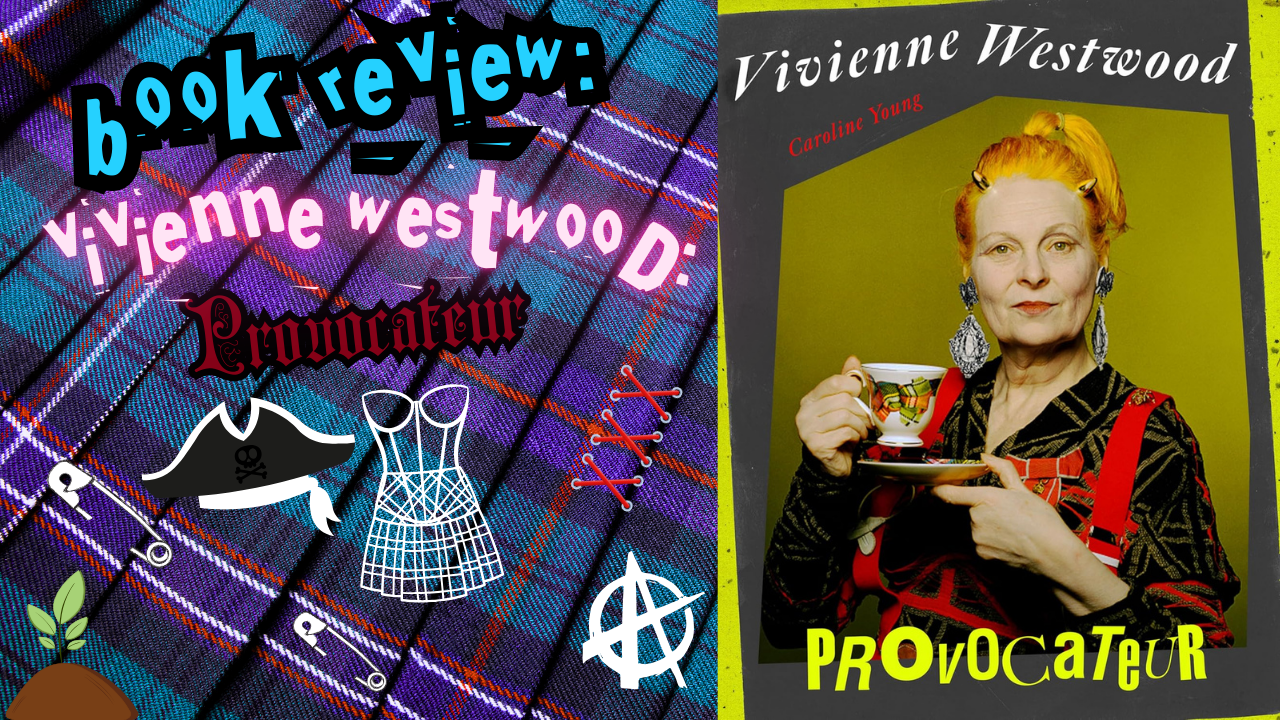

Disclosure: I received a review copy of this book in exchange for my honest opinion.
Which fashion designer do you associate most with classic rock? I’d say an excellent candidate for that honour is Vivienne Westwood. She and her then husband Malcolm McLaren, who was a promoter and manager for groups like the New York Dolls, Sex Pistols, and Adam and the Ants, ran a provocatively named boutique together called Sex. Chrissie Hynde worked at that boutique before getting famous with The Pretenders.
Vivienne Westwood was not just a tastemaker for punk fashion, she also was highly influential in the 80s New Romantic look with her Pirate collection from 1981, the revival of corsetry with her Portrait collection (frequently imitated by many brands), and 90s Cool Britannia with her Anglomania collection. Her work was also quite political and that of course fits right in with her punk ethos in the 70s. She was outspoken about climate change, animal rights and vegetarianism, democracy and freedom of speech, and ethical fashion.
When I went to Japan last year, I saw how beloved her brand was and on my fashion bucket list was a Vivienne Westwood bag. I finally got one recently for half the price of a new one and I love it! It’s so timeless looking and excellent quality.
When I saw this book was available to review on Net Galley, I jumped on the opportunity to read about one of the most interesting designers of our time. This being a fashion related book, there are going to be a lot of pictures throughout.
Vivienne’s story begins in Derbyshire, located in the East Midlands. Clothing manufacturing and textiles are in her family tree with her mother having been a weaver in a cotton factory in WWII making uniforms and her grandfather having been a shoemaker. Rationing continued for years after the war, so people had to make do and mend. So it’s no surprise that she would constantly sew and make things and that her generation would go on to be hippies and punks into DIY. The mid 20th century was a time of change and early on in her life, Vivienne Westwood had a strong sense of justice and a desire to be a freedom fighter. Thanks to the popularity of Marilyn Monroe and Jayne Mansfield, she went from tomboy to unapologetically femme and started padding out her chest. wearing pencil skirts, and wearing stilettos for an eye-catching look. Rock and roll was escapism for Vivienne’s generation and at the height of early rock and roll, the family moved to London for better opportunities.
Frustrated with art school, she dropped out and studied to be an art teacher. She got into the mod subculture and adopted the style. She married a mod named Derek Westwood, hence where her last name came from (her maiden name was Swire). Being a free spirit, she got frustrated with the married life and wanted freedom so she divorced Derek in 1965 and she and her son moved back in with her parents. Besides being a teacher, she had a side gig making and selling jewellery.
Through her brother Gordon, she met Malcolm McLaren, who had also attended Harrow Art School. The two would collaborate on designs. The late 60s was a time of student protests and situationists and that influenced the style they would become known for in the 70s. After Malcolm McLaren graduated from college, he and Vivienne Westwood opened up their own shop on Kings Road, where Mary Quant’s Bazaar and Granny Takes a Trip were located. The shop was originally called Let It Rock, which is the name of a Chuck Berry song. During this time there was a bit of a 50s revival with groups like Sha Na Na and Showaddywaddy, shows like Happy Days, and movies like That’ll Be The Day. They started out repairing OG Teddy Boy garments before selling reproductions. Enough time had passed since the 1950s so it was cool again and so the shop had posters of Elvis and James Dean with the jukebox playing 50s rock and roll, a nod to Vivienne’s youth. After the shop sign started falling apart, Malcolm renamed the shop “Too Fast to Live, Too Young to Die”, still having that James Dean vibe and appealing to rockers. They got famous customers like Iggy Pop, Marianne Faithfull, Jimmy Page, The Kinks, and The New York Dolls.
In 1974, the shop entered a new era when it rebranded to Sex, which shocked the public much like Mae West had done nearly 50 years earlier with her play of the same name. Just like Mae West, Vivienne Westwood got arrested for obscenity because of it, and arguably it was a boost to her career. It was also a big middle finger to conformity. As you can expect, the shop sold BDSM gear and fetish wear, big influences on the punk aesthetic, as well as t-shirts with provocative photos and slogans. Like its predecessor, rock stars like Alice Cooper, Siouxsie Sioux, and Toyah Willcox would shop there. The Sex Pistols formed at the shop, made up of former employees and hangers-on. Like Vivienne Westwood said, it was not just a rejection of the older generation’s values, it was also a rejection of their taboos.
Once again, the boutique rebranded to Seditionaries and the clothes had more of an anarchist spin with anarchy logos on the clothes. The clothes were pricey because they were made of quality materials and components. Her ideas were ripped off by establishment designers and shown on catwalks, but she kept evolving and innovating.
The Sex Pistols were a short-lived band and the death of Sid Vicious marked an end of an era. Malcolm left Vivienne not long after, but the two would collaborate on collections until 1984. Punk was a youthful rebellious movement, so Vivienne Westwood did the opposite and looked further back at the past for her next inspiration, the macaronis of the 18th century, a look that would influence the New Romantics. The pirate look symbolised toughness, romance, and heroism just like the old Hollywood swashbuckling movies. It was a lot softer than the previous dominatrix looks, but still rebellious. Makes sense why Adam Ant called himself the “dandy highwayman” in “Stand and Deliver”. She then released a line inspired by multiple cultures around the world and blended them with western culture.
In 1985,, Vivienne Westwood revived the crinoline with the mini-crini, something that is seen in Gothic Lolita fashion and eschewed the athletic narrow hipped 80s look. Sadly, her contract with Armani was cancelled and so her awaited Paris fashion show was too, but she didn’t give up. Those designs were lifted by Chanel. Much like the 60s, the haute couture world was getting their inspiration from the underground. She refined her style and started collaborating with Harris Tweed from Scotland, a very classy, aristocratic look, but with Vivienne Westwood it’s gotta be a bit edgy. Harris Tweed also was the inspiration for her iconic Orb logo with the crown on top. She made Haris Tweed cool again.
For her Britain Must Go Pagan collection, she looked even further back, this time looking at the classics, Ancient Greece, but with a Regency twist. Two notable pieces from the collection are tights with a fig leaf on the crotch and the Apollo winged rocking horse shoes. Like her earlier collections the colour schemes were interesting. Much like her punk days, there were t-shirts and other garments with phallic symbols on them. She also made it a point to have diverse models and broke taboos by having curvy models, pregnant models, and older models walking the runway. She also encouraged the models to show their personalities and this helped the brand stand out. It’s not surprising that the fashion establishment looked at her with a side eye. But her provocative, unique collections did ensure that she would be talked about.
In the 90s, she released her famous Portrait collection, got married to Andreas Kronthaler, and the two would collaborate on the fashion collections. She won Designer of the Year awards and they opened doors for her, therefore bringing in more money and opportunities. For her You’re Always On Camera collection, she went more contemporary, taking inspiration from Old Hollywood, especially androgynous bicon Marlene Dietrich. For her Anglomania collection, she had top models Christy Turlington, Naomi Campbell, Linda Evangelista, and Kate Moss wearing her designs on the catwalk. That same show, Naomi Campbell famously fell on the runway in her gigantic platforms. Top models were happy to model for her in exchange for free clothing. Her Café Society collection took inspiration from the legendary 19th century design house, House of Worth, known for those beautiful gowns wealthy women would wear. Kate Moss famously walked down the runway topless eating a Magnum ice cream. For her On Liberty collection she added even more 19th century influence with frock coats and bustles. By this point department stores like Bergdorf Goodman and Saks Fifth Avenue were carrying her designs. More historical influences would be seen in late 90s collections. She was criticised for looking backwards, but she said she didn’t believe in progress. Instead her brand was about not keeping up with the times, and that’s what people love about her. Her collections have an artistic approach.
In the 21st century her early designs had a revival in popularity thanks to the 30 year rule with nostalgia, so there were reissues of some of her archived designs. Her runway shows had political commentary. Her designs were famously worn by Sarah Jessica Parker, Dita Von Teese, Helena Bonham Carter, Nigella Lawson, and Gwen Stefani. She also became Dame Vivienne Westwood, which some republican fans might criticise. Even royals were wearing her designs. Virgin Atlantic’s iconic red uniform? That’s also a Vivienne Westwood design. Keeping consistent with her environmentalist activism, instead of expanding the business, she decided to shrink down her collections and espoused the message of buying less, but buying better and that’s why she defended high fashion. She also protested in support of freeing Julian Assange and supported the controversial Just Stop Oil protesters. She truly beat the odds as a working class northern English woman, who was once a single mother who had to move back in with her parents and she never gave up on her dream.
Overall, this book is a great biography and retrospective of Vivienne Westwood’s vibrant life, career, and artwork. It’s well-designed and well laid out, so very easy to follow and I love seeing the corresponding pictures next to the text. Yes, I think her fashion is truly artistic. I love seeing all the photos and the quotes. It’s very detailed going through the variety of collections, their inspirations, and showing the impact they’ve had on the fashion world. I think this book is a great gift for fans of Vivienne Westwood and it’s a great read for fans of 70s punk rock.
Vivienne Westwood: Provocateur comes out on 16 October.
Liked this blog post and want to support independent classic rock journalism? Donate to The Diversity of Classic Rock on Patreon or Paypal or follow me on Facebook, Bluesky, or Instagram, buy my book Crime of the Century, click the follow button on my website, leave a nice comment, send your music or classic rock related books for review, or donate your art and writing talents to the blog.
If you donate any amount to my Patreon or PayPal, you’ll get a Crime of the Century ebook, so it’s pay what you can! The best deal you’ll get on the book and you won’t find this deal anywhere else! I just want to give back to my readers and say thank you for your support.
 The Diversity of Classic Rock
[…] Clothes were imported from England and they’d sell like hotcakes. Meanwhile back in England, Vivienne Westwood and Malcolm McLaren set up shop in World’s […]
LikeLike