
Disclosure: I received a review copy of this book from the author in exchange for my honest opinion. Thank you Jeffrey and Kathy for sending me a review copy!
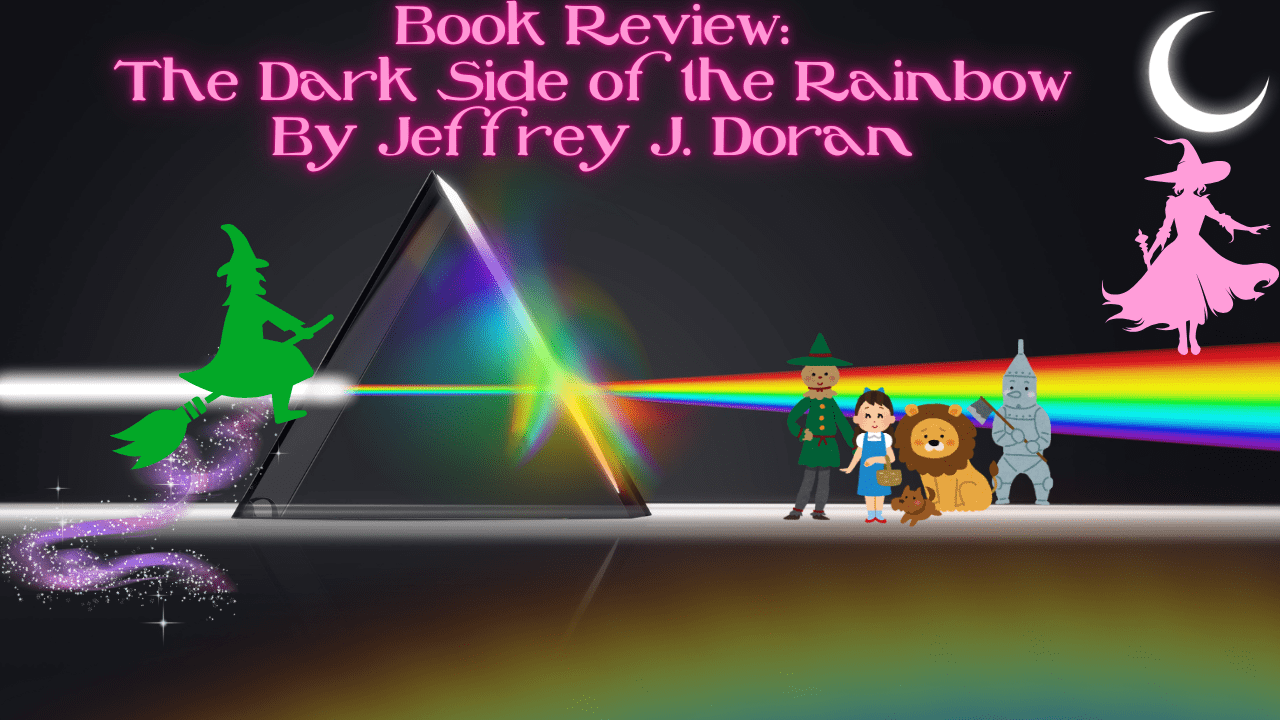
A little over a decade ago I met my friend Paul on Tumblr. He is also a classic rock fan and he wrote a biography of Jimmy McCulloch, which I reviewed on this blog. We would talk a lot about classic rock every day back when I was in university and one of the things we’d talk about was the classic Pink Floyd album The Dark Side of the Moon.
It may sound clichéd, but that was the first album I owned on vinyl. It was a gift from my secondary school friend Kellyanna. One of the things that fascinates both me and Paul is how well The Dark Side of the Moon syncs with The Wizard of Oz. I would watch the two synced up while high in my dorm room in first year of uni. Once again this was a work of art that was near and dear to me, gonna sound clichéd, but it was the first classic film I ever watched and I remember watching it when I was around 7 or 8 and wanting a pair of ruby slippers just like Dorothy’s. Little did I know how horribly Judy Garland was treated, but I digress. Funnily enough, Paul and I were talking about that connection recently, was this a sign?
I got an email from Jeffrey’s wife, Kathy, asking if I would like to review a book about the connections between DSOTM and The Wizard of Oz and I immediately said yes and they sent over a copy very quickly. As someone who loves to make connections between seemingly very different pop culture things, this sounded like something that’s right up my alley. The book cover looks cool, a prism, but with yellow bricks in it, clearly conveying a message of the two topics colliding. This is his first classic rock related book. Most of his books are about hiking, but one of them is titled Ramble On, so I can tell he likes classic rock. He runs an online hiking trail guide business.
Many people have been talking about this connection for decades and Pink Floyd have denied that DSOTM had anything to do with The Wizard of Oz. Some people are of the persuasion that if the creator of a work says something, then they must be taken at their word. However, the counterpoint is that once an artist puts their artwork out there for the public to consume, be it by sight in a painting, sculpture, play, or film, by hearing in a song or spoken word, or by reading a book or poem, it’s no longer fully theirs and it’s for all to enjoy and interpret as they wish. This is a concept known as Roland Barthes’ Death of the Author. Art is very much subjective and that’s the beautiful thing about it. It gives our lives meaning and the fact that everyone’s life is different means that we each create and interpret art differently, and that’s amazing. So that’s why people don’t want to put this matter to rest and continue to debate it even over 50 years since the album’s release in 1973.
It’s a historic album with one of the most recognisable covers (by Hipgnosis) and it was a major commercial success, being on the charts for 990 weeks. It continues to captivate the younger generations of music listeners. Oh to listen to it for the first time again. Well, as I’m writing this, I’m listening to the Live At Wembley 1974 version and it’s incredible, not surprising since I saw Roger Waters play The Wall live when I was 18 and it was easily one of the best concerts I’ve ever been to, and I’m usually someone who prefers smaller gigs. I love how theatrical it was and how there’s a vision beyond the music. I think that’s what makes Pink Floyd so special and innovative.
Interestingly enough, the mainstream discourse around The Dark Side of the Rainbow didn’t begin back in the 70s, but two decades later in the 90s. Back in the early 70s when DSOTM came out, home video wasn’t a thing, as they didn’t have VCRs, so if a movie wasn’t playing in the cinema or on TV, tough. But by the 80s and 90s, it was the golden age of home video on VHS. I have fond memories of going to Blockbuster to rent movies (often I was renting Sailor Moon movies). The 20th century was really a time of a lot of change. However, it is mentioned in the book that some people claim to have synced the movie and the album together and see those parallels in the 70s. There were a lot of stoners and when you get stoned your imagination goes a lot of places.
If you’re in the Pink Floyd fandom and you’re familiar with the memes, you’ll know all about Roger Waters and concept albums. He was the mastermind behind Pink Floyd’s masterpiece concept albums at their artistic peak: The Dark Side of the Moon, Wish You Were Here, Animals, and The Wall (David Gilmour had written a few tracks on The Wall, but it was mostly Roger Waters’ baby). Roger Waters was very much the Pete Townshend of Pink Floyd. Some theorists say that maybe Roger Waters had written a score of sorts to The Wizard of Oz and then not told his bandmates.
The person credited with starting this theory (it was more like he made it go viral, to be honest) was reporter Charles Savage who had written an article in the Fort Wayne Journal Gazette where he suggested readers play DSOTM and The Wizard of Oz at the same time after the MGM Lion roars for the third time and they’ll notice there are a lot of parallels between the lyrics and the plot of The Wizard of Oz, like it’s really really close. Too many similarities for it to be random chance or coincidence, many say. From there, others like Boston DJ George Taylor Morris, Richard Lebos (of The Kind), and Alex Harm have spoken of the parallels between the two works of art. Author Jeffrey Doran had heard about the theory early on, but had forgotten about it until recently when the memory came up and he watched Dark Side of the Rainbow on YouTube and found dozens of connections, blowing his mind.
Some examples of coincidences include “Speak to Me” playing in the opening credits (back in the old days credits were at the beginning of the movie, this would change by the 60s/70s when union rules required that people be credited for their work and because there was this general trend of everything growing faster paced as time progresses), Clare Torry’s howling vocals on “The Great Gig in the Sky” synchronising with the tornado scene, when it’s time to flip the record from Side A to Side B the movie goes from black and white to Technicolor, “Brain Damage” playing as the Scarecrow sings “If Only I Had A Brain”, and the heartbeat at the end of the album synchronising with Dorothy listening to the Tin Man’s nonexistent heart. The real highlight of the book is the watching guide with all the different connections.
But is this actually a real pattern or just an example of apophenia, the brain’s tendency to look for patterns and filtering anything that doesn’t fit in with our patterns and ideas, much like that of all the coincidences of Lincoln and Kennedy. Or perhaps it’s confirmation bias.
In the first chapter of The Dark Side of the Rainbow, Doran talks about compelling reasons why Pink Floyd might have had The Wizard of Oz on their minds like the fact that they’ve also referenced other classics in their music, like Animals being inspired by George Orwell’s Animal Farm and their Syd Barrett era debut The Piper at the Gates of Dawn being a reference to The Wind in the Willows (side note: Debbie Harry was in a band of that name in the 60s). As well, Pink Floyd, like many other rock bands have crossed over to some extent into cinema, appearing and making music for films like Tonite Let’s All Make Love in London (How many times have I watched them play “Interstellar Overdrive” while stoned in university? Way too many to count!), The Body, and Jeanetta Cochrane. They also had made music videos of sorts like Live at Pompeii. They also had scored the films More, La Vallée, and Zabriskie Point, so they had knowledge of how to score a movie and Nick Mason said as much in an interview that they’d time how long a scene was and play music for that time exactly and it would fit perfectly in the film.
A counter to this point is that like I said earlier, VHS didn’t exist back in 1972-1973 so how could they score to The Wizard of Oz? One possibility is that there were home projectors and film piracy and bootlegging was a thing back then, yes long before Limewire and Pirate Bay (anyone remember those?). By that time, Pink Floyd were famous enough to have the connections to acquire projectors and film reels. Nick Mason claimed that Pink Floyd had no interest in Judy Garland or The Wizard of Oz at the time, but they later on listed Judy Garland’s death in London in 1969 as a significant event in the liner notes for their 25th anniversary box set. Is it possible they were downplaying the influence of the movie because of copyright reasons? Rumour has it that Rick Wright said that the reason they didn’t talk about The Wizard of Oz’s influence is because MGM wouldn’t let them license clips of the film to be played at their concerts. Pink Floyd were known for having very theatrical shows, like Taylor Swift’s Eras Tour before Eras Tour with a lot of logistics and planning going into the transport of the sets. They even dubbed the circular shaped screen that would play film clips Mr Screen.
In the following chapters, Doran goes into context, talking about The Wonderful Wizard of Oz (the book), the film adaptation, and Dark Side of the Moon, before synthesising and analysing the parallels. At the age of seven, I remember reading the book and I do remember it being quite different from the movie, pretty standard for any movie that is based on a book, there’s always going to be some artistic licence. One of the most noticeable changes is the slippers being changed from silver to ruby red because it would really pop in Technicolor. I appreciate that he gives a short biography of the author L. Frank Baum, who worked as a journalist before writing The Wonderful Wizard of Oz. When walking around town, kids always ask him to tell stories and he found that he had a talent for telling stories to kids and that inspired him to go in the direction of writing children’s books. Obviously, when reading about historical figures, you’re going to find not so wholesome things about them, and here’s the elephant in the room, he was prejudiced against Native Americans and he had written a non-ironic editorial asserting that a genocide of Native Americans was necessary to keep American settlers safe, writing this days after Sitting Bull was killed.
A lot of art is political and it is believed that The Wonderful Wizard of Oz is a populist allegory with Dorothy representing the everyman, The Scarecrow representing the down and out farmer, The Tin Woodman (known as the Tin Man in the movie) as the factory worker, Cowardly Lion as an orator who is all talk and no action, Munchkins as labourers, the Wicked Witch of the West as the drought, Winged Monkeys as Native Americans (very problematic, would get you cancelled today), Emerald City as Washington DC and the dollar/greenback, Yellow Brick Road as the gold standard (follow the yellow brick road to solve your problems), The Wizard as President Grover Cleveland (politicians being liars), Four travellers on the Yellow Brick Road being workers marching, silver shoes as free silver, Kansas as ground zero for the populist movement, the cyclone being the populist movement, Oz standing for ounce – measuring gold and silver, and Glinda the Good Witch of the South representing the Populist Party. Others have interpreted the story as Feminist or LGBT, with the saying Friends of Dorothy being a codeword for gay men. One thing Baum was progressive on was women’s suffrage, so it’s possible that it was a feminist allegory. However, Baum denied these claims, much like Pink Floyd did for Dark Side of the Rainbow. Another possibility is he had written The Wonderful Wizard of Oz based on his own experiences living in South Dakota.
Before The Wizard of Oz was adapted into a screenplay, it was adapted into a play and Baum had written the play adaptation and we learn that Dorothy’s last name is Gale. The play and the book were both big successes and Baum became the first successful American children’s book author. Baum died in 1919, 20 years before the most famous film adaptation came out, but his wife Maud lived until 1953 and helped promote the film.
Much like how Disney’s Alice in Wonderland was not the first film adaptation of Lewis Carroll’s Through the Looking Glass, the 1939 Wizard of Oz starring Judy Garland was not the first film adaptation, as there were multiple silent film adaptations released beforehand. Much like Pink Floyd were classic rock multimedia pioneers, L. Frank Baum embraced multiple forms of media and made The Wonderful Wizard of Oz into a franchise with ambitious projects. These landed him in debt, as it was expensive to produce. The 1910 film adaptation had Imogene the Cow in place of Toto. The most famous version of the film was inspired by the success of Disney’s Snow White and the Seven Dwarfs and it was a big budget production with 60 sets, 600 actors, and 1,000 costumes to be made. While it wasn’t the first colour film, it was revolutionary. In the end the film cost $1 million over budget to make, and it had barely broken even at the time of release. The investment eventually paid off and it’s one of the most watched movies of all time. You could think of it as the “Bohemian Rhapsody” or “Good Vibrations” of movies. Or maybe it’s more of The Velvet Underground and Nico of movies because of how much cultural impact it had decades later. In the book, Doran goes into all the classic rockers referencing The Wizard of Oz like ELO and Elton John and the 70s remake of sorts called The Wiz starring Diana Ross and Michael Jackson. Of course in the 2000s you had Wicked and last year the film adaptation starring Ariana Grande and Cynthia Erivo came out.
The book goes into some film history and I really appreciate that as someone who took some video production and film history classes in university. As gorgeous as Technicolor looks, it’s laborious because it requires a lot of lights, ergo a lot of equipment, labour, and electricity, which is expensive. Not only the lighting equipment, but also all the things that would be filmed would require careful consideration to look great on film. I also appreciate the subtle Kinks reference with “Celluloid Heroes” the heading title for Wizard of Oz actor bios, that’s an S-tier Kinks song! This book tells lots of wild, sad stories beyond Judy Garland that I didn’t know about. Feels like I’m watching a Horrible Histories episode, but about The Wizard of Oz with all the stories of asbestos and borderline toxic cosmetics and OSHA violations.
Finally, it comes together in the connections chapter where you get the watching guide and then there’s the conclusion. Long story short, perhaps the truth is somewhere in the middle and The Wizard of Oz was an influence on the composing of DSOTM, perhaps it’s just coincidence because LPs are only so long per side and in classic rock songs are a certain length (but Pink Floyd have plenty of those long, proggy songs). But there’s way too many coincidences for these two to be completely isolated. Well, I guess the only people who know the truth deep down inside are Pink Floyd themselves. But at the same time, does it really matter what they have to say? Art is something that is personal and subjective and there really are no wrong answers.
Overall, this book was a really interesting easy breezy read. No nonsense, no fluff. Just lots of information well curated. Perfect for a plane or train trip if you’re planning to do some reading and sync DSOTM and The Wizard of Oz. Maybe I should try that sometime. The choice is yours! A nice gift for film buffs or Pink Floyd fans.
Liked this blog post and want to support my work and see more? Donate to The Diversity of Classic Rock on Patreon or Paypal or follow me on Facebook, Bluesky or Instagram, buy my book Crime of the Century, click the follow button on my website, leave a nice comment, send your music or classic rock related books for review, or donate your art and writing talents to the blog. Thank you for your support! If you donate any amount of money to my Patreon or PayPal, you’ll get a Crime of the Century ebook, so it’s basically pay what you can! The best deal you’ll get on the book and you won’t find this deal anywhere else! I just want to give back to my readers and say thank you for your support.
 The Diversity of Classic Rock
[…] also appeared once again on the incredible Rock Daydream Nation to talk about Pink Floyd. Recently I reviewed a book about The Dark Side of the Rainbow theory, so it was good timing to talk about one of the greatest albums of all time. It was also the […]
LikeLike